Required section · Section 3 of 6
The variables that make or break decentralized quality
Device inventory and configuration control are the foundation. A device that is not on the current inventory, that is running the wrong lot, or that has not had its patient-ID and barcode functions verified is a device the governance program cannot vouch for. Operator lockout, the device refusing to run a patient sample for an untrained, expired, or unauthorized operator, is the control that keeps an unqualified person from generating a reportable result.
A POCT data-management or connectivity system, built on a framework like CLSI (Clinical and Laboratory Standards Institute) POCT01, Point-of-Care Connectivity, can enforce that lockout, capture patient and operator identifiers, track reagent lot and QC status, and flag results for manual reconciliation when an identifier or a device-to-record mapping fails.
POCT01 defines the technical interoperability framework; it does not itself set numeric targets for lockout rates, invalid-ID rates, or repeat-testing thresholds. Those targets are a local-policy decision, which is why the dashboard below is presented as an example, not a mandated number.
QC requirements track complexity. For nonwaived quantitative testing, federal regulation requires control procedures at least once each day of patient testing, commonly two levels, unless an approved alternative, such as an IQCP, provides equivalent quality assurance; IQCP does not apply to a site running only waived tests. For accuracy verification, a federally regulated analyte uses a CMS (Centers for Medicare & Medicaid Services)-approved PT program under Subpart I of 42 CFR Part 493.
A nonregulated analyte, or one lacking a compatible PT program, still needs documented accuracy verification at least twice a year, an alternative performance assessment (APA). If PT material is used to satisfy that requirement, it has to be tested by routine personnel using the routine method, and the laboratory must not discuss results with other laboratories before the submission deadline or send the sample out to another certified laboratory for testing.
Operator training and competency carry their own frequency and content rules, and they are the area most exposed to high turnover in a POCT program. Competency assessment for nonwaived testing personnel must cover six elements: direct observation of routine testing, monitoring of recording and reporting, review of QC, PT, and maintenance records, direct observation of instrument maintenance and function checks, testing of blind or PT material, and assessment of problem-solving skills.
It must be documented at least semiannually during an operator's first year and at least annually after that, and reassessed before an operator reports results again after a method or instrument change. A training session and an annual performance evaluation, on their own, are not a substitute for that documented six-element assessment; a laboratory with fast staff turnover needs a process that catches every new operator before that person's first unsupervised result, not a periodic sweep that finds them months later.
Maintenance, cleaning, infection prevention, supply storage, and environmental limits round out the operating conditions that connectivity and QC data cannot see directly. CAP's Laboratory General Checklist requires the quality management system's process for identifying and recording problems to reach every section of the laboratory and every shift, so a POCT problem discovered on a night shift or a satellite unit cannot fall outside the same process a day-shift core-lab problem would trigger.
Practical ways to keep testing available while a problem is worked include backup testing at the central laboratory, an alternate device or method, or a trained on-call person, none of which is itself a numeric CAP target. A minimum oversight dashboard pulls these threads together into a small set of quality indicators drawn from the peer-reviewed literature: connectivity or transmission failure rate, invalid patient- or operator-ID rate, operator lockout rate, QC lockout rate, and repeat-testing rate.
None of these has a CLIA- or CLSI-mandated numeric target; each needs a locally defined numerator, denominator, and exclusion set, and the laboratory sets its own alert threshold. A repeat result that differs from the initial result by more than a locally defined discordance threshold, a published example used 20%, is worth investigating as a discordant repeat distinct from a repeat ordered for a clinical reason.
Connectivity data tells you whether the program is running as designed; it does not replace the judgment call about whether a particular result should be trusted, and that judgment is what the guided example works through next.
Illustrative drawing — this picture was drawn rather than captured.
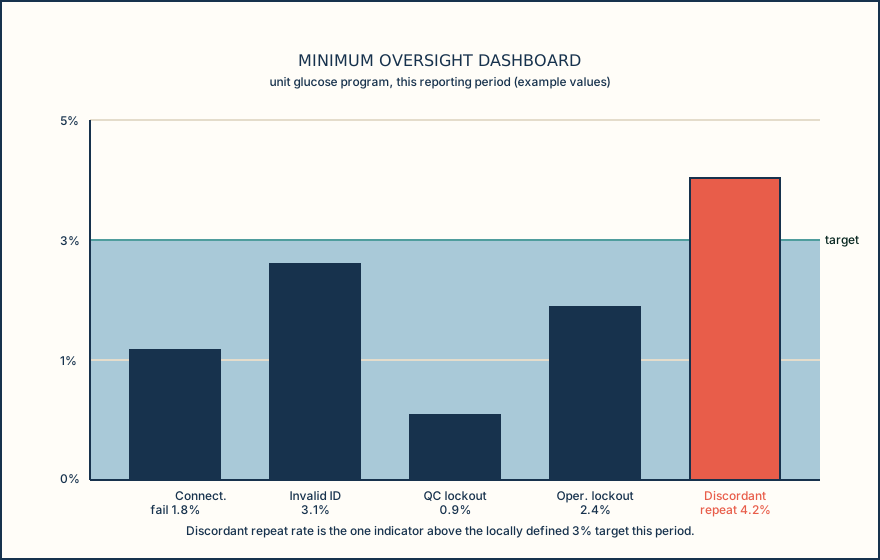
| Indicator | This period | Locally defined target |
|---|---|---|
| Connectivity/transmission failure rate | 1.8% | <2% |
| Invalid patient/operator ID rate | 3.1% | <3% |
| QC lockout rate | 0.9% | <1% |
| Operator lockout rate | 2.4% | <3% |
| Discordant repeat rate (>20% difference) | 4.2% | <3% |
Knowledge checks
Reading and checks are open. Sign in only to save.
Knowledge check 1
Knowledge check 2
Knowledge check 3
Knowledge check 4
Section status
Finish this section
Reading and checks are open. Sign in only to save.
The module finishes after every required section is marked done and every check in those sections is correct.