Required section · Section 2 of 6
Who owns what: governance and the test lifecycle
A POCT program works because responsibility is split and written down, not assumed. The POCT supervisor defines the test and equipment selection, operator roles, QC and result review, training and competency, procedures, environment, inventory, and escalation arrangements. Operators follow the approved procedure, verify identity, recognize exceptions, and escalate them.
The College of American Pathologists (CAP) Laboratory General Checklist requires the laboratory to document its reporting relationships in an organizational chart or narrative description, and its quality management system must be implemented in every area of the laboratory, explicitly including point-of-care testing.
Neither requirement mandates one specific management structure: a program can be centrally coordinated by one designated POCT director or coordinator who reviews procedures, QC, and training records across every site under one CLIA number, or it can be decentralized to unit leadership, as long as the chosen structure and its authority are documented and the quality system actually reaches every site.
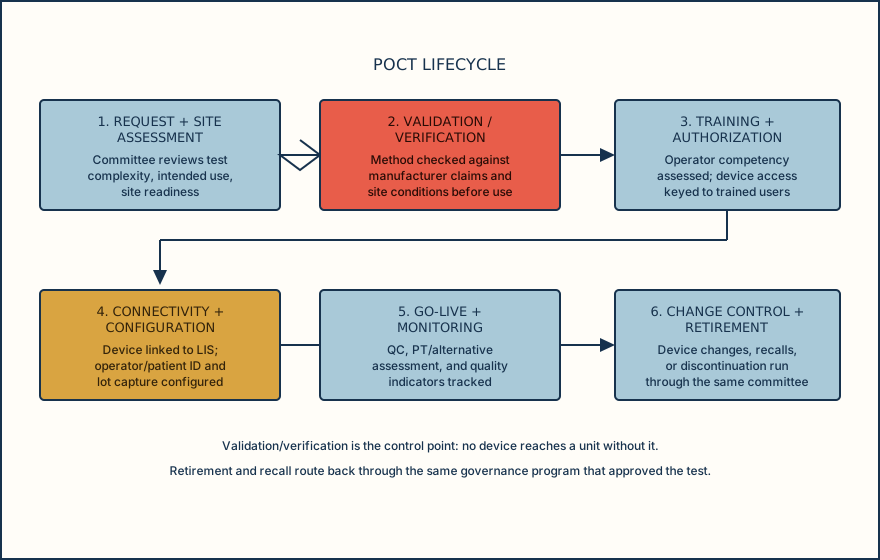
The lifecycle runs from a clinical request for a point-of-care test through retirement. Complexity and the approved procedure determine the required controls; the authority name matters only when it assigns an action to the supervisor or operator.
If a waived test is altered outside the required nonwaived framework, do not operate or report it as waived. Route the configuration for proper classification, authorization, validation or verification, QC, PT, and competency before use or reporting.
Know who owns the device and the approved procedure: changing one instruction line on a waived test moves the whole test into a different regulatory category, and an altered waived configuration cannot continue to operate or report as waived.
Illustrative drawing — this picture was drawn rather than captured.
| Complexity category | Governing requirement | QC/oversight implication |
|---|---|---|
| Waived | Certificate of Waiver; follow manufacturer instructions exactly | No IQCP requirement; modifying instructions removes waived status |
| Moderate (includes PPM) | Nonwaived personnel, QC, and PT requirements apply | Control procedures at least once per day of patient testing, commonly two levels, unless an approved alternative such as IQCP is in place |
| High complexity | Full nonwaived personnel, QC, competency, and PT/APA requirements | Six-element competency assessment; supervisor qualification pathways under 42 CFR §493.1461 |
The POCT lifecycle: each stage remains under documented program oversight.
Request and site assessment
A clinical need is identified. The committee evaluates test complexity, intended use, and whether the site can support the test safely.
Validation or verification
The method is checked against manufacturer performance claims and local conditions before any patient result is reported from it.
Operator training and authorization
Operators complete competency assessment; the device is configured so only trained, in-date operators can run patient testing.
Connectivity and configuration
The device is linked to the LIS or electronic medical record (EMR) through middleware, with patient ID, operator ID, and reagent lot capture configured.
Go-live with QC and monitoring
QC and proficiency testing or an alternative performance assessment run on schedule; quality indicators begin tracking program performance.
Change control and retirement
Software updates, recalls, and eventual discontinuation are managed by the same governance process that approved the test, so no device drifts outside oversight.
Knowledge checks
Reading and checks are open. Sign in only to save.
Knowledge check 1
Section status
Finish this section
Reading and checks are open. Sign in only to save.
The module finishes after every required section is marked done and every check in those sections is correct.