Required section · Section 4 of 6
Guided example: the 182 mg/dL that was not reassuring
Return to the case from the opening screen, now with the full record. The setting is a hospital-wide POCT glucose program, a connected meter with bidirectional middleware to the LIS. The patient is an adult on peritoneal dialysis using an icodextrin-containing exchange solution, day three of therapy. The order is a routine pre-meal point-of-care glucose per nursing protocol. Every process control passed: trained, in-date operator with badge scan accepted, wristband barcode matched to the admission record, and a result of 182 mg/dL transmitted to the LIS in 40 seconds, inside the unit's connectivity target. On the connectivity dashboard, this result looks unremarkable.
What the meter measures and what the result may mean are two different things. The device's manufacturer instructions for use declare a GDH-PQQ (glucose dehydrogenase, pyrroloquinone quinone) chemistry, a chemistry class the FDA (Food and Drug Administration) prescribing information for icodextrin peritoneal dialysis solution identifies as subject to positive interference. Icodextrin is metabolized to maltose and related sugars that cross-react with GDH-PQQ, GDO, and certain GDH-FAD enzyme systems, producing a falsely elevated glucose reading. That interference risk runs during icodextrin therapy and for up to 14 days after it stops. The meter did not malfunction and no process control failed; the chemistry itself cannot tell true glucose from cross-reacting maltose in this patient population, so a normal-to-high point-of-care result cannot rule out hypoglycemia here.
Nursing documentation of diaphoresis and mild confusion is inconsistent with a glucose of 182 mg/dL. Professional guidance is direct on this point: a point-of-care glucose result that is inconsistent with the patient's clinical picture should be confirmed with a laboratory plasma glucose method before it is relied on for a management decision. The bench decision-support pattern here is to not use the point-of-care result to withhold treatment for suspected hypoglycemia, obtain a laboratory plasma sample using a method not exposed to the same interference, and manage the patient by clinical status while that confirmation is pending. The laboratory-facing decision here is to distrust the discordant result and escalate for confirmation; it does not direct a specific treatment order.
The confirmatory laboratory plasma glucose result was 46 mg/dL, released 14 minutes after collection. That value meets this unit's locally defined critical-low threshold, declared here as an example institutional value, not a universal cutoff; no single CLIA or CLSI source sets one mandatory numeric critical-low glucose for every laboratory.
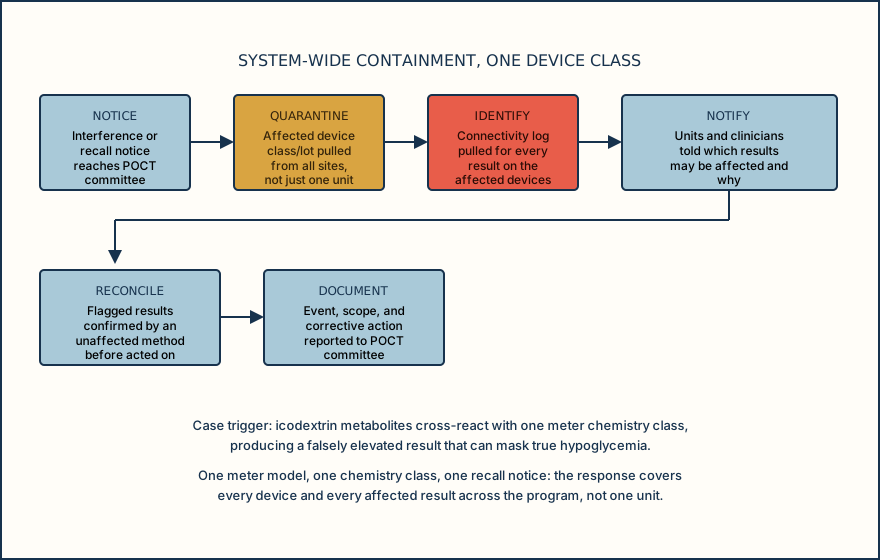
Under a common classification framework, level 1 hypoglycemia runs below 70 and at or above 54 mg/dL, and level 2, requiring immediate action, is below 54 mg/dL; level 3 is defined by the patient's need for assistance regardless of the measured value. The 46 mg/dL confirmatory result met level 2. The point-of-care result was flagged as discordant with the confirmed laboratory value, a reconciliation note was added, and the device, lot, operator, and time were already captured through connectivity, so the audit trail existed before anyone went looking for it.
Illustrative drawing — this picture was drawn rather than captured.
| Event | Value or time | Note |
|---|---|---|
| Point-of-care glucose result | 182 mg/dL | Device flagged in range; chemistry does not detect icodextrin interference |
| Clinical status at bedside | Diaphoretic, mildly confused | Inconsistent with a glucose of 182 mg/dL |
| Confirmatory action ordered | Laboratory plasma glucose | Ordered because the point-of-care result did not match the clinical picture |
| Laboratory plasma glucose result | 46 mg/dL, released 14 min after collection | Meets this unit's example critical-low threshold (local policy, not a universal cutoff) |
| Documentation | Discordant flag plus reconciliation note | Device, lot, operator, and time already captured by connectivity |
Knowledge checks
Reading and checks are open. Sign in only to save.
Knowledge check 1
Knowledge check 2
Section status
Finish this section
Reading and checks are open. Sign in only to save.
The module finishes after every required section is marked done and every check in those sections is correct.