Required section · Section 3 of 6
Competency, Preanalytical Limits, and CGM Mechanics
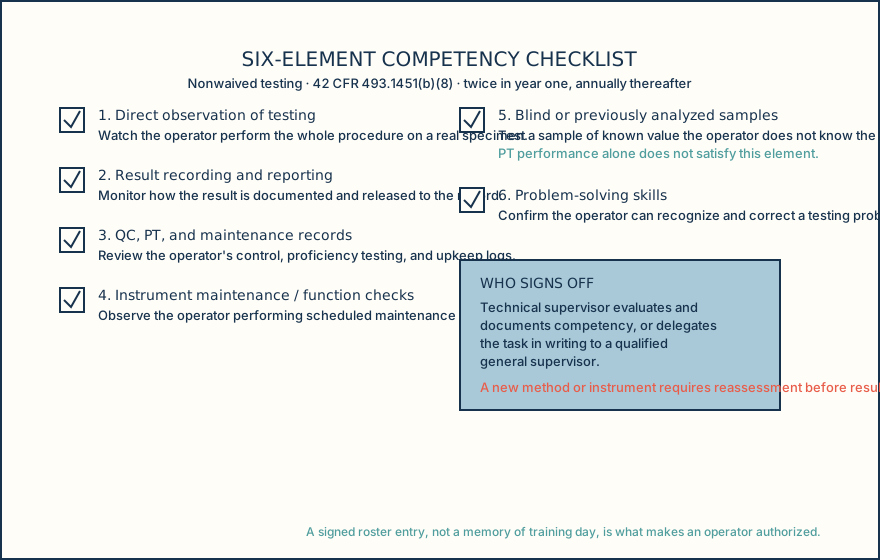
For nonwaived testing, CLIA requires competency assessment across six elements under 42 CFR 493.1451(b)(8): direct observation of testing, monitoring of result recording and reporting, review of quality control (QC), proficiency testing (PT), and maintenance records, direct observation of instrument maintenance and function checks, assessment of test performance using previously analyzed or blind samples, and assessment of problem-solving skills. The technical supervisor is responsible for evaluating and documenting this competency, though the duty may be delegated in writing to a qualified general supervisor. Assessment happens at least twice during an operator's first year on a given test system and at least annually after that, and reassessment is required before an operator reports results on a new method or instrument. PT performance alone does not satisfy the requirement; it can support only the fifth element.
Waived testing does not require the six-element assessment, but it is not unsupervised. Operators still need training and have to follow the manufacturer's current instructions without modification; an applicable modification that changes the cleared or approved system's intended use, such as an unapproved specimen type, may remove the original waived category; classify that use under the current applicable rules rather than assuming every change is high complexity. CAP accreditation checklists add a practical layer on top of both categories: a current authorized-operator roster tied to a specific test, instrument, and methodology, documented initial training and competency before independent testing, and removal of authorization the moment competency lapses or performance becomes unacceptable. Figure 2 lays out the six elements as a working checklist, including who signs off and when reassessment is triggered.
A bedside glucose result can be technically well-run and still misleading. Capillary results may be unreliable in shock, severe edema, poor peripheral perfusion, and marked hematocrit abnormality, and FDA guidance for hospital-use devices calls for evaluating hematocrit and oxygen-tension effects specifically because critically ill patients have a broader physiologic range than home users; a hematocrit-related bias is device-specific and not universally correctable. Strip storage, temperature, and short-filled or inadequate sample volume add further preanalytical risk, and positive patient identification with at least two identifiers, never a room or bed number, is required before specimen collection and testing. Table 2 collects the interference factors named in current guidance alongside what each one does to the reading.
Two chemistry-specific interferences matter here. Glucose dehydrogenase-pyrroloquinoline quinone (GDH-PQQ) strip chemistry can cross-react with non-glucose sugars, including maltose, galactose, and xylose, producing falsely elevated glucose. Icodextrin, a peritoneal dialysis solution metabolized to maltose, is a documented cause of this false elevation, and the resulting overtreatment has caused severe hypoglycemia. Acetaminophen interferes with some electrochemical glucose meter and CGM chemistries as well; FDA's 2020 guidance uses 20 mg/dL as a representative interference-testing concentration, and the actual clinical impact is device- and dose-specific rather than uniform.
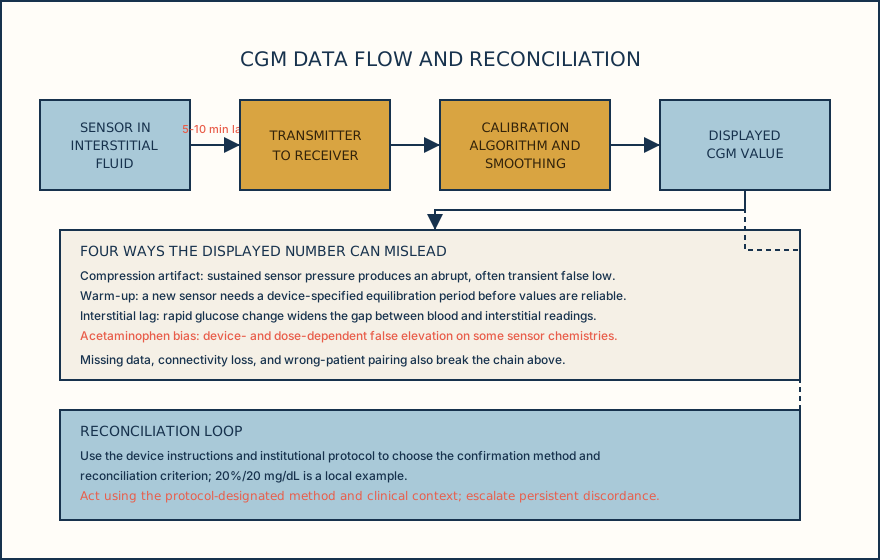
CGM adds a second measurement problem on top of these. A CGM measures glucose in subcutaneous interstitial fluid, not blood directly, and a physiologic diffusion delay, commonly cited near 5 to 10 minutes, plus sensor membrane and algorithmic smoothing, produces a lag between interstitial and blood glucose that matters most when glucose is changing quickly. Sustained pressure on a sensor can produce a compression artifact, an abrupt and often transient false low, which hospital consensus guidance flags as a reason to reconsider an unexplained low CGM reading, especially overnight, before treating. Newly inserted sensors need a manufacturer-specified warm-up period, and accuracy in the first 24 to 48 hours can be less consistent than later in sensor life; exact duration is device-specific, for example roughly two hours for one labeled model. For patients on intravenous insulin infusions, frequent point-of-care glucose, commonly every 30 minutes to 2 hours per protocol, remains the basis for dose titration; CGM is an adjunct there, not a substitute. Figure 2 traces this chain from sensor to displayed value and back to the protocol-directed confirmation step. Every limitation above is a reason to ask what a discordant number means, not a reason to distrust every reading equally.
Illustrative drawing — this picture was drawn rather than captured.
Illustrative drawing — this picture was drawn rather than captured.
| Factor | Effect on reading | Source |
|---|---|---|
| Poor peripheral perfusion, shock, severe edema | Result may not reflect true blood glucose | clsi-poct12-a3 |
| Marked hematocrit abnormality | Device-specific bias, not universally correctable | fda-bgms-guidance-2020 |
| GDH-PQQ strip with icodextrin exposure | Falsely elevated glucose from maltose cross-reaction | fda-gdh-pqq-warning |
| Acetaminophen | Device- and dose-specific interference, some meters and CGMs | fda-bgms-guidance-2020 |
| Short fill, improper strip storage or temperature | Invalid or inaccurate result, may error or bias low/high | clsi-poct12-a3 |
How the protocol handles a discordant or unexpected glucose reading, including confirmation failure or persistent discordance
Flag the discordant value
A CGM or bedside glucose result is unexpected, symptom-discordant, or outside the recent trend.
Rule out a known artifact
Check for compression, sensor warm-up, storage or temperature problems, hematocrit extremes, or a known interferent for the device in use.
Obtain a confirming result
Obtain point-of-care or central-lab glucose by a method not subject to the suspected interference. If it is unavailable or delayed, use the approved backup/downtime route, notify the responsible clinician as the current protocol directs, and do not substitute an unconfirmed value for the designated decision method.
Apply the agreement criterion
Compare the values using the device instructions and institution’s stated reconciliation criterion. Persistent discordance is documented and escalated to the responsible clinician and POCT/CGM lead under the current protocol for further assessment.
Act on the governing value
Treat, dose, or hold only under the action path that the protocol designates as authoritative, and document the values, reconciliation, and any escalation.
Knowledge checks
Reading and checks are open. Sign in only to save.
Knowledge check 1
Knowledge check 2
Knowledge check 3
Section status
Finish this section
Reading and checks are open. Sign in only to save.
The module finishes after every required section is marked done and every check in those sections is correct.