Required section · Section 4 of 6
Guided Case: One Shift, Two Discordant Readings
The patient from the opening problem is an adult inpatient: on a basal-bolus subcutaneous insulin order, taking acetaminophen 650 mg by mouth every six hours for pain, with a personal CGM continued at admission under the unit's continuation protocol. The sensor is on day nine of wear. At 06:00 the CGM displays 58 mg/dL with a single-down arrow; the patient is awake and ambulating, so compression artifact is not the obvious explanation. At 06:02 a bedside glucometer draw, GDH-based per the current strip insert with no documented icodextrin exposure, reads 61 mg/dL, flagged low against the unit's 70 mg/dL low-glucose alert but not below the laboratory's critical-low threshold.
This unit's CGM protocol uses a stated reconciliation criterion; the cited 20/20 approach is one institutional validation example, not a universal dosing rule. Here the values differ by 3 mg/dL (61 minus 58), which meets the unit's protocol criterion and supports treating the low as real rather than an isolated CGM artifact. The treatment decision is made using the method and action pathway the protocol designates, here the point-of-care value of 61 mg/dL. The patient is treated per hypoglycemia protocol with oral carbohydrate at 06:15.
A repeat point-of-care glucose at 06:30 shows recovery to 92 mg/dL, and the CGM at 06:32 reads 79 mg/dL with a level arrow. The two values are farther apart here than at 06:00, and that gap is expected: interstitial lag is most visible when glucose is changing quickly, which recovery from a treated low certainly is. No new action is required at this point beyond continued monitoring, because the trend and the point-of-care value agree with the clinical picture.
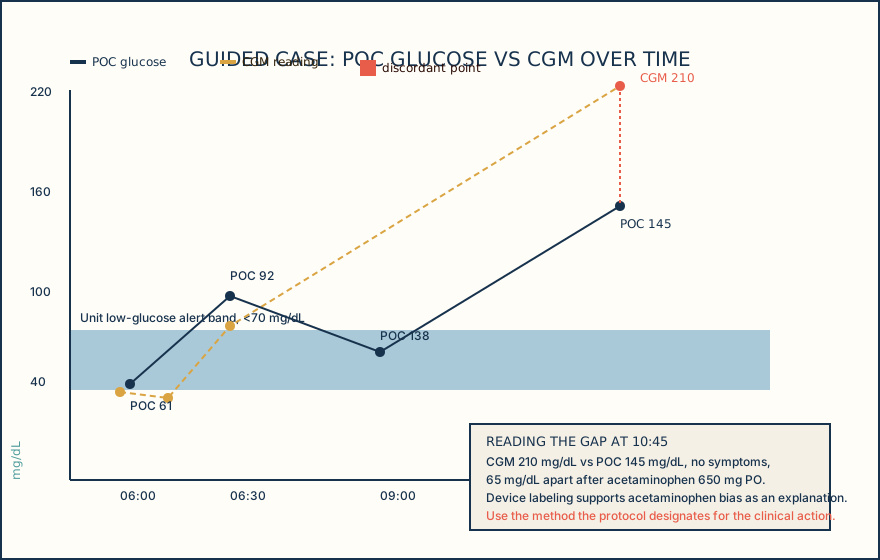
The second discordant reading arrives later in the shift. At 10:00 the patient receives the scheduled acetaminophen dose. At 10:45 the CGM reads 210 mg/dL, the patient reports no hyperglycemia symptoms, and the most recent point-of-care value, drawn at 09:00, was 138 mg/dL. That is a 65 mg/dL jump with no symptomatic or clinical explanation, and it is discordant under the unit's stated reconciliation criterion. Because the CGM model's labeling lists a potential acetaminophen-related high bias, a confirming point-of-care glucose is drawn: 145 mg/dL, close to the 09:00 baseline. Table 3 lays out the full timeline, and Figure 3 charts it.
The discrepancy is best explained by device-specific acetaminophen interference on this sensor's chemistry, not a true glucose rise, and the confirming point-of-care value is what governs any dosing decision. Nothing in this case authorizes generalizing the acetaminophen effect to every CGM model; FDA review materials found no significant interference from a single 1,000 mg acetaminophen dose on one system while other systems' labeling lists potential high bias at higher cumulative daily doses, so the exact device's current labeling is what matters. Follow the device instructions, institutional protocol, and clinical context for the action; this protocol uses point-of-care confirmation and its stated reconciliation criterion before dosing.
Illustrative drawing — this picture was drawn rather than captured.
| Time | CGM value (mg/dL) | POC value (mg/dL) | Note |
|---|---|---|---|
| 06:00 | 58, single-down arrow | - | No compression suspected, sensor day 9 |
| 06:02 | - | 61 | Meets this unit's protocol criterion; treated per hypoglycemia protocol |
| 06:30 / 06:32 | 79, level arrow | 92 | Gap consistent with interstitial lag during recovery |
| 09:00 | - | 138 | Baseline before acetaminophen dose |
| 10:00 | - | - | Acetaminophen 650 mg PO given |
| 10:45 | 210 | 145 | 65 mg/dL gap explained by device-specific acetaminophen bias |
Knowledge checks
Reading and checks are open. Sign in only to save.
Knowledge check 1
Knowledge check 2
Section status
Finish this section
Reading and checks are open. Sign in only to save.
The module finishes after every required section is marked done and every check in those sections is correct.