Required section · Section 5 of 6
Run the huddle, assign the work, escalate the gap
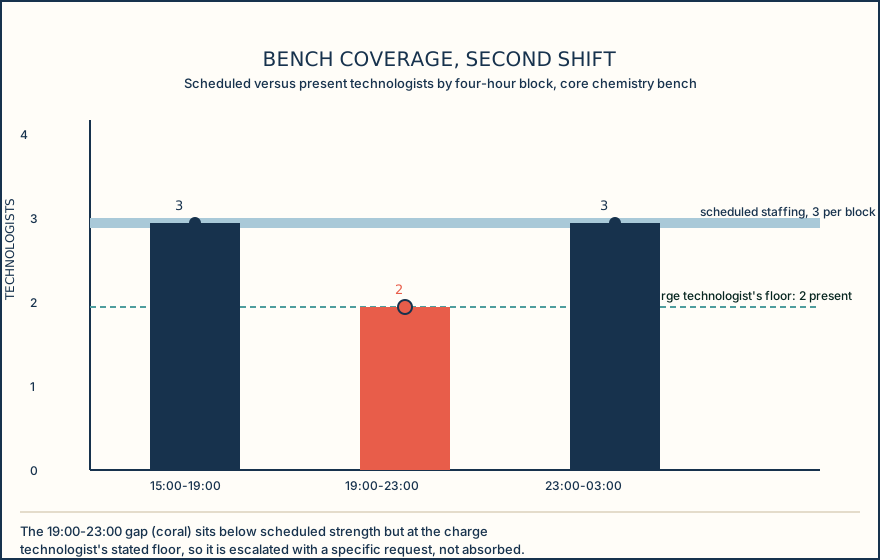
You are the charge technologist at 18:40. The huddle board is in front of you with the entries described above. Before you can close the huddle and move into the 19:00-23:00 block, you need to decide three things: how you deliver the potassium result so it is both fast and on record, who covers which task given the skill matrix, and how you phrase the staffing escalation so the supervisor can act on it immediately rather than needing to ask follow-up questions.
The skill matrix shows four technologists relevant to this decision: Tech A, on bench, qualified for both moderate- and high-complexity chemistry; Tech B, on bench, qualified only for moderate-complexity work; Tech C, who called out sick at 17:00 and is not available; and Tech D, on-call, qualified for both complexity levels. The 19:00-23:00 block needs high-complexity coverage on the bench, and the send-out packaging task does not require high-complexity qualification.
The checks that follow ask you to choose the SBAR elements that belong in the potassium call, identify the closed-loop step that is missing if a technologist reads the result and hangs up without a repeat-back, assign the reassignment that respects the skill matrix, and choose the escalation phrasing that names the risk and requests a specific action rather than a vague appeal for help.
The decision that actually protects the shift is not any single clever choice, it is making the critical call fast and documented, keeping every task inside the qualification of the person doing it, and putting the staffing risk in front of someone who can add coverage or limit service.
Illustrative drawing — this picture was drawn rather than captured.
| Technologist | Status | Moderate complexity | High complexity |
|---|---|---|---|
| Tech A | On bench | Qualified | Qualified |
| Tech B | On bench | Qualified | Not qualified |
| Tech C | Called out 17:00 | Off shift, not counted | Off shift, not counted |
| Tech D | On-call | Qualified | Qualified |
Ordering exercise
Put the potassium notification in the order the charge technologist actually performs it, from verified result to closed record.
1. Document the notification
The technologist records date, time, result, and the name and role of the person notified.
2. Sender confirms the repeat-back
The technologist confirms, "that is correct," or corrects any mismatch before ending the call.
3. Receiver reads back the value
The nurse repeats the value, units, and requested action back to the technologist.
4. Deliver the result using SBAR
The technologist calls the emergency department and states situation, background, assessment, and the requested action.
5. Result verifies at 6.9 mmol/L
The plasma potassium verifies against the local critical-value list, which flags above 6.5 or below 2.5 mmol/L.
6. Escalate failed contact or an incorrect repeat-back
If the receiver cannot be reached, the read-back is incorrect and cannot be corrected, or the responsible recipient is unavailable, follow the current escalation policy and document the route.
Knowledge checks
Reading and checks are open. Sign in only to save.
Knowledge check 1
Knowledge check 2
Section status
Finish this section
Reading and checks are open. Sign in only to save.
The module finishes after every required section is marked done and every check in those sections is correct.