Required section · Section 5 of 6
Your decision: hold the line and escalate in order
The nurse is still on the line. You have already held the result, documented the flag, and requested a redraw. Two more decisions are in front of you: exactly what to communicate right now, and, if the pressure continues after this call, what order to escalate in. Neither decision benefits from improvising in the moment; both are decisions your laboratory has effectively already made through policy and regulation, and your job is to apply them correctly.
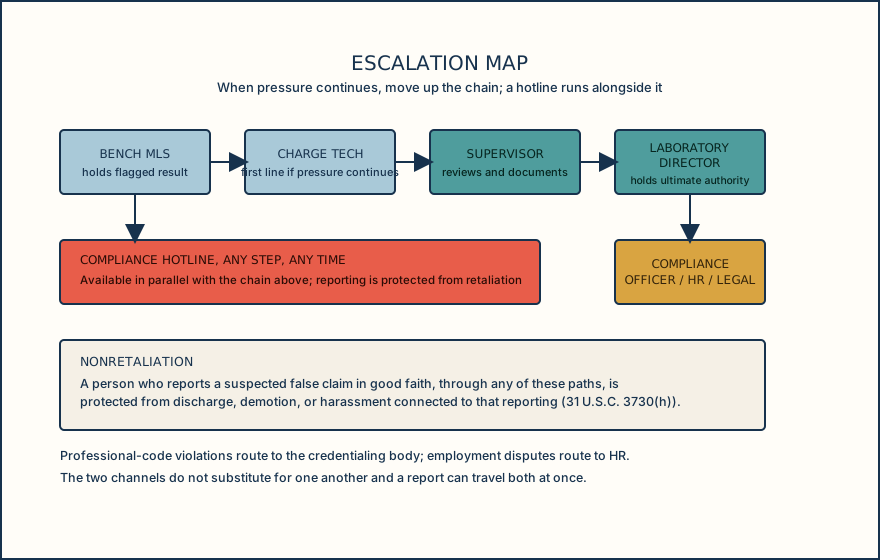
The ordering exercise below asks you to sequence the defensible response, from documenting the flag through escalating to the laboratory director's designee if the request keeps coming. The figure alongside it shows the fuller escalation map: a stepwise chain of command for a testing or pressure problem, running in parallel with a compliance hotline that is available at any step, for any concern, including one that never involves this specimen.
The same minimum-necessary and nonretaliation principles apply outside this specific case. A billing coordinator asking for more of the record than a claim requires, or a colleague reporting suspected billing fraud through the compliance hotline, both call for the same reasoning: limit what is shared to what the purpose needs, and know that raising a good-faith concern is protected. Under 31 U.S.C. 3730(h), a person who lawfully investigates, reports, or acts to stop a suspected false claim is protected from retaliation, such as discharge, demotion, or harassment connected to that reporting, whether or not a lawsuit is ever filed and whether or not the report used the words 'False Claims Act.'
Escalate one step at a time, keep the ordering unit informed while you do, and do not let the number of times you are asked change what the specimen actually supports.
Illustrative drawing — this picture was drawn rather than captured.
Ordering exercise
The charge nurse calls and asks you to release the flagged potassium result immediately. Put the defensible response in order.
1. Notify the ordering unit
Tell the nurse the specimen problem and the expected time for a redrawn result.
2. Escalate to supervisor or director
If it is still unresolved, involve the supervisor or the laboratory director's designee.
3. Document the flag
Record the hemolysis index flag and the time the result was held.
4. Escalate to the charge tech
If the pressure to release continues, bring in the charge tech.
5. Request a redraw
Ask for a fresh specimen under the laboratory's hemolysis policy.
Knowledge checks
Reading and checks are open. Sign in only to save.
Knowledge check 1
Knowledge check 2
Section status
Finish this section
Reading and checks are open. Sign in only to save.
The module finishes after every required section is marked done and every check in those sections is correct.