Required section · Section 2 of 6
Two Ways Cells Come Together
Rouleaux are orderly, curving stacks of adjacent RBCs, often most evident in the thicker smear area; surrounding single RBCs remain visible. Agglutination is irregular, multidirectional clumping in the monolayer, with variable clump size and single RBCs around clumps. A localized edge artifact is not either pattern.
A saline evaluation is an authorized, interpretive-only morphology comparison, not a CBC correction: under the validated local method, make the approved isotonic-saline replacement or dilution preparation and compare an equivalent smear area before and after manipulation. Its purpose is to test whether an orderly stack disperses in a changed protein environment. Record complete dispersion (single RBCs replace the stacks), partial dispersion (stacks decrease but remain), or absent dispersion (no meaningful change). It may support a rouleaux interpretation, but it neither diagnoses a cause nor establishes CBC validity.
Choose separate branches from the shown evidence: orderly stacks with stable, coherent results may undergo the authorized saline evaluation; irregular monolayer clumps with implausible RBC-associated results require the validated warming-and-rerun branch; failed stability or specimen integrity requires recollection. Missing required observations also prevent corrective release. Persistent clumps, absent/failed correction, or a repeat that fails acceptance ends in hold, qualified review, and escalation rather than release.
Illustrative drawing — this picture was drawn rather than captured.
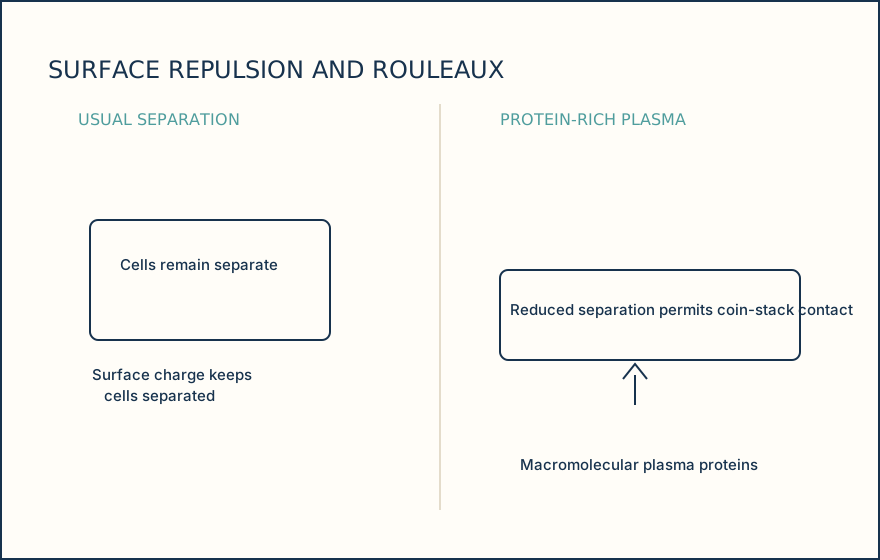
Illustrative drawing — this picture was drawn rather than captured.
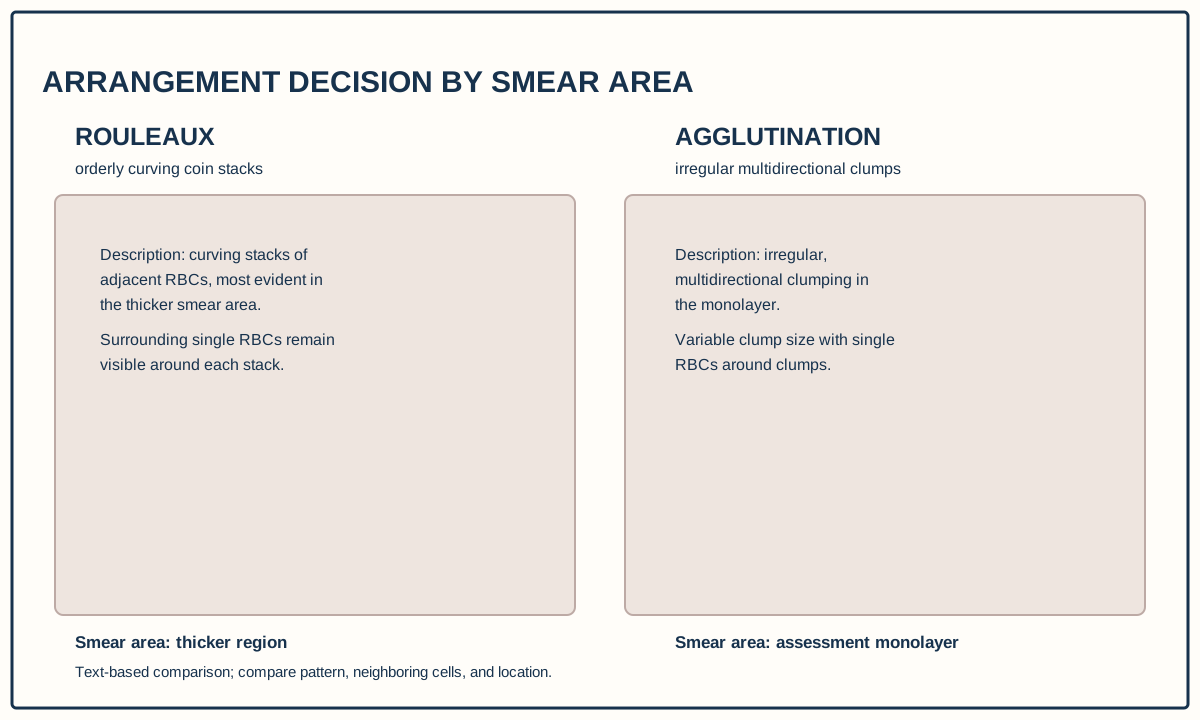
Observed arrangement to conditional release workflow
Observe smear evidence
Compare monolayer, thicker area, clump shape, neighboring single RBCs, and distribution.
Conditional saline comparison
For orderly stacks with stable, numerically coherent results, use the authorized saline comparison and record complete, partial, or absent dispersion. It is interpretive only.
Conditional warming and rerun
For irregular monolayer clumps plus implausible RBC-associated results, follow validated warming, mixing, and prompt rerun; verify the repeat smear and acceptance evidence.
Conditional recollection
When specimen stability, integrity, or required evidence fails, recollect under the local procedure rather than applying a correction.
Release, hold, or escalate
Release only if clumps are absent and flags, numerical consistency, specimen stability, and local criteria are acceptable. Persistent clumps or a failed correction require hold, qualified review, and escalation.
Knowledge checks
Reading and checks are open. Sign in only to save.
Knowledge check 1
Knowledge check 2
Section status
Finish this section
Reading and checks are open. Sign in only to save.
The module finishes after every required section is marked done and every check in those sections is correct.