Required section · Section 2 of 6
Iron supply, storage, and restriction
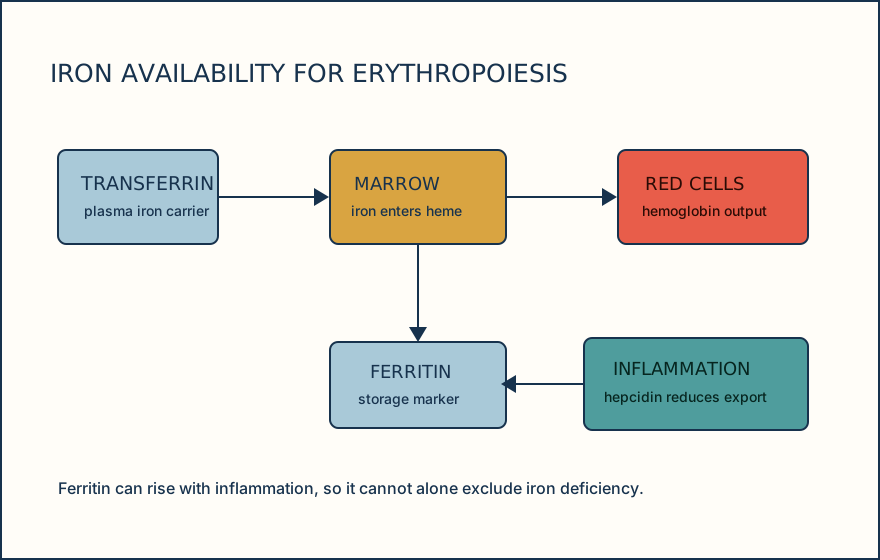
Transferrin carries iron in plasma, and marrow erythroid precursors incorporate available iron into heme. Ferritin reflects storage iron in uncomplicated deficiency. This physiology explains why depleted stores and impaired delivery can both produce iron-restricted erythropoiesis.
Ferritin is also an acute-phase reactant. Inflammation increases hepcidin and reduces iron export, leaving less iron available for erythropoiesis even when stored iron is present. A normal or increased ferritin therefore cannot by itself exclude iron deficiency during inflammation.
Transferrin saturation (TSAT) is serum iron ÷ total iron-binding capacity (TIBC) × 100. Serum iron has biologic variability and is not sufficient alone to classify iron status. Soluble transferrin receptor (sTfR) reflects erythroid iron demand and can support investigation of iron-restricted erythropoiesis when ferritin is confounded by inflammation; it is not interchangeable between assays and cannot establish iron deficiency alone.
Document whether TIBC is measured or calculated and apply the local formula, units, and rounding rule before releasing TSAT.
Illustrative drawing — this picture was drawn rather than captured.
Interpret an iron-restricted pattern as a structured comparison, not a single result.
Verify context
Review collection timing, transfusion, iron therapy, pregnancy, inflammation, renal disease, and local method fields.
Compare the panel
Read ferritin, iron, TIBC or transferrin, TSAT, CBC indices, and smear together.
Choose a bounded action
Release verified results and follow local policy for a comment, hemoglobin analysis, iron evaluation, or further investigation.
Knowledge checks
Reading and checks are open. Sign in only to save.
Knowledge check 1
Knowledge check 2
Section status
Finish this section
Reading and checks are open. Sign in only to save.
The module finishes after every required section is marked done and every check in those sections is correct.