Required section · Section 2 of 6
Build the destruction pattern
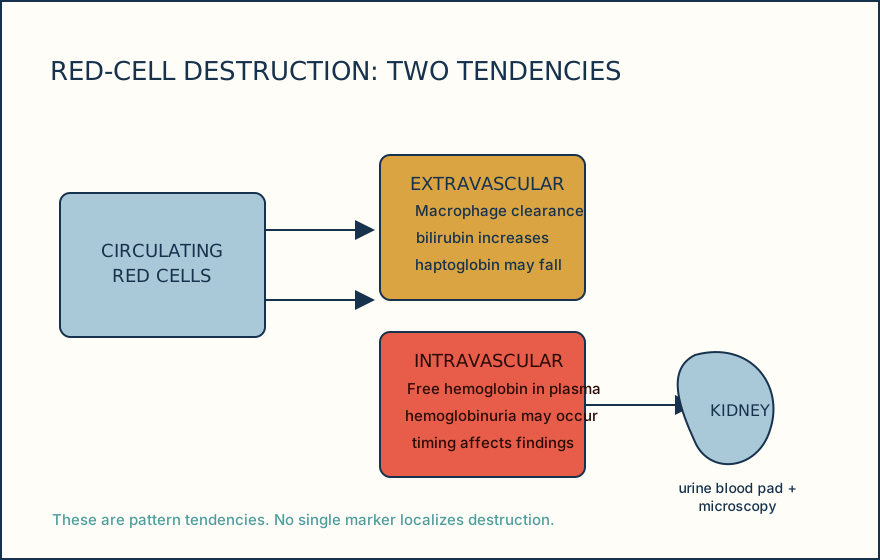
Red cells are normally cleared as they age by macrophage-mediated extravascular clearance, with hemoglobin handled outside the circulation. Increased destruction can raise unconjugated bilirubin and LDH, lower haptoglobin through free-hemoglobin binding, and stimulate reticulocyte release. No one marker establishes hemolysis.
Intravascular and extravascular are probabilistic tendencies, not closed compartments. Plasma free hemoglobin, hemoglobinuria, and later urine hemosiderin support an intravascular component; their absence does not establish macrophage-mediated extravascular clearance. A normal or low reticulocyte response does not exclude hemolysis when marrow suppression, nutrient deficiency, parvovirus B19, severe illness, or severe immune hemolysis limits compensation. Reticulocyte intervals are method, analyzer, and laboratory specific. Compare the reticulocyte response with anemia and the local interval, not with a percent alone.
Illustrative drawing — this picture was drawn rather than captured.
A reusable pattern assembly sequence
Verify specimen
Check collection, appearance, hemolysis index, and assay-specific interference policy before interpreting results.
Assemble markers
Integrate anemia, reticulocytes, bilirubin, LDH, haptoglobin, urine, and smear rather than relying on one marker.
Describe tendency
Use plasma and urine findings to describe intravascular tendency while retaining uncertainty.
Route follow-up
Use DAT and morphology to route qualified follow-up without making a bench diagnosis.
Knowledge checks
Reading and checks are open. Sign in only to save.
Knowledge check 1
Knowledge check 2
Section status
Finish this section
Reading and checks are open. Sign in only to save.
The module finishes after every required section is marked done and every check in those sections is correct.