Required section · Section 2 of 5
Method limits and pediatric context
The five-part differential and peripheral smear are complementary, not interchangeable. The analyzer reports its method-defined differential categories and may issue an IG count and/or IG flag; it does not provide a band result unless that method explicitly reports one. In this case, segmented cells and bands are from a locally triggered manual differential. An IG flag is an analyzer-generated prompt whose meaning is method-, software-, and locally validated-rule-dependent. It is resolved by the required smear or repeat pathway; do not report a manual immature-cell category, infer blasts, or equate the flag with infection from the flag alone.
Reference intervals have provenance. The pediatric values below are exact published CALIPER study intervals from apparently healthy Canadian participants tested on a Beckman Coulter DxH 900, using K2EDTA blood analyzed within 8 hours. They demonstrate age dependence; they are not release intervals for another analyzer, laboratory, or population. Use the locally verified interval for the patient and method.
Definitions for routing: left shift is increased circulating immature granulocytic forms beyond the local method/rule, not an IG flag alone. Dysplasia is reproducible abnormal maturation morphology assessed under local criteria. A leukoerythroblastic pattern combines immature myeloid forms with nucleated red cells on an acceptable smear. Persistence is an abnormality demonstrated on dated results across the locally defined interval. Urgency is a locally defined combination requiring prompt escalation—for example, verified blasts, an abnormal-promyelocyte concern, leukoerythroblastosis with concerning cytopenias, or an extreme count with clinical concern—not neutrophilia or a single IG flag alone.
Illustrative drawing — this picture was drawn rather than captured.
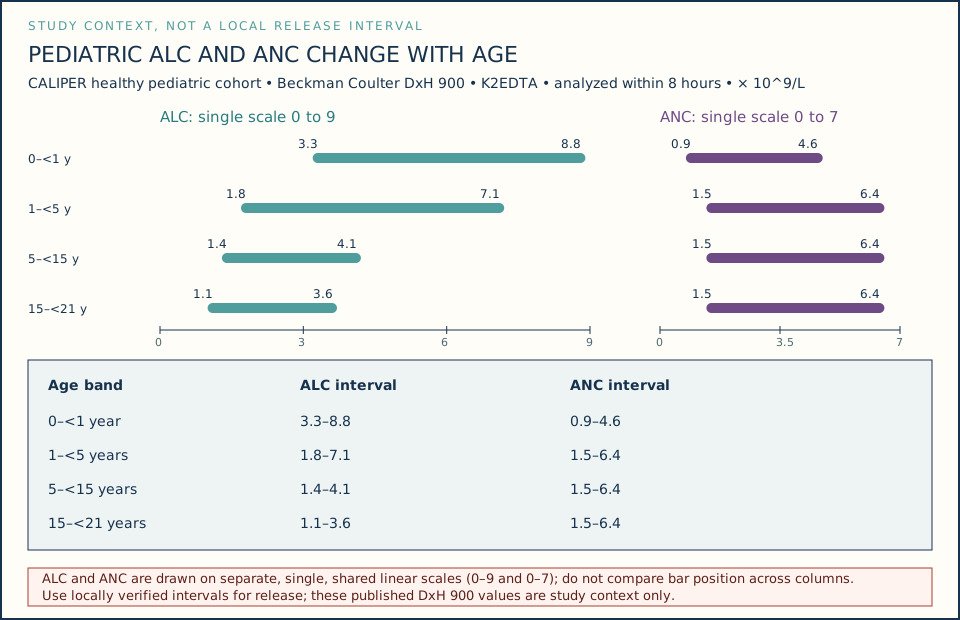
| Age band | ALC | ANC | Use |
|---|---|---|---|
| 0–<1 year | 3.3–8.8 | 0.9–4.6 | Study context only |
| 1–<5 years | 1.8–7.1 | 1.5–6.4 | Study context only |
| 5–<15 years | 1.4–4.1 | 1.5–6.4 | Study context only |
| 15–<21 years | 1.1–3.6 | 1.5–6.4 | Study context only |
Knowledge checks
Reading and checks are open. Sign in only to save.
Knowledge check 1
Section status
Finish this section
Reading and checks are open. Sign in only to save.
The module finishes after every required section is marked done and every check in those sections is correct.