Required section · Section 1 of 5
The bounded question
A 31-year-old outpatient has K2EDTA whole blood collected at 09:10 and analyzed at 09:35. Physically inspect the tube—not the instrument status alone—for adequate fill and a visible clot before proceeding; then confirm identity/timing and review analyzer errors, flags, and scatter information under the local procedure. The analyzer's five-part differential reports neutrophils 78% (no band result). A locally triggered 100-cell manual smear differential reports segmented neutrophils 78% and bands 2%; the analyzer IG flag is a separate instrument prompt, not a cell percentage.
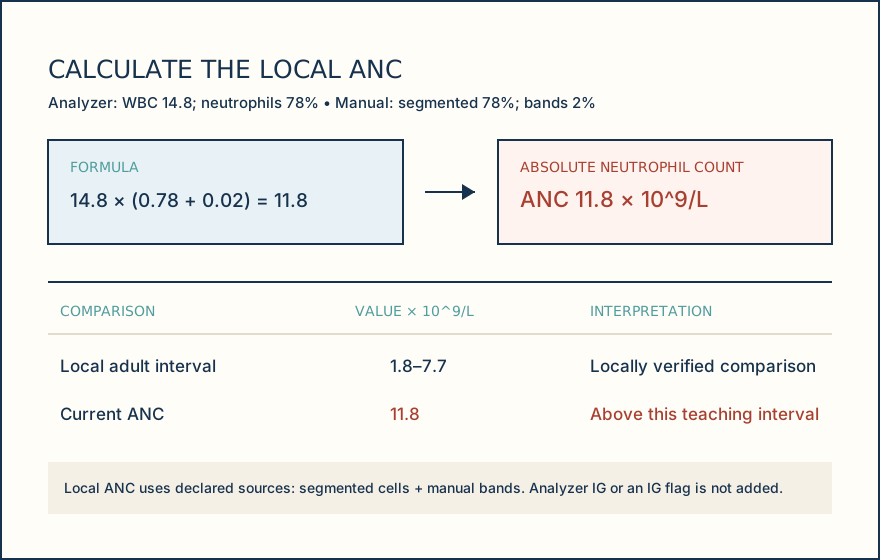
This teaching laboratory's local ANC convention is WBC × (segmented-neutrophil fraction + manual-band fraction): 14.8 × (0.78 + 0.02) = 11.8 × 10^9/L. Analyzer IG, when reported by a method, is not added to ANC under this local convention; an IG flag is not an IG count. The local adult teaching interval is 1.8–7.7 × 10^9/L, so the ANC is above that interval. A percentage describes distribution; it does not itself establish an increased cell number.
One bounded workflow governs review of a flagged neutrophilia result: specimen/analyzer validity; absolute counts; local smear rule; flag resolution; release or escalation. It does not diagnose infection, marrow production, or neoplasm. The analyzer supplies counts, categories, flags, and instrument information; the quality smear supplies morphology only when the local review rule is met. Local policy, not a generic teaching workflow, defines review triggers, repeat/rerun rules, delta limits, reporting comments, urgency, and referral criteria.
Illustrative drawing — this picture was drawn rather than captured.
| Component | Differential source | Reported fraction | Absolute count × 10^9/L | Local adult teaching interval × 10^9/L |
|---|---|---|---|---|
| WBC | Analyzer CBC | — | 14.8 | — |
| Segmented neutrophils | 100-cell manual smear differential | 78% | 11.5 | 1.8–7.7 ANC (local convention includes manual bands) |
| Bands | 100-cell manual smear differential | 2% | 0.30 | Included only because manual differential supplied them |
| Analyzer IG / IG flag | Analyzer method / instrument prompt | Not used in case | Not added to ANC | Separate from manual bands and ANC |
One locally governed workflow for a flagged neutrophilia result
Inspect specimen and instrument context
Confirm identity and timing; physically inspect the tube for adequate fill and visible clot; then review analyzer errors, flags, and scatter information under local criteria.
Calculate and compare the local ANC
Calculate locally defined absolute counts. In this case, ANC = WBC × (segmented neutrophils + manual bands); do not add analyzer IG or an IG flag.
Resolve the flag on a quality smear
When the local rule requires review, assess an acceptable Wright-Giemsa smear for the reported feature, artifacts, bands/immature granulocytes, blasts, dysplasia, and other lineages; resolve the IG flag by documented findings and the stated next step.
Compare a dated prior CBC
Record the collection date and result when available; it supplies duration evidence, not a diagnosis.
Release or escalate locally
Document the verified pattern and follow the established review, communication, and referral pathway.
Knowledge checks
Reading and checks are open. Sign in only to save.
Knowledge check 1
Section status
Finish this section
Reading and checks are open. Sign in only to save.
The module finishes after every required section is marked done and every check in those sections is correct.