Required section · Section 3 of 6
Direct versus surrogate detection, and the controls that keep a color honest
Use one taxonomy throughout: a pad is direct for the analyte its reagent chemistry actually detects. This analytical classification does not say that the analyte proves a particular cell type, organism, or diagnosis. Glucose oxidase and peroxidase form gluconic acid and hydrogen peroxide from glucose, then oxidize a chromogen, so the glucose pad is direct for urinary glucose, not a general reducing-substance test. The nitroprusside ketone reaction is direct for acetoacetic acid and does not detect beta-hydroxybutyrate. The protein pad uses the protein error of indicators at a constant buffered pH; it directly detects protein with strongest response to albumin and less sensitivity to globulins and mucoproteins. A negative protein pad therefore does not exclude nonalbumin proteinuria.
The blood pad is direct for heme: it detects heme's pseudoperoxidase activity whether the heme arrives in intact red blood cells, free hemoglobin, or myoglobin. Its direct heme signal is not proof that intact red blood cells are present; microscopy is needed to demonstrate intact cells and distinguish that source from the others.
Leukocyte esterase directly detects granulocyte esterase activity through hydrolysis of a pyrrole ester whose product couples with a diazonium salt to purple color; it is therefore a clinical surrogate for white cells, not a white-cell count. Nitrite directly detects nitrite through diazotization and coupling to pink; it is a clinical surrogate for bacterial nitrate reduction, not a bacterial count, and a negative nitrite does not exclude bacteriuria if bladder dwell time was short, diet was low in nitrate, or the organism does not reduce nitrate.
The bilirubin pad directly detects bilirubin by coupling it with diazotized dichloroaniline in acid to a tan color, but it does not specifically detect unconjugated bilirubin. Urobilinogen directly produces pink-red color by the Ehrlich reaction, which does not reliably detect porphobilinogen. Both bilirubin and urobilinogen are unstable with room-temperature and light exposure, so a delayed or poorly protected specimen can understate either result. The pH pad is a double-indicator system; the specific gravity pad estimates ionic concentration through a polyelectrolyte pKa shift rather than measuring the refractive index of every dissolved solute, so it can disagree with a refractometer when unusual nonionic solutes such as glucose are present, and it can read falsely low in strongly alkaline urine.
For this Multistix 10 SG strip family, the IFU specifies that no color change is interpreted after two minutes. Start the timer on removal and read every pad at its bottle-label time; a later color is drift, not signal for this strip family. Read manually in good, even light, never direct sunlight, because color perception under poor or colored light is a documented source of misread pads.
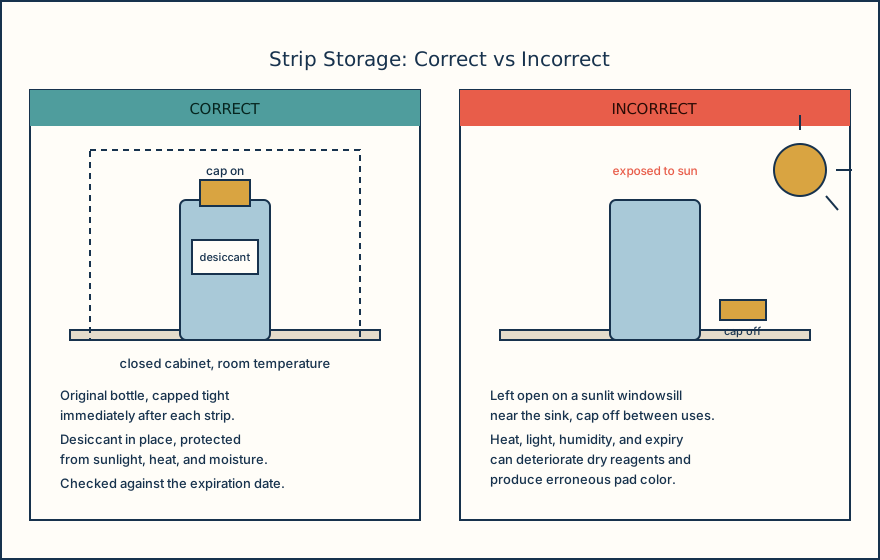
Store unused strips capped, with desiccant, away from sunlight, heat, and ambient moisture, and never use an expired strip. Moisture, heat, light, and expiration can deteriorate dry reagents or their color indicators, causing weakened, altered, or erroneous color development. An automated reader is programmed to its own timing and its own approved strip and software combination; it does not substitute for using the matching strip, software, and operator procedure, and an intensely colored specimen can still fool a reflectance reader even when a visual read would catch the anomaly.
Classify the pad by the analyte it directly detects, then state separately when that analyte is only a clinical surrogate; treat timing, lighting, and storage as part of the test, not as housekeeping around it.
Illustrative drawing — this picture was drawn rather than captured.
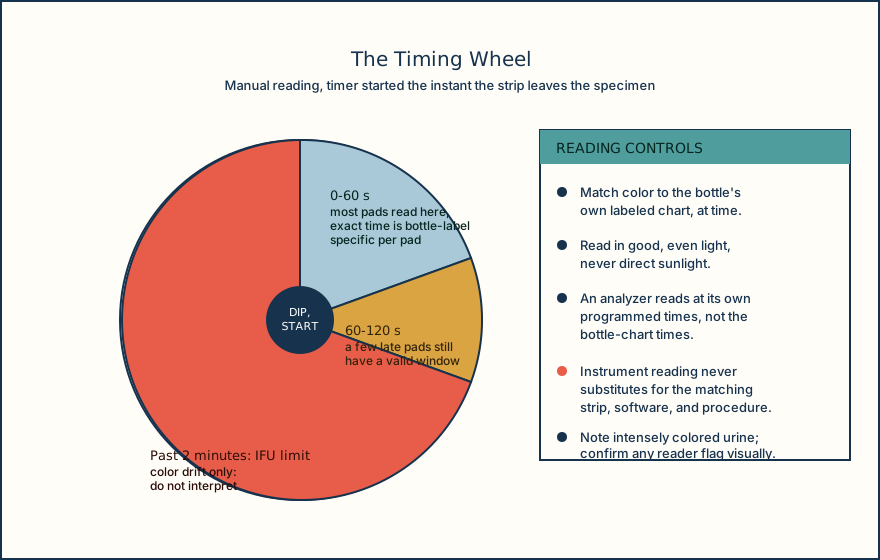
Illustrative drawing — this picture was drawn rather than captured.
| Pad | Approximate sensitivity | Directly detected analyte and clinical boundary |
|---|---|---|
| Protein | 15 to 30 mg/dL albumin | Direct for protein, albumin-predominant; not an exclusion of nonalbumin protein |
| Glucose | 75 to 125 mg/dL | Direct for glucose |
| Ketone | 5 to 10 mg/dL acetoacetic acid | Direct for acetoacetic acid; not beta-hydroxybutyrate |
| Bilirubin | 0.4 to 0.8 mg/dL | Direct for bilirubin; delayed or light-exposed urine can understate it |
| Nitrite | 0.06 to 0.1 mg/dL | Direct for nitrite; clinical surrogate for bacterial nitrate reduction |
Knowledge checks
Reading and checks are open. Sign in only to save.
Knowledge check 1
Knowledge check 2
Knowledge check 3
Knowledge check 4
Section status
Finish this section
Reading and checks are open. Sign in only to save.
The module finishes after every required section is marked done and every check in those sections is correct.