Required section · Section 2 of 6
Crystals precipitate from a chemical environment
A urine crystal forms when a solute exceeds its solubility in that specimen at that moment. Supersaturation depends on pH, solute concentration, temperature, and how long the urine has stood before it is examined. Crystal formation shows that a solute became supersaturated; it does not by itself establish nephrolithiasis or any other disease. Treat every crystal first as a solubility event and only second as a possible clinical clue.
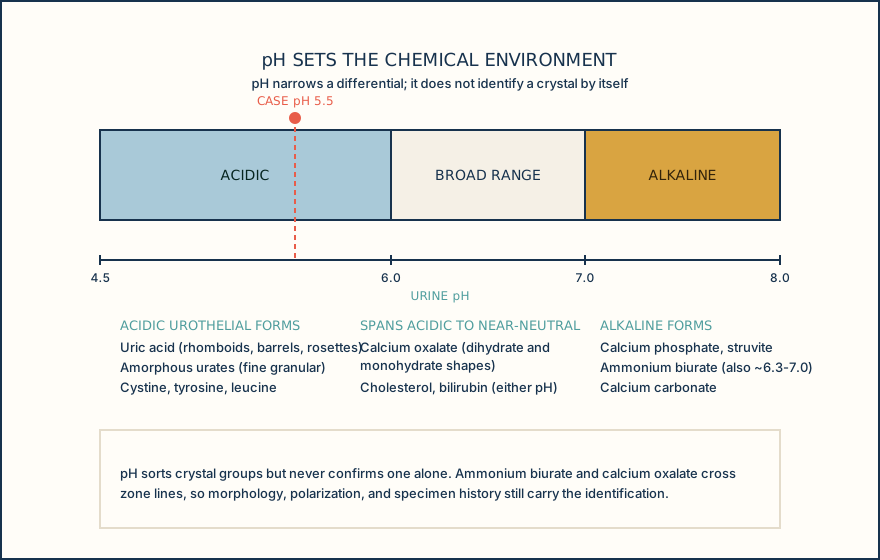
Because pH, solute concentration, urine flow, and specimen age all move the solubility line, several variables narrow a differential together and no single one proves an identity alone. A useful mental model works those variables in a fixed order: read the chemical context first, then the shape, then reach for polarization only when it will actually change the answer. That order keeps a reader from anchoring on the first shape that looks familiar.
Automated sediment systems still miss or misclassify some crystals, so a flagged or visually unusual particle belongs on the laboratory's manual-review pathway rather than an automated call alone. The model below is the same order a competent microscopist works through on every unfamiliar crystal, whether the front end is manual or automated.
Work pH, then morphology, then polarization and specimen history, in that order, before you commit to a name.
Illustrative drawing — this picture was drawn rather than captured.
The reasoning order for narrowing a crystal identification, applied on every unfamiliar or flagged particle.
Read the chemical context
Note urine pH, specific gravity, and dipstick findings before naming anything; each supplies context that a shape alone cannot.
Describe the morphology
Describe size, border, internal detail, and color in brightfield, and compare against the full shape range for each candidate crystal, not one memorized picture.
Apply polarization when it helps
Use polarized light where birefringence actually discriminates between look-alikes; some crystals give little added information from polarization.
Weigh specimen history
Factor in specimen age, temperature, and storage; a change between a fresh and a held aliquot points toward a storage artifact rather than a new finding.
Apply local review criteria
Route an unusual, higher-concern, or clinically flagged crystal through the laboratory's defined review and communication pathway before it is reported as an identification.
Knowledge checks
Reading and checks are open. Sign in only to save.
Knowledge check 1
Knowledge check 2
Section status
Finish this section
Reading and checks are open. Sign in only to save.
The module finishes after every required section is marked done and every check in those sections is correct.