Required section · Section 4 of 6
Guided case: the two-aliquot workup
A clean-catch urine specimen is collected and transported under the laboratory's urine collection and handling procedure, consistent with current urine specimen collection guidance, and is received 25 minutes after collection. A fresh aliquot is mixed, spun by the local manual-sediment procedure, and examined in brightfield and polarized light. A second aliquot is refrigerated at 2 to 8 degrees Celsius for 4 hours, then returned to room temperature for 20 minutes before repeat microscopy. The macroscopic result is unremarkable: yellow and clear on the fresh pour, specific gravity 1.028, pH 5.5, and every dipstick chemistry negative, with 0 to 2 red cells and 0 to 2 white cells per high-power field on the fresh aliquot.
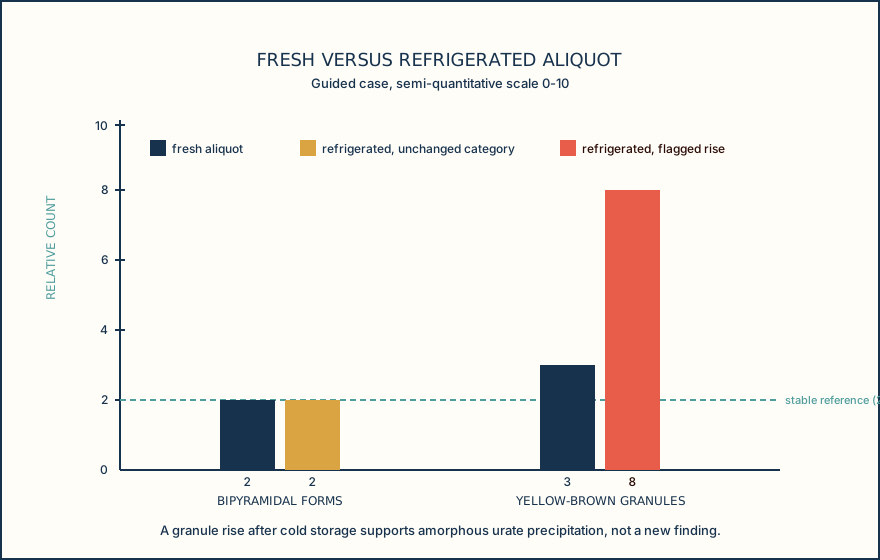
The sediment carries two crystal populations. Fresh microscopy shows a few colorless bipyramidal forms and a few fine yellow-brown granules. On the refrigerated aliquot the bipyramidal forms are unchanged, but the fine yellow-brown granules are now many, and the system flags possible storage-related crystallization. Polarized light does not add a decisive pattern for the bipyramidal forms in this case, and granular material is not used for identity regardless of polarization state.
The colorless bipyramidal forms are compatible with calcium oxalate dihydrate. That morphology-based identification is only released if the laboratory's atlas and competency rules support the call, per the reasoning order in the mental model above: chemical context first, then shape, then polarization and history. The acidic pH of 5.5 is consistent with either urate or uric-acid possibilities for the fine yellow-brown granules, and their sharp increase only after refrigeration supports amorphous urates precipitating out of solution, a storage effect, not a new patient condition.
The technologist documents collection time, receipt time, and examination time for both aliquots, reports the finding from the fresh aliquot, and applies local review criteria if an unusual crystal, reported symptoms, renal injury markers, or medication history would raise a higher-concern differential. No drug crystal or diagnostic claim is made from this sediment alone. The laboratory must also define, monitor, and document the specimen and reagent storage conditions relevant to this workflow, consistent with manufacturer instructions where one applies; refrigeration itself is a defined preservation method under the CAP Urinalysis Checklist, and that checklist specifically notes that refrigeration, while it inhibits bacterial growth, may induce urine crystal formation.
When a crystal count rises only after cold storage while everything else on the sediment is stable, report the fresh-aliquot finding and treat the rise as a handling effect, not a new diagnosis.
Illustrative drawing — this picture was drawn rather than captured.
| Result | Fresh aliquot | Refrigerated aliquot | Local reference or flag |
|---|---|---|---|
| Color/clarity | Yellow, clear | Yellow, slightly cloudy | No interval |
| Specific gravity | 1.028 | 1.028 | 1.003-1.030 |
| pH | 5.5 | 5.5 | 4.5-8.0 |
| RBC/WBC per hpf | 0-2 / 0-2 | 0-2 / 0-2 | 0-2/hpf reference; 0-5/hpf refrigerated flag |
| Crystals | Few bipyramidal forms; few fine yellow-brown granules | Few bipyramidal forms; many fine yellow-brown granules | Report per local convention |
| Flag | None | Possible storage-related crystallization | Local review rule |
Knowledge checks
Reading and checks are open. Sign in only to save.
Knowledge check 1
Knowledge check 2
Section status
Finish this section
Reading and checks are open. Sign in only to save.
The module finishes after every required section is marked done and every check in those sections is correct.