Required section · Section 2 of 6
How a Signal Becomes a Value
An analyzer does not measure concentration directly. It measures a physical signal, absorbance, a potential, a photon count, or a fluorescence intensity, produced when a reagent reacts with the analyte in a specimen. Calibration is the process that turns that raw signal into a reportable value: the laboratory runs materials of known or assigned value, called calibrators, and the instrument's software fits a curve relating the signal each calibrator produced to its assigned value. Every patient result afterward is read off that curve.
A calibrator's assigned value only means something if it is traceable, a documented, unbroken chain of comparisons, each with its own stated uncertainty, linking that value back to a higher-order reference measurement procedure or reference material, ultimately to an SI (International System of Units) unit or an internationally agreed convention. Traceability is what lets a laboratory in one city and a laboratory in another city, running different instruments, report the same patient's glucose as the same number.
Traceability is not the whole story. A calibrator must also be commutable, meaning it behaves like a real patient specimen across the measurement procedures it calibrates. Matrix effects, protein binding, viscosity, added stabilizers, lyophilization artifacts, can make a material behave differently from a fresh patient specimen even when its assigned value is accurately known. A material can be perfectly traceable and still non-commutable, and a non-commutable calibrator used to transfer a calibration can introduce a method-specific bias that never shows up as a labeling error, only as a shifted patient result.
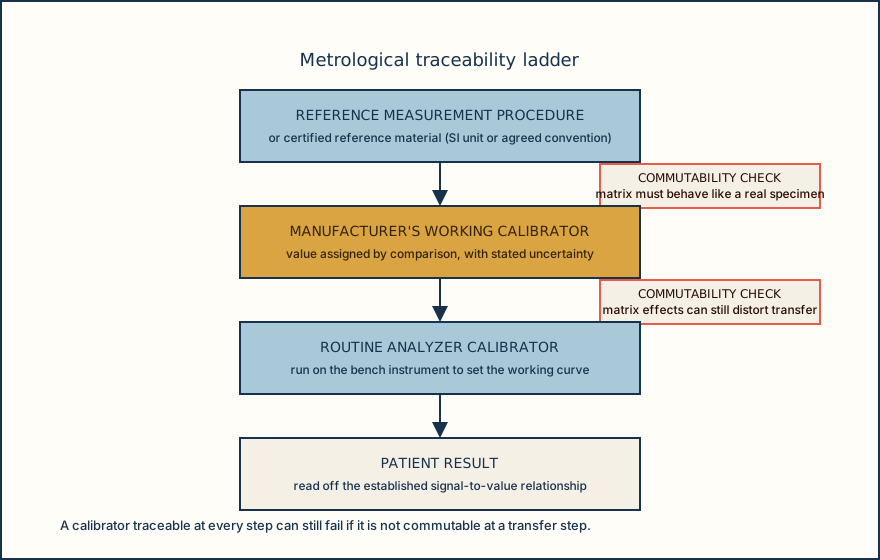
The traceability ladder below shows where that risk concentrates: at each step where a value is transferred from one material to the next, matrix effects can distort the transfer even though the paperwork behind the assigned value is sound. The steps between the reference procedure and the manufacturer's working calibrator, and between that calibrator and the routine analyzer calibrator, are exactly where commutability has to hold.
When you ask whether a calibrator is trustworthy, ask two separate questions, is its value traceable, and will it behave like a patient specimen on this instrument, because a yes to the first does not answer the second.
Illustrative drawing — this picture was drawn rather than captured.
The calibration life cycle on an in-service analyzer, from running calibrators to acting on a verification result.
Run calibrators
The laboratory runs calibrator materials of known or assigned value through the test system per the manufacturer's instructions.
Fit or apply the curve
The analyzer's software fits a new curve from the signal-response pairs, or applies a stored lot-specific curve, relating signal to assigned value.
Verify across the range
At the required interval or after a trigger event, the laboratory runs low, mid, and high calibration verification material and compares recovery to its acceptance limits.
Interpret the signal
The technologist reads the recovery, or a residual pattern, against the manufacturer's instructions and the laboratory's own acceptance limits.
Act and document
The laboratory accepts the curve, recalibrates, or escalates and reviews patient results already released, and documents the decision.
Knowledge checks
Reading and checks are open. Sign in only to save.
Knowledge check 1
Section status
Finish this section
Reading and checks are open. Sign in only to save.
The module finishes after every required section is marked done and every check in those sections is correct.