Required section · Section 4 of 6
Guided example: Case A, a routine outpatient pair
A 44-year-old outpatient has blood drawn at 08:15 for a routine chemistry panel that includes TSH and, because TSH returns high, a reflex free T4 is added to the same specimen. No acute illness, no new medication, and no supplement use is documented in the history.
TSH releases at 42.6 mIU/L against this laboratory's reference interval of 0.40 to 4.50 mIU/L, flagged high. Free T4 releases at 0.5 ng/dL against a reference interval of 0.8 to 1.8 ng/dL, flagged low. Both values are markedly outside interval, drawn at a stable morning time point, from a patient with no noted confounder.
Reading the pair against the mental model: the stimulating hormone (TSH) is high while the target hormone (free T4) is low. That is the primary-failure direction. The feedback drive to the pituitary is intact and is pushing harder, evidence that the pituitary is trying to compensate, which points to the target gland (thyroid) as the site of failure rather than the pituitary or hypothalamus. Because the specimen was drawn at a routine outpatient visit with no illness or supplement history to explain a spurious result, no obvious confounder needs to be worked through before trusting the direction of this pair.
What this pattern supports is localization, not a finished diagnosis: it points toward a primary thyroid problem and away from a central one, and it hands the clinician a defensible next step. It does not by itself state a specific disease, a severity, or a treatment, and it does not replace clinical correlation. When both values move in the expected primary-failure direction and no confounder is present in the history, the pattern is strong support for localization, and that support is exactly what gets reported forward, no more and no less.
Illustrative drawing — this picture was drawn rather than captured.
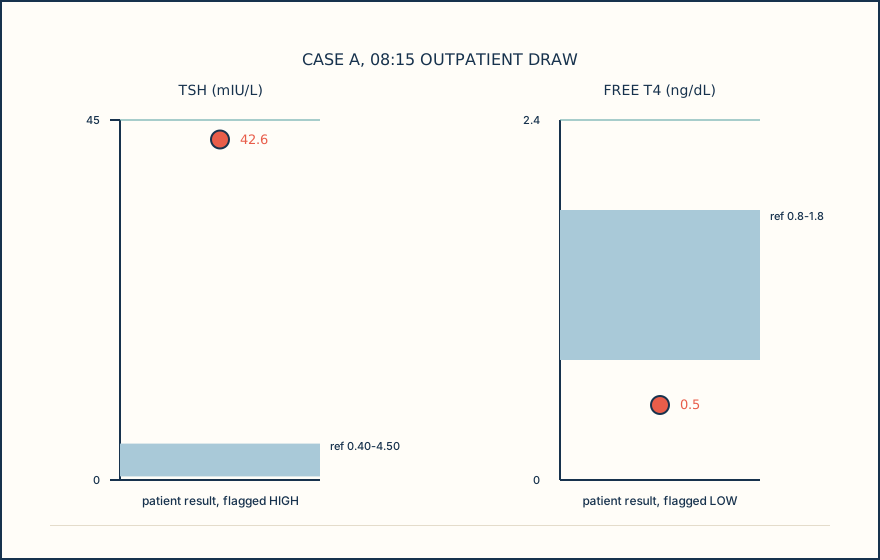
| Analyte | Result | This laboratory's reference interval | Flag | Collection time |
|---|---|---|---|---|
| TSH | 42.6 mIU/L | 0.40-4.50 mIU/L | High | 08:15, outpatient |
| Free T4 | 0.5 ng/dL | 0.8-1.8 ng/dL | Low | 08:15, outpatient (same draw) |
Knowledge checks
Reading and checks are open. Sign in only to save.
Knowledge check 1
Knowledge check 2
Section status
Finish this section
Reading and checks are open. Sign in only to save.
The module finishes after every required section is marked done and every check in those sections is correct.