Required section · Section 5 of 6
Learner decision: Case B, a pair that does not fit cleanly
A 61-year-old patient, admitted two days ago with sepsis, has a chemistry panel drawn at 03:40 from the intensive care unit. Nursing history notes the patient reports taking a high-dose biotin supplement, 10 mg daily, before admission.
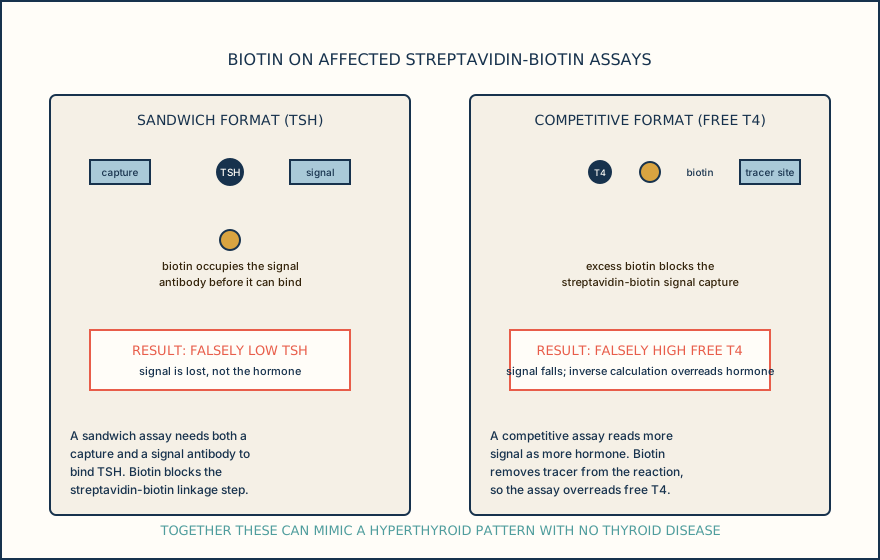
TSH releases at 0.31 mIU/L against a reference interval of 0.40 to 4.50 mIU/L, flagged low. Free T4 releases at 0.6 ng/dL against a reference interval of 0.8 to 1.8 ng/dL, flagged low. Neither value fits the clean primary pattern from Case A, and neither confounder in the history explains the whole picture by itself: on affected streptavidin-biotin assay systems, high-dose biotin can cause a falsely low TSH on a sandwich immunoassay and a falsely high free T4 on a competitive immunoassay, but this free T4 is low, the opposite of what biotin alone would produce. Acute illness (non-thyroidal illness syndrome) better explains a falling free T4 alongside a TSH that fails to rise, though it does not rule out some biotin contribution to the low TSH.
This is the moment to apply the loop rather than pattern-match by memory. Ask what the primary and central patterns would predict, note that low TSH with low free T4 formally reads as a central-direction pattern, and then ask what would have to be true, or checked, before trusting that reading given a specimen drawn overnight from an acutely ill patient with an unverified supplement history. Neither a clean primary nor a clean central conclusion is defensible yet.
Preferred reasoning: name the direction pattern (low stimulating hormone, low target hormone, formally central-direction), name the confounders most worth checking (acute illness context and the biotin history, since each explains part but not the whole picture, and a redraw after a biotin washout period would help separate them), and state explicitly that one isolated pair drawn under these conditions is not sufficient to localize the problem, let alone diagnose it. A response that jumps straight to a central hypothyroidism diagnosis, or that ignores the biotin and illness history entirely, is unsupported by what this specimen can show.
When a pair does not cleanly fit either expected direction, or when it does fit but was drawn under conditions known to distort the axis, the correct laboratory action is to identify the single most useful next piece of information, illness context, medication or supplement history, collection timing, or a repeat after resolving a known interference, rather than to force the pair into a diagnosis.
Illustrative drawing — this picture was drawn rather than captured.
| Analyte | Result | This laboratory's reference interval | Flag | Collection time |
|---|---|---|---|---|
| TSH | 0.31 mIU/L | 0.40-4.50 mIU/L | Low | 03:40, inpatient ICU |
| Free T4 | 0.6 ng/dL | 0.8-1.8 ng/dL | Low | 03:40, inpatient ICU (same draw) |
| History | Sepsis, hospital day 2; reports high-dose biotin supplement, 10 mg/day, before admission | - | - | - |
Ordering exercise
Case B's pair does not fit cleanly. Put these reasoning steps in the order a laboratory professional should work through them before reporting a conclusion forward.
1. Compare against the primary/central shape
Check whether the direction pair matches the primary-failure shape, the central-failure shape, or neither.
2. Identify the single most useful next step
Decide what one piece of information, a repeat, a free-hormone assay, a history detail, or a dynamic test, would most narrow the differential, rather than concluding from the pair alone.
3. Read both directions
Note whether the stimulating hormone and the target hormone are each high, low, or within interval.
4. Check timing, specimen, and history
Review collection time, specimen integrity, illness context, and medication/supplement history for anything that could distort either result.
Knowledge checks
Reading and checks are open. Sign in only to save.
Knowledge check 1
Knowledge check 2
Knowledge check 3
Section status
Finish this section
Reading and checks are open. Sign in only to save.
The module finishes after every required section is marked done and every check in those sections is correct.