Required section · Section 3 of 6
Why one estradiol number needs its context
A single total-estradiol result cannot be read against one fixed range. Reference intervals differ by cycle phase (early follicular versus midcycle versus luteal), by sex, by life stage (child, reproductive-age adult, postmenopausal adult), by pregnancy, and by exogenous hormone use, and they are method-specific: an immunoassay and an LC-MS/MS platform give different numeric intervals for the same population, even when both are performing correctly. Reference-laboratory catalogs show this spread, but any interval used at the bench must be the laboratory's own verified interval for its analyzer, reagent lot, and population, not a number copied from a catalog or a textbook.
This immunoassay has an LoD of 5 pg/mL and an LoQ of 25 pg/mL. Its week-4 and week-12 raw analyzer signals of 22 and 21 pg/mL, each reported with the validated below-LoQ qualifier, are below LoQ and require that qualifier rather than a precise released number. LC-MS/MS uses its own LoD, LoQ, and reporting rule.
Immunoassay antibodies also cross-react with structurally related estrogens and metabolites, including estrone, estriol, conjugated and glucuronidated estradiol species, ethinyl estradiol, and hydroxylated metabolites. A manufacturer method sheet for one widely used platform documents specific cross-reactivity percentages; one hydroxylated estradiol metabolite shows essentially full cross-reactivity in that assay. At low true estradiol concentrations, a cross-reacting compound present at high concentration in a given patient's serum can inflate the reported estradiol several-fold, which is exactly the mechanism behind a falsely flat, falsely reassuring low-range trend.
LC-MS/MS uses chromatographic separation before quantification, which gives materially better specificity and low-end sensitivity than direct immunoassay. It is the preferred method for men, postmenopausal women, children, and aromatase-inhibitor monitoring, but it is not infallible: it still depends on calibration, extraction recovery, matrix effects, and standardization, and even mass-spectrometric methods can struggle below about 5 pg/mL. Estradiol also circulates mostly protein-bound, to sex hormone-binding globulin (SHBG) with high affinity and to albumin with low affinity; calculated free or bioavailable estradiol has no well-established standardized reference ranges.
Two regulatory and accreditation frameworks explain why these numbers are verified rather than assumed. Under CLIA (42 CFR 493.1253), a laboratory using an unmodified FDA-cleared test system must verify the manufacturer's accuracy, precision, reportable range, and reference-interval appropriateness for its own patient population; a laboratory using a modified, non-cleared, or in-house method must establish the fuller set of performance specifications. CAP accreditation separately requires that the laboratory verify or establish its reference intervals for each analyte and specimen type; sound practice further partitions those intervals by clinically relevant factors such as sex, age, pregnancy, menopausal status, and cycle phase where relevant, with one common (not the only) approach being roughly an illustrative local verification example with no more than about 2 falling outside the interval.
Illustrative drawing — this picture was drawn rather than captured.
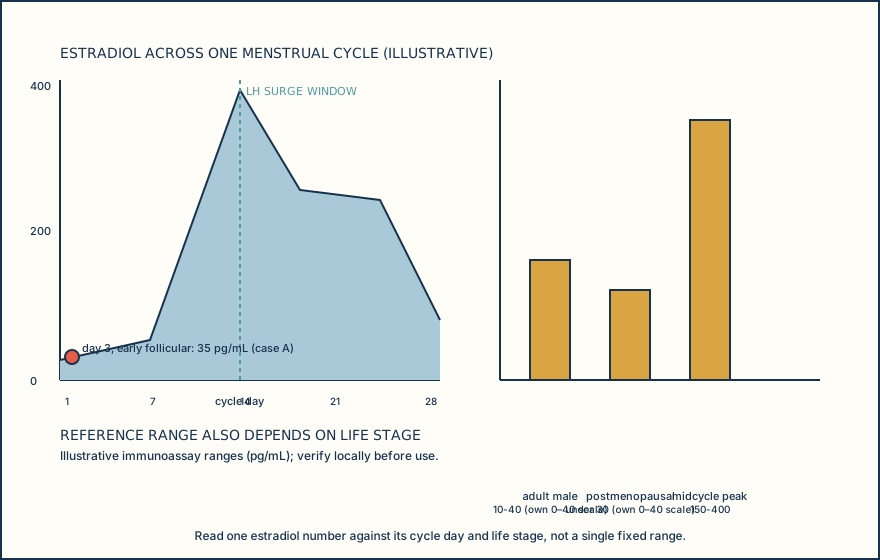
| Context | Estradiol range (pg/mL) | Method |
|---|---|---|
| Early follicular (cycle day 3) | About 20-60 | Immunoassay |
| Midcycle (LH surge window) | About 150-400 | Immunoassay |
| Adult male | About 10-40 | Immunoassay |
| Postmenopausal, untreated | Under about 30 | Immunoassay |
Knowledge checks
Reading and checks are open. Sign in only to save.
Knowledge check 1
Knowledge check 2
Knowledge check 3
Section status
Finish this section
Reading and checks are open. Sign in only to save.
The module finishes after every required section is marked done and every check in those sections is correct.