Required section · Section 2 of 6
What the HPG axis is doing when nothing is wrong
The hypothalamic-pituitary-gonadal (HPG) axis is a feedback loop, not a one-way signal. The hypothalamus releases gonadotropin-releasing hormone (GnRH) in pulses. Pulsatile GnRH drives the anterior pituitary to release follicle-stimulating hormone (FSH) and luteinizing hormone (LH); continuous, non-pulsatile GnRH exposure instead suppresses gonadotropin release, which is why GnRH agonist therapy can shut the axis down.
In the ovary, FSH and LH act on two different cell types in what is called the two-cell, two-gonadotropin model. LH drives theca cells to make androgen precursors; FSH drives granulosa cells to express aromatase, the enzyme that converts that androgen to estradiol. In the testis, LH drives Leydig cells to make testosterone, and Sertoli cells and peripheral tissue aromatize a fraction of that testosterone to estradiol; Sertoli-cell inhibin B selectively suppresses FSH. Adrenal cortex androgen precursors (DHEA, androstenedione) and peripheral adipose aromatase are additional estrogen sources, most relevant in postmenopausal women and in men.
Estradiol almost always feeds back to suppress the axis: rising estradiol turns down GnRH and FSH/LH. There is one important exception. A sustained high estradiol level in the late follicular phase flips the feedback from negative to positive for a short window, which triggers the LH surge that precedes ovulation. Outside that window, more estradiol means less GnRH, FSH, and LH; during that window, more estradiol means more LH.
Because FSH and LH drive estradiol production and estradiol feeds back onto FSH and LH, the three results are not independent. A laboratory professional reading an estradiol value in isolation, without its FSH/LH context, is reading one point of a loop and missing the rest of it. Read estradiol alongside FSH and LH, not as a standalone number, because the axis is a loop and the loop is the physiology being measured.
Illustrative drawing — this picture was drawn rather than captured.
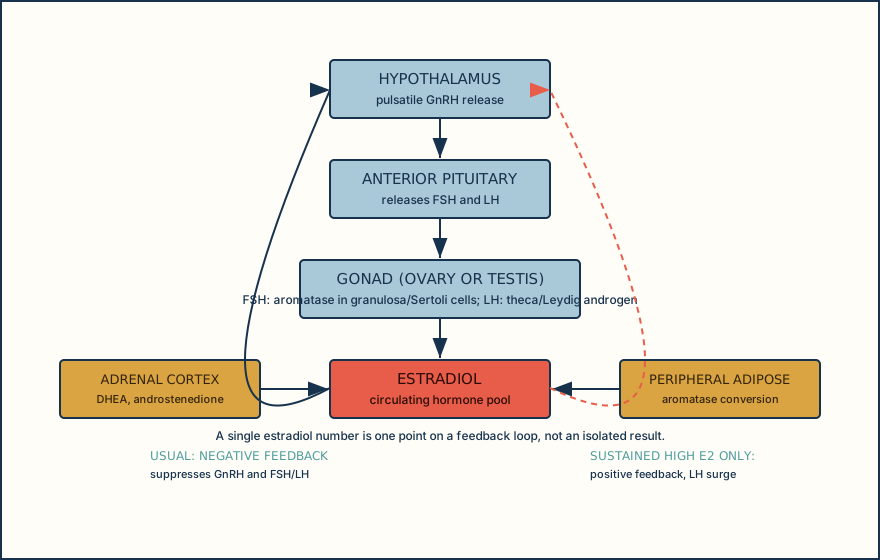
The HPG axis signal path from hypothalamus to circulating estradiol and back.
Pulsatile GnRH release
The hypothalamus releases GnRH in pulses; continuous exposure instead suppresses the axis.
Pituitary FSH and LH release
Pulsatile GnRH drives the anterior pituitary to release FSH and LH into circulation.
Gonadal estradiol production
FSH drives aromatase (granulosa or Sertoli cells); LH drives androgen precursor supply (theca or Leydig cells); together they yield estradiol.
Non-gonadal estrogen sources
Adrenal androgen precursors and peripheral adipose aromatase add estradiol outside the gonad, most relevant postmenopause and in men.
Feedback to hypothalamus and pituitary
Estradiol usually suppresses GnRH and FSH/LH; a sustained high estradiol level briefly reverses this to trigger the LH surge before ovulation.
Knowledge checks
Reading and checks are open. Sign in only to save.
Knowledge check 1
Knowledge check 2
Section status
Finish this section
Reading and checks are open. Sign in only to save.
The module finishes after every required section is marked done and every check in those sections is correct.