Required section · Section 1 of 6
The suppression that will not show up
A postmenopausal patient on aromatase-inhibitor therapy is followed with a serum estradiol every four weeks. The pretreatment immunoassay result was 30 pg/mL. At week 4 it produced a 22 pg/mL raw signal, reported with the validated below-LoQ qualifier. At week 12 it produced a 21 pg/mL raw signal, reported with the validated below-LoQ qualifier. On the face of it, the trend looks flat: a small early drop, then nothing. A clinician reading only these three numbers could reasonably ask whether the drug is doing its job.
Aromatase inhibitors work by blocking the peripheral conversion of androgen to estradiol, the same peripheral aromatization that supplies estrogen outside the ovary. In a postmenopausal patient with no ovarian production left, effective aromatase inhibition should drive true estradiol very low, often below what a routine immunoassay can measure with confidence. A flat line near 21 to 22 pg/mL is not obviously reassuring and not obviously alarming from the numbers alone.
The laboratory ran a send-out LC-MS/MS (liquid chromatography-tandem mass spectrometry) confirmation on the week 12 specimen. It came back at 6 pg/mL, well below the immunoassay's own limit of quantitation of 25 pg/mL for this reagent. The immunoassay was not tracking the true value at all in this range; it was reporting a floor created partly by cross-reacting compounds rather than by true estradiol.
Before reading a low estradiol trend as reassuring, check where the numbers sit relative to the assay's own limit of quantitation.
Illustrative drawing — this picture was drawn rather than captured.
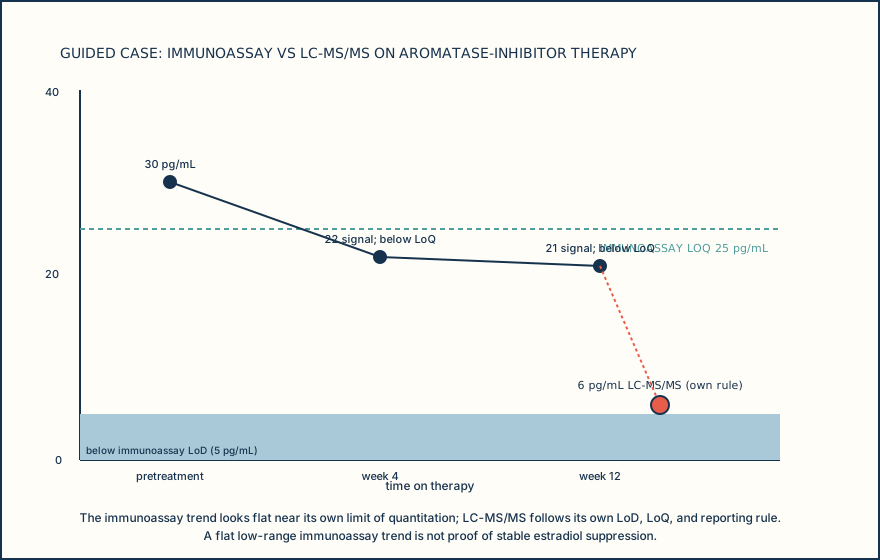
| Time point | Method | Analyzer signal or method result | Relative to immunoassay LOQ (25 pg/mL) |
|---|---|---|---|
| Pretreatment | Immunoassay | 30 (quantifiable) | Above LoQ; released as 30 pg/mL |
| Week 4 | Immunoassay | Raw signal 22; released with the validated below-LoQ qualifier | Below LoQ; not released or interpreted as a precise value |
| Week 12 | Immunoassay | Raw signal 21; released with the validated below-LoQ qualifier | Below LoQ; not released or interpreted as a precise value |
| Week 12 (same draw) | LC-MS/MS | 6 | Above immunoassay LoD (5 pg/mL) and below immunoassay LoQ (25 pg/mL); apply LC-MS/MS reporting rule |
Knowledge checks
Reading and checks are open. Sign in only to save.
Knowledge check 1
Section status
Finish this section
Reading and checks are open. Sign in only to save.
The module finishes after every required section is marked done and every check in those sections is correct.