Required section · Section 3 of 6
Four Tests, Four Failure Modes
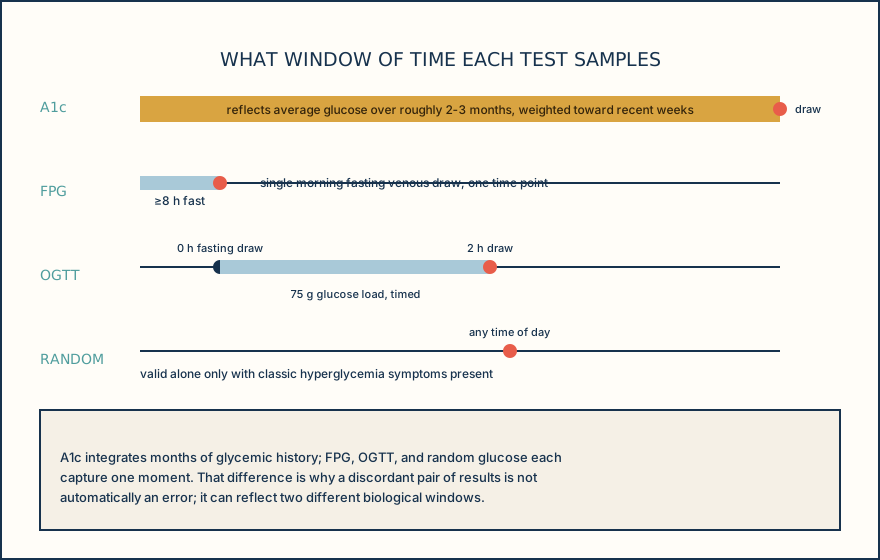
Fasting plasma glucose (FPG), the 2-hour oral glucose tolerance test (OGTT), random plasma glucose, and A1c each carry conditions under which the result should not be trusted at face value. FPG depends entirely on the fasting definition being met and on the specimen handling covered in the previous section; a delayed spin permits ongoing glycolysis and can lower glucose; it cannot raise it. Random glucose is only interpretable alone when classic hyperglycemia symptoms (polyuria, polydipsia, unexplained weight loss) are present; without them, a single random value above 200 mg/dL is a lead, not a diagnosis.
The OGTT diagnostic load for a nonpregnant adult is 75 g of anhydrous glucose in water, sampled fasting and again at 2 hours. Standard preparation calls for an unrestricted diet with at least 150 g of carbohydrate per day for at least 3 days beforehand, normal activity, then an overnight fast of commonly 8 to 14 hours (water only), with no smoking, eating, or unusual activity during the 2-hour window itself. Acute illness, an unreported medication change, or a break in the timed collection or fasting instructions can invalidate the result; the ordering clinician's and laboratory's specific instructions govern the exact preparation used, and a worksheet documenting timing is part of the record, not paperwork. For this illustrative local protocol, stop the OGTT and do not interpret the timed result if the participant eats, smokes, exercises unusually, becomes acutely ill, or cannot complete the specified timed collection; follow the local protocol for disposition.
A1c for diagnosis must be measured by a method that is NGSP-certified and standardized to the DCCT reference; that certification establishes analytical traceability and comparability, but it does not by itself rule out interference from a given hemoglobin variant or clinical condition. Conditions that shorten red-cell survival, such as hemolysis or recent significant blood loss, tend to produce a falsely low A1c regardless of assay method, because the circulating cells have had less time to glycate. Conditions that prolong red-cell survival or reduce turnover can push A1c falsely high; direction and magnitude are disease- and assay-dependent. Hemoglobin variant interference is both variant- and method-specific: ion-exchange HPLC may show a variant on the chromatogram while still misreporting the value, and immunoassay interference may generate no visible flag at all. In homozygous or compound hemoglobinopathies with little or no HbA, such as HbSS, HbCC, or HbSC, A1c may be uninterpretable and should not be reported; some laboratories use glycated albumin or fructosamine instead, each with its own reference interval that is a local decision.
Point-of-care capillary glucose sits outside the diagnostic role entirely. CLSI POCT12 governs point-of-care blood-glucose monitoring program management in laboratory-supported acute- and chronic-care facilities, and it explicitly excludes patient self-monitoring, diabetes screening, and diagnosis of diabetes from its scope. FDA-cleared meter labeling commonly states the device is not intended for diagnosis or screening. Under CLIA, a waived glucose meter used per its FDA-cleared instructions is waived testing (42 CFR 493.15); used off-label, for example on an unapproved specimen type or population, it is treated as modified and regulated as high-complexity testing instead. Abnormal hematocrit and critical illness (dehydration, shock, diabetic ketoacidosis) are recognized sources of point-of-care bias, and the magnitude is device-specific, found in that meter's own labeling.
Before treating any glucose or A1c value as diagnostic-grade, confirm it came from a method validated for that role, on a specimen collected the way that method requires.
Illustrative drawing — this picture was drawn rather than captured.
| Test | Diabetes | Prediabetes | Normal |
|---|---|---|---|
| A1c | ≥6.5% | 5.7-6.4% | <5.7% |
| Fasting plasma glucose | ≥126 mg/dL | 100-125 mg/dL | <100 mg/dL |
| 2-h OGTT (75-g load) | ≥200 mg/dL | 140-199 mg/dL | <140 mg/dL |
| Random glucose + symptoms | ≥200 mg/dL | not applicable | not applicable |
Ordering exercise
A patient is scheduled for a diagnostic 75-g OGTT. Put the required steps in the order they must occur for the result to be interpretable.
1. Draw the 2-hour plasma glucose
The second of the two timed values compared against the OGTT criteria on the card.
2. Administer the 75 g anhydrous glucose load
Starts the timed 2-hour window; timing begins at the start of ingestion.
3. Unrestricted diet, at least 150 g carbohydrate per day, for 3 days beforehand
Prevents a false impression of impaired tolerance from short-term carbohydrate restriction.
4. Hold the patient seated, no smoking, eating, or unusual activity for 2 hours
Activity or intake during the window can alter the glucose curve and invalidate the timed result.
5. Overnight fast, commonly 8 to 14 hours, water only
Establishes the fasting baseline the 0-hour draw depends on.
6. Draw the fasting (0-hour) plasma glucose
Sets the baseline value and confirms the patient is an appropriate candidate to continue.
Knowledge checks
Reading and checks are open. Sign in only to save.
Knowledge check 1
Knowledge check 2
Section status
Finish this section
Reading and checks are open. Sign in only to save.
The module finishes after every required section is marked done and every check in those sections is correct.