Required section · Section 3 of 6
Formation and resorption markers, and what moves them
The International Osteoporosis Foundation and International Federation of Clinical Chemistry (IOF-IFCC) designated serum total P1NP (procollagen type I N-terminal propeptide) as the reference bone-formation marker and serum beta-CTX-I as the reference bone-resorption marker; the 2025 ESCEO-IOF-IFCC consensus reaffirmed that pairing. P1NP reflects type I collagen synthesis by osteoblasts; beta-CTX reflects collagen breakdown released during osteoclast-mediated resorption. Both are markers of remodeling activity and rate, not measurements of bone density or bone strength. Designating them as reference markers standardizes which analytes get measured across studies and laboratories; it does not create one universal reference interval, because intervals still vary by assay, sex, age, and menopausal status.
Bone-specific alkaline phosphatase (BSAP, sometimes BALP) is the osteoblast-derived isoform of ALP and functions as a formation marker; it does not measure resorption. BSAP is particularly useful when liver disease could confound a total ALP result, and in chronic kidney disease-mineral bone disorder (CKD-MBD), where a markedly high or low BSAP helps characterize the underlying turnover state. Neither total ALP nor BSAP is a diagnostic test for osteoporosis, and a normal result does not exclude low bone mass or fracture risk.
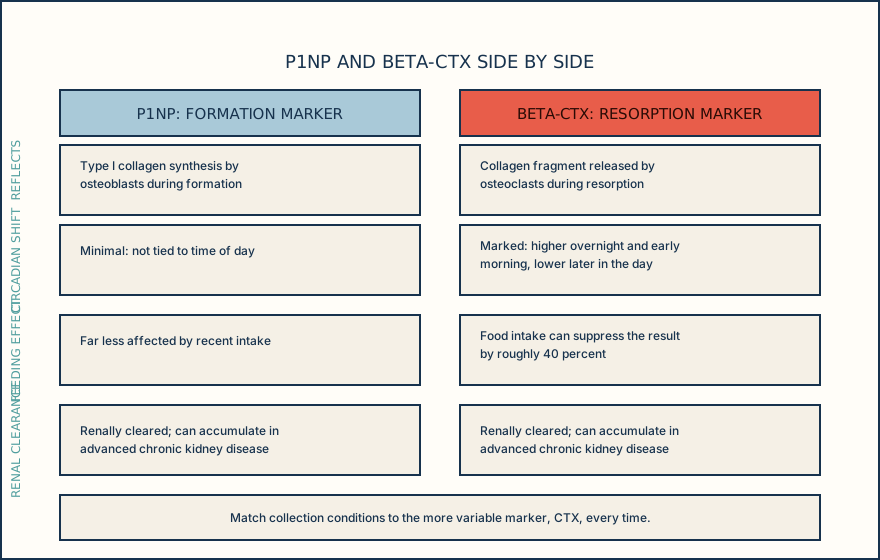
Biological variation is the reason these two markers behave so differently in practice. Beta-CTX has marked circadian variation, running higher overnight and in the early morning and lower later in the day, and food intake can suppress it by roughly 40 percent. The consensus-recommended collection window for beta-CTX is an overnight fast, commonly 8 to 12 hours, with venipuncture in the morning, approximately 7:30 to 10:00 AM. P1NP is far less affected by recent food intake and time of day; measured alone it does not require a fasting morning draw, though a standardized fasting morning sample is commonly used when both markers are ordered together for consistency.
Two other variables change how a turnover marker should be read. Recent fracture elevates both P1NP and CTX for an extended period; in fracture-healing cohorts, markers commonly peak around 2 to 6 months after the fracture and can remain mildly elevated out to about 12 months, so a result drawn in that window reflects healing, not baseline turnover. Acute exercise can shift results within hours of the activity, while regular training over weeks to months has smaller, less predictable, direction-mixed effects compared with fracture healing. Renal impairment complicates interpretation because total P1NP and beta-CTX-I are cleared renally and can accumulate in chronic kidney disease, especially advanced disease; BSAP, intact P1NP, or TRACP-5b may be considered as alternatives in that setting.
The 2024 Endocrine Society guideline on vitamin D for disease prevention no longer endorses a universal target 25(OH)D level of 30 ng/mL or fixed sufficiency and deficiency cutoffs for generally healthy people, and it recommends against routine 25(OH)D testing in that population. That recommendation does not govern populations with an established indication for testing, such as documented metabolic bone disease, malabsorption, or abnormal calcium, so 25(OH)D testing inside a secondary-cause bone workup falls outside the against-routine-testing recommendation. 25(OH)D is the analyte used to assess vitamin D stores; it is one input into the secondary-cause evaluation, not a bone-turnover marker and not a standalone screen with a universal cutoff.
Illustrative drawing — this picture was drawn rather than captured.
| Marker | Premenopausal interval | Postmenopausal interval | Units |
|---|---|---|---|
| Total P1NP | 15.13-58.59 | 16.27-73.87 | ng/mL |
| Beta-CTX (beta-CrossLaps/serum) | 0.136-0.689 | 0.177-1.015 | ng/mL |
Knowledge checks
Reading and checks are open. Sign in only to save.
Knowledge check 1
Knowledge check 2
Section status
Finish this section
Reading and checks are open. Sign in only to save.
The module finishes after every required section is marked done and every check in those sections is correct.