Required section · Section 5 of 6
Deciding what the follow-up result can say
Twelve weeks after starting therapy, a follow-up beta-CTX is drawn non-fasting at 3:40 PM at an outside laboratory on a different immunoassay platform: 0.22 ng/mL, against a baseline of 0.61 ng/mL. Numerically that looks like a large drop. Before accepting it as a treatment response, walk the same checks used to build the baseline: same laboratory, same platform, matched fasting and time-of-day, and no unaccounted confounder between the two draws.
This pair fails more than one of those checks at once. The draw time moved outside the fasting morning window, so circadian variation and the roughly 40 percent feeding suppression are now both in play in a direction that would lower the number regardless of any treatment effect. The assay platform changed, and reported P1NP and CTX intervals differ meaningfully across manufacturers and assay generations, so a raw number from one platform is not directly comparable to a raw number from another without assay-specific validation. On top of that, the patient sustained a wrist fracture six weeks after starting therapy; fracture healing independently elevates turnover markers for months, and by week 12 that healing signal is mixed into whatever treatment effect is present.
Even when two results do come from the same laboratory, same platform, and matched conditions, a numeric difference is not automatically a true change. It should not be called a true change unless it exceeds the assay- and population-specific least significant change (LSC), roughly 2.33 times the within-person coefficient of variation for a one-sided, known-direction comparison; commonly cited legacy monitoring LSC magnitudes run approximately 40 to 56 percent for CTX and 30 to 40 percent for P1NP, with the laboratory's own validated value taking precedence over any cited figure. In this case the comparability failures come first: a draw that changed timing, platform, and clinical context at the same time cannot be salvaged by an LSC calculation, because the LSC is only valid for two results that were otherwise collected the same way.
The defensible laboratory statement is that this pair of results cannot be used to conclude a treatment response. A valid comparison needs a repeat fasting morning draw on the same platform at the same laboratory, ideally deferred until fracture-healing turnover has had time to settle, and then interpreted against the laboratory's own LSC, not the raw percentage difference. Rule out a preanalytical or method explanation for a striking serial change before you let it change the clinical story.
Illustrative drawing — this picture was drawn rather than captured.
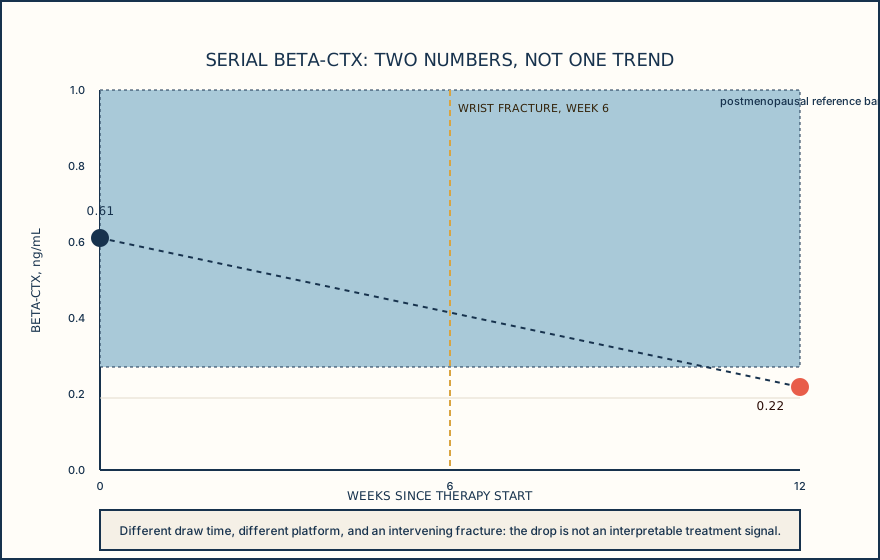
| Variable | Baseline draw | Follow-up draw |
|---|---|---|
| Time since therapy start | Week 0 | Week 12 |
| Collection time | 8:15 AM | 3:40 PM |
| Fasting status | Fasting | Non-fasting |
| Laboratory / platform | Same lab, Elecsys platform | Outside lab, different platform |
| Intervening event | None | Wrist fracture at week 6 |
| Result | 0.61 ng/mL | 0.22 ng/mL |
Ordering exercise
Before trusting a percentage change between two serial beta-CTX results, put these checks in the order a laboratory scientist should work through them.
1. Apply the laboratory's least significant change
Only after method and conditions are confirmed matched does a percentage difference get compared against the validated LSC.
2. Screen for confounders such as recent fracture
Fracture healing, and to a lesser extent exercise, can shift turnover markers independent of treatment.
3. Confirm same laboratory and same assay platform
Reference intervals and raw values differ meaningfully across manufacturers and assay generations, so this comes first.
4. Confirm matched fasting status and draw-time window
CTX has marked circadian variation and a feeding effect; timing has to match before the numbers are comparable.
Knowledge checks
Reading and checks are open. Sign in only to save.
Knowledge check 1
Knowledge check 2
Section status
Finish this section
Reading and checks are open. Sign in only to save.
The module finishes after every required section is marked done and every check in those sections is correct.