Required section · Section 4 of 6
Working the baseline panel
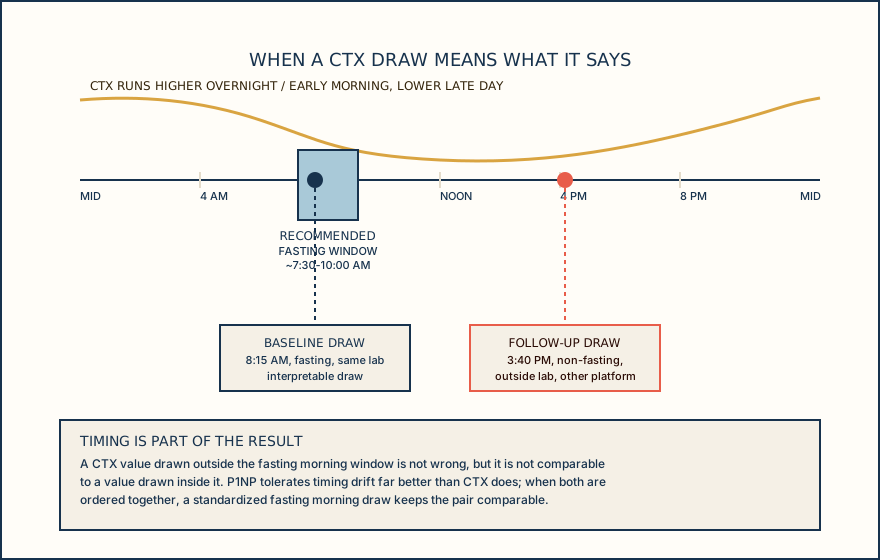
Return to the case. The patient's baseline panel is drawn fasting at 8:15 AM, inside the recommended morning collection window, at the same laboratory that will perform the follow-up testing on the same immunoassay platform (electrochemiluminescence immunoassay, Roche Elecsys/cobas family, Elecsys Total P1NP and Elecsys beta-CrossLaps/serum reagents in this example). That timing and method detail is not incidental; it is what makes the baseline usable for a future comparison.
The secondary-cause screen is unremarkable. Calcium is 9.4 mg/dL, phosphate 3.6 mg/dL, creatinine 0.8 mg/dL with an eGFR of 85 mL/min/1.73m2, TSH 2.1 mIU/L, intact PTH 38 pg/mL, and total ALP 72 U/L, all within or near their reference intervals. 25(OH)D is 24 ng/mL, an input to the workup rather than a pass/fail cutoff, since this patient has an established indication (a T-score in the osteoporosis range) that puts her outside the 2024 Endocrine Society against-routine-testing recommendation. Nothing here points to a secondary cause; the bone loss is being managed as primary postmenopausal osteoporosis.
The turnover markers sit inside their reference intervals: beta-CTX 0.61 ng/mL and P1NP 52 ng/mL, both read against the postmenopausal columns of this platform's manufacturer method sheet. Reported P1NP and CTX reference intervals differ meaningfully across assay generations and manufacturers for the same analyte name; that is a direct illustration of the standardization limitation described earlier, and it is one more reason a laboratory reports its own validated interval rather than a number pulled from a textbook or a different platform's package insert.
Before either marker is trusted, the specimen itself has to pass general integrity checks: correct identification and labeling, no hemolysis or clotting, no short fill, and timely, temperature-controlled processing and separation, per CLSI PRE04 general preexamination requirements for blood specimens. CLSI PRE04 explicitly defers to the manufacturer's instructions for analyte-specific stability and storage limits, so a laboratory's rejection and stability criteria for a CTX or P1NP order are built from both documents together, not from CLSI PRE04 alone. A valid baseline is a baseline drawn at the right time, on the right platform, on an acceptable specimen, all three, not any one of them.
Illustrative drawing — this picture was drawn rather than captured.
| Test | Result | Unit | Note |
|---|---|---|---|
| Calcium | 9.4 | mg/dL | within reference |
| Phosphate | 3.6 | mg/dL | within reference |
| Creatinine (eGFR) | 0.8 (eGFR 85) | mg/dL (mL/min/1.73m2) | normal renal function |
| TSH | 2.1 | mIU/L | within reference |
| Intact PTH | 38 | pg/mL | within reference |
| 25-hydroxyvitamin D | 24 | ng/mL | context, not a pass/fail cutoff |
| Total ALP | 72 | U/L | within reference, no source-narrowing needed |
| Beta-CTX | 0.61 | ng/mL | within postmenopausal reference interval |
| P1NP | 52 | ng/mL | within postmenopausal reference interval |
Knowledge checks
Reading and checks are open. Sign in only to save.
Knowledge check 1
Section status
Finish this section
Reading and checks are open. Sign in only to save.
The module finishes after every required section is marked done and every check in those sections is correct.