Required section · Section 3 of 6
Variables that change how a troponin result should be read
Sampling algorithms turn the acute-versus-chronic question into a protocol. The 2023 European Society of Cardiology (ESC) guideline for acute coronary syndromes recommends a 0h/1h hs-cTn algorithm as the preferred rapid rule-out or rule-in strategy, with a 0h/2h algorithm as an alternative when a one-hour second draw is not feasible. Both algorithms sort a patient into a rule-out, observe, or rule-in zone using two assay-specific numbers: a baseline (0h) cutoff and an absolute-change (delta) cutoff measured at the second draw.
Those cutoffs are not interchangeable between manufacturers and are not interchangeable between troponin I and troponin T. The 0h and 1h (or 2h) labels refer to blood-draw times, not to when the result becomes available, and the one-hour window is approximately 60 plus or minus 10 minutes from the first draw. A patient who lands in the observe zone generally needs an additional sample at approximately 3 hours, particularly a very early presenter or a patient with recurrent symptoms. A second specimen collected outside the validated 60 ±10 minute window cannot use the 1-hour delta cutoff; follow the local alternative or repeat-sampling path instead.
For the Roche Elecsys hs-cTnT assay specifically, the ESC 0h/1h table permits the very-low baseline rule-out of under 5 ng/L only when symptom onset was more than 3 hours before presentation. Earlier presenters need the delta/observation path. The same table uses a low baseline of under 12 ng/L paired with a 1-hour delta under 3 ng/L for rule-out; baseline at or above 52 ng/L or a 1-hour delta at or above 5 ng/L is rule-in. The 0h/2h table for the same assay lists a low baseline under 14 ng/L with a 2-hour delta under 4 ng/L for rule-out, and the same 52 ng/L baseline or a 2-hour delta at or above 10 ng/L for rule-in.
These algorithms are meant to be read together with the clinical presentation and a 12-lead ECG. They are not intended for isolated or indiscriminate use in patients whose troponin may rise from a nonischemic cause, such as sepsis or stroke, where an injury pattern can appear without an acute coronary event.
Assay identity matters beyond the sampling algorithm. The FDA-cleared Elecsys Troponin T Gen 5 STAT assay reports an overall URL of 19 ng/L with sex-specific limits of 14 ng/L in women and 22 ng/L in men in its US labeling. Sex-specific reporting is adopted by some hs-cTn methods but is not universal across all cleared assays, so whether a given laboratory's method reports a sex-specific limit is a local, method-specific fact to confirm before interpreting a borderline result.
A newer Roche platform, the Elecsys Troponin T hs Gen 6 assay, reports different 99th-percentile values than Gen 5 STAT. A generation change on the same manufacturer's platform changes the decision limit and invalidates a historical trend comparison across the generation boundary unless the laboratory has a bridging or comment practice in place.
Chronic kidney disease (CKD) or renal failure, heart failure, tachyarrhythmia, shock, anemia, and hypoxemia are nonischemic contexts for troponin elevation. Chronic elevations vary by CKD population, dialysis status, and assay; a stable elevation is chronic myocardial injury, not elevation without injury.
Proposed mechanisms include impaired clearance of smaller troponin fragments, uremia-related cardiomyocyte injury, dialysis-related myocardial stunning, and subclinical microinfarction, with no single mechanism established as sufficient. Current literature treats this elevation primarily as a real marker of myocardial injury, not as an assay artifact, which is why a chronic, stable elevation in a CKD patient still needs an explanation rather than automatic dismissal.
Specimen quality and interference change whether a number can be trusted at all. Hemolysis can bias a troponin result in an assay-dependent direction and magnitude, and there is no single universal hemolysis rejection threshold for hs-cTn; the acceptable hemolysis-index limit must come from the specific method's current manufacturer instructions for use. A specimen flagged for hemolysis beyond that validated limit should not be reported numerically.
Policy should call for recollection rather than a mathematical correction, especially when the patient is being evaluated for possible acute coronary syndrome or the result sits near a decision limit. CLSI (Clinical and Laboratory Standards Institute) EP07, third edition, is the current framework for designing interference studies and investigating a discrepant patient result; it covers exogenous interferents such as drugs and endogenous interferents such as bilirubin, lipids, and hemoglobin, but it explicitly excludes physiological effects such as pregnancy or diurnal variation.
Before you act on a troponin trend, confirm which assay generation produced every value, which sampling algorithm and cutoff table your medical staff has adopted, and whether the specimen met the method's hemolysis limit.
Illustrative drawing — this picture was drawn rather than captured.
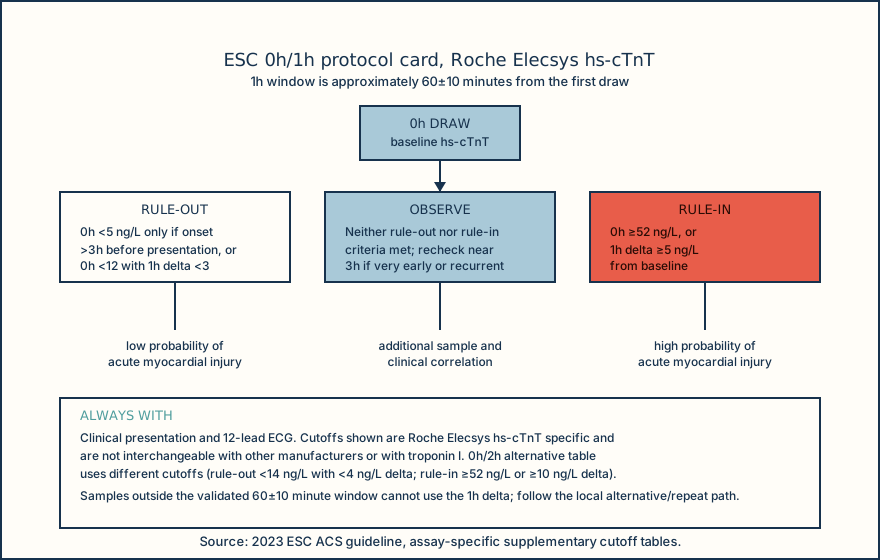
| Algorithm | Rule-out | Observe | Rule-in |
|---|---|---|---|
| 0h/1h | 0h <5 only if symptom onset >3h before presentation, or 0h <12 with 1h delta <3 | Neither rule-out nor rule-in criteria met; earlier presenters use delta/observation path | 0h ≥52, or 1h delta ≥5 |
| 0h/2h | 0h <14 with 2h delta <4 | Neither rule-out nor rule-in criteria met | 0h ≥52, or 2h delta ≥10 |
| Assay | Women | Men | Overall |
|---|---|---|---|
| Gen 5 STAT (FDA labeling, K162895) | 14 | 22 | 19 |
| Gen 6 | 18 | 32 | 27 |
Structured workup for a discordant troponin result suspected of interference
Review the pattern
Compare the result against the clinical picture and the serial kinetics; a value that will not move with expected biology is the first clue.
Test an alternate platform
Repeat the measurement on a different troponin assay or platform to see whether the elevation is method-dependent.
Treat with a blocking reagent
Treat an aliquot with a validated heterophile-blocking reagent; a meaningful drop supports heterophilic-antibody interference.
Check dilution recovery
Assess recovery after serial dilution of the specimen to look for nonlinearity consistent with a large interfering complex.
Run PEG precipitation with a control
Perform polyethylene glycol (PEG) precipitation against a parallel control; marked signal loss supports an immunoglobulin-associated complex such as macrotroponin but is a screening step, not a stand-alone confirmatory test.
Knowledge checks
Reading and checks are open. Sign in only to save.
Knowledge check 1
Knowledge check 2
Section status
Finish this section
Reading and checks are open. Sign in only to save.
The module finishes after every required section is marked done and every check in those sections is correct.