Required section · Section 4 of 6
Guided example: reading the serial result
Return to the case from the opening problem. The patient is an adult presenting to the emergency department with chest discomfort, described only as female for the purpose of anchoring the sex-specific URL, with no other identifying detail. The declared method is the Roche Elecsys Troponin T hs STAT assay, reported in ng/L, with a female URL of 14 ng/L, a male URL of 22 ng/L, and an overall URL of 19 ng/L. The medical staff has adopted the ESC 0h/1h algorithm for this patient population.
The first draw (0h) is collected at 09:02 and results at 18 ng/L. That value is above the female URL of 14 ng/L, so myocardial injury is present by definition. It is not, by itself, low enough to rule out (it exceeds both the very-low and low 0h/1h thresholds) and it is not yet at the rule-in baseline of 52 ng/L, so the 0h value alone places the patient in a zone that requires the 1-hour delta before it can be classified.
The second draw (1h) is collected within the guideline window, at 10:01, 59 minutes after the first draw, and results at 26 ng/L. The absolute delta is 26 minus 18, or +8 ng/L. That delta exceeds the assay's ESC rule-in delta of 5 ng/L or more, so the pattern now meets the rule-in criterion. Combined with the 0h value already above the URL, this satisfies the Fourth Universal Definition's description of acute myocardial injury: a rise in troponin with at least one value above the 99th percentile.
Per local protocol for an observe-zone or very-early presentation, a third, confirmatory draw is collected at 12:00 and results at 31 ng/L, continuing the rise. The case narrative states plainly what the laboratory data supports and what it does not: this pattern indicates myocardial injury with a rise consistent with an acute process.
A final classification as myocardial infarction requires clinical correlation, meaning symptoms, ECG changes, or imaging evidence of new loss of viable myocardium, that sits outside laboratory data alone. The absolute delta was the right calculation choice here because both values are low relative to the URL; the IFCC/AACC guidance notes that absolute (ng/L) deltas are generally preferred at low concentrations, while relative (percent) change may be more informative at higher concentrations, and any delta is only interpretable when both values come from the same assay in the same patient.
The 1-hour delta, not the first number, is what moved this case from an ambiguous result to a defensible rule-in classification.
Illustrative drawing — this picture was drawn rather than captured.
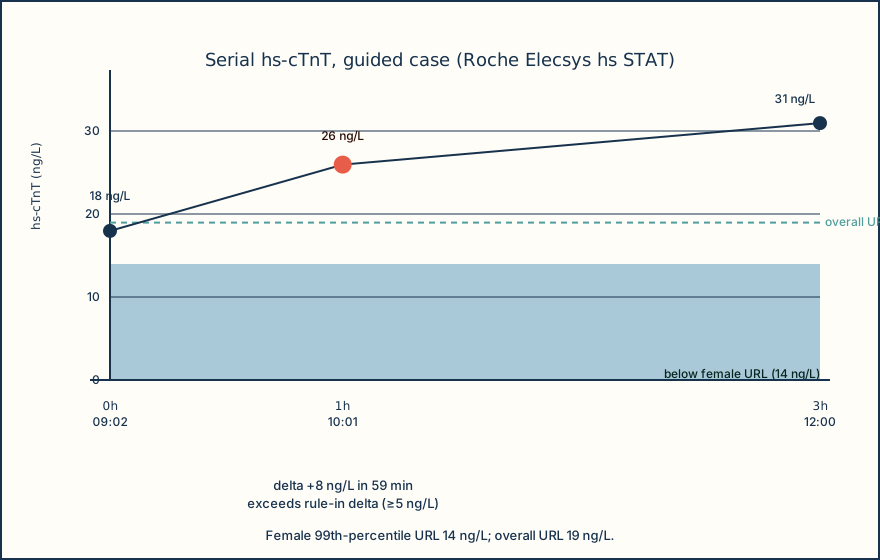
| Draw | Collection time | hs-cTnT (ng/L) | Flag vs female URL (14 ng/L) | ESC 0h/1h zone |
|---|---|---|---|---|
| 0h | 09:02 | 18 | Above URL | Neither rule-out nor rule-in; evaluate with 1h delta |
| 1h (window 60±10 min) | 10:01 | 26 | Above URL | Delta +8 ng/L exceeds rule-in delta of ≥5 ng/L |
| 3h confirmatory | 12:00 | 31 | Above URL | Continued rise, consistent with acute injury pattern |
Ordering exercise
Put the steps of evaluating this patient's ESC 0h/1h result in the order they actually happen at the bench.
1. Classify the patient into rule-out, observe, or rule-in
A delta of +8 ng/L exceeds the ≥5 ng/L rule-in threshold, so the patient is rule-in.
2. Collect the 0h specimen
Baseline draw at 09:02.
3. Correlate with symptoms, ECG, and imaging
Laboratory injury classification is combined with clinical evidence before any infarction diagnosis is made.
4. Calculate the absolute delta between 0h and 1h
26 minus 18 equals +8 ng/L.
5. Collect the 1h specimen within the guideline window
Second draw at 10:01, 59 minutes after the first.
6. Evaluate the 0h value against the baseline cutoffs
18 ng/L is above the URL but not low enough to rule out and not at the 52 ng/L rule-in baseline.
Knowledge checks
Reading and checks are open. Sign in only to save.
Knowledge check 1
Knowledge check 2
Section status
Finish this section
Reading and checks are open. Sign in only to save.
The module finishes after every required section is marked done and every check in those sections is correct.