Required section · Section 2 of 6
What a troponin result is actually measuring
Cardiac troponin I and troponin T are structural proteins built into the sarcomere, the contractile unit of the cardiomyocyte. Only a small fraction circulates free in the cytoplasm at any moment; most of the protein stays bound to the contractile apparatus. When a cardiomyocyte is injured badly enough that its membrane integrity fails, that small cytoplasmic pool leaks into the bloodstream first, and continued or worsening injury releases the structurally bound pool as well. The assay measures whatever troponin is circulating in the specimen at the moment of the draw. It does not directly measure how much muscle was damaged, how long ago the damage started, or whether the damage is ongoing; those are inferences drawn from the pattern of results over time.
High-sensitivity troponin (hs-cTn) assays are not a different biology from earlier-generation assays. They are defined by analytical performance: the ability to measure the analyte, with acceptable imprecision, in most clinically healthy people. A method earns the high-sensitivity label when it holds imprecision at or below 10% coefficient of variation (CV) at its own 99th-percentile URL, a quality target set by the IFCC (International Federation of Clinical Chemistry) and AACC (Academy of the American Association for Clinical Chemistry) task force on cardiac biomarkers. That precision is what lets a laboratory distinguish a real change between two draws from assay noise.
The 99th-percentile URL is the line the Fourth Universal Definition of Myocardial Infarction uses to define myocardial injury: at least one troponin value above that assay-specific URL. The URL itself is not a universal number. It comes from each manufacturer's own validated reference population study and differs between methods, between troponin I and troponin T, and sometimes between generations of the same manufacturer's platform. A value that is high on one assay can be unremarkable on another, so a URL is only meaningful attached to the method that produced it.
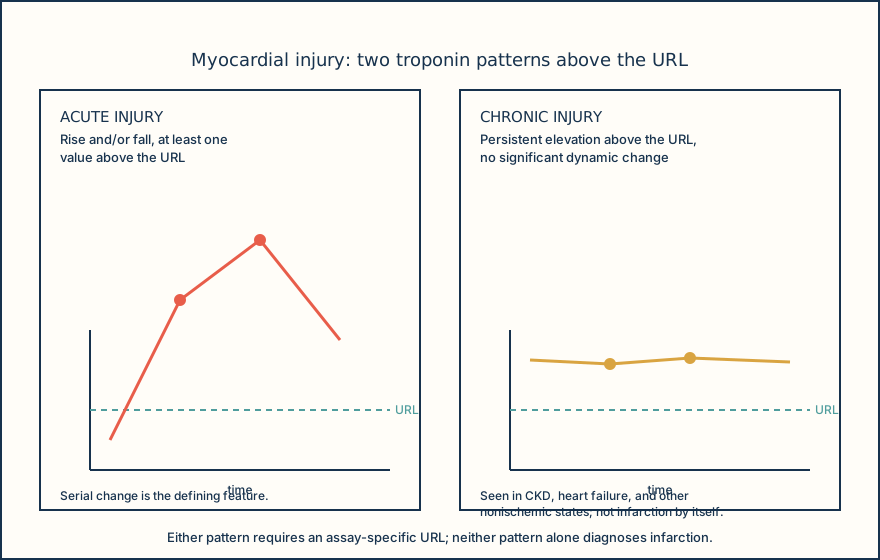
The same consensus definition separates two patterns of injury once the URL is crossed. Acute myocardial injury shows a rise and/or fall in serial troponin with at least one value above the 99th percentile. Chronic myocardial injury shows a persistent elevation above the URL without a significant dynamic change between draws. The pattern, not the first number, is what tells you whether something is actively happening or has been present for a while. That is why serial results, not a single result, separate acute from chronic injury.
Read troponin as a marker of myocyte injury with a method-specific decision line, not as a direct measurement of infarct size or a stand-alone diagnosis.
Illustrative drawing — this picture was drawn rather than captured.
Knowledge checks
Reading and checks are open. Sign in only to save.
Knowledge check 1
Section status
Finish this section
Reading and checks are open. Sign in only to save.
The module finishes after every required section is marked done and every check in those sections is correct.