Required section · Section 2 of 6
Three oxygen quantities, one transport model
PaO2 is the partial pressure of dissolved oxygen in arterial plasma, reported in mmHg. SaO2 or sO2 describes hemoglobin saturation, while FO2Hb is fractional oxyhemoglobin among total hemoglobin including dyshemoglobins. CaO2 is arterial oxygen content in mL O2 per dL blood. They are related but are not interchangeable.
Most arterial oxygen is bound to hemoglobin, not dissolved in plasma. Using the declared clinical constant, CaO2 equals 1.34 times hemoglobin in g/dL times saturation as a fraction, plus 0.003 times PaO2 in mmHg. The 1.34 constant is empirical; some references use 1.39 as theoretical capacity, so the constant must be named. At similar PaO2 and saturation, anemia lowers CaO2 and polycythemia raises it.
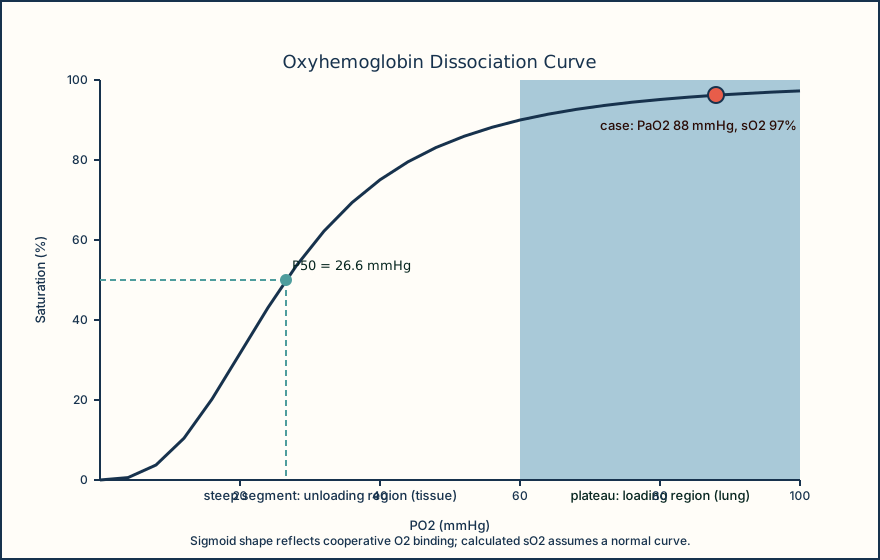
The dissociation curve is sigmoid because oxygen binding is cooperative. P50 is the PO2 at 50% saturation and is approximately 26 to 27 mmHg in normal adult blood. The plateau from roughly 60 to 100 mmHg preserves high saturation as PO2 falls, while the steep 20 to 60 mmHg region supports tissue unloading. For oxygen content, calculate with the reported hemoglobin and method-labeled saturation rather than inferring from SpO2.
Illustrative drawing — this picture was drawn rather than captured.
Use this sequence to separate pressure, saturation, and content.
Identify method and convention
Determine whether saturation is calculated, pulse-ox estimated, functional sO2, or fractional FO2Hb.
Read PaO2 separately
Treat oxygen tension as dissolved oxygen pressure, not total oxygen content.
Calculate or assess CaO2
Use hemoglobin, a fraction saturation, PaO2, and the stated 1.34 clinical constant.
Check fractions when needed
Use co-oximetry when dyshemoglobin or a discordant reading is plausible.
Knowledge checks
Reading and checks are open. Sign in only to save.
Knowledge check 1
Knowledge check 2
Section status
Finish this section
Reading and checks are open. Sign in only to save.
The module finishes after every required section is marked done and every check in those sections is correct.