Required section · Section 2 of 6
Read each signal on its own clock
Lactate is a marker that can reflect impaired perfusion but can also rise with adrenergic stimulation, seizure, liver dysfunction, or some medications. A normal lactate does not exclude sepsis, and an elevated lactate does not prove it. Septic shock requires vasopressors for mean arterial pressure of at least 65 mmHg plus lactate above 2 mmol/L despite adequate volume resuscitation, without hypovolemia explaining it.
Procalcitonin, abbreviated PCT, rises about 2 to 4 hours after bacterial or systemic inflammatory stimulus and commonly peaks around 24 to 48 hours. It can fall by about 50 percent per day when the stimulus is controlled, but renal impairment can raise and prolong it. PCT bands on a particular assay are risk stratification, not a diagnosis.
C-reactive protein, abbreviated CRP, is an acute-phase reactant driven mainly by hepatic production. It rises and falls more slowly than the early lactate trend. An early or isolated CRP is nonspecific, and lack of a CRP decline two hours after treatment cannot show failed response.
The useful model is signal, clock, and context. Ask what the method measures, when the specimen was collected, and whether a change is biologically plausible over that interval. A discordant early CRP and lactate trend may be expected kinetics, not a laboratory conflict.
Illustrative drawing — this picture was drawn rather than captured.
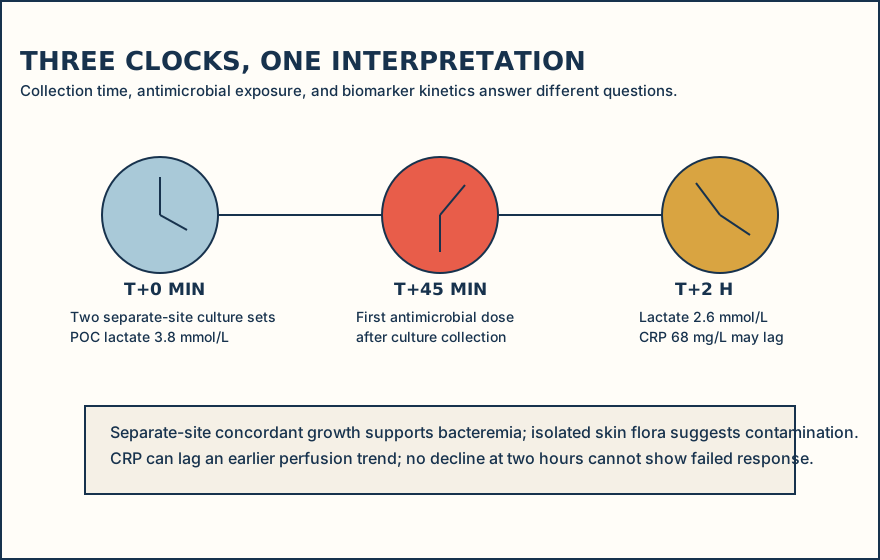
Use this sequence before assigning meaning to a sepsis biomarker result.
Identify the measured signal
Name whether the result is lactate, PCT, CRP, culture context, or an emerging-marker result.
Place it on the timeline
Document collection time, onset context, interventions, and prior values.
Verify specimen and method continuity
Check tube, processing, analyzer, specimen type, and local comparability.
State the bounded conclusion
Describe what the result supports and what no single result can prove.
Knowledge checks
Reading and checks are open. Sign in only to save.
Knowledge check 1
Section status
Finish this section
Reading and checks are open. Sign in only to save.
The module finishes after every required section is marked done and every check in those sections is correct.