Required section · Section 3 of 6
Screening and confirmation answer different questions
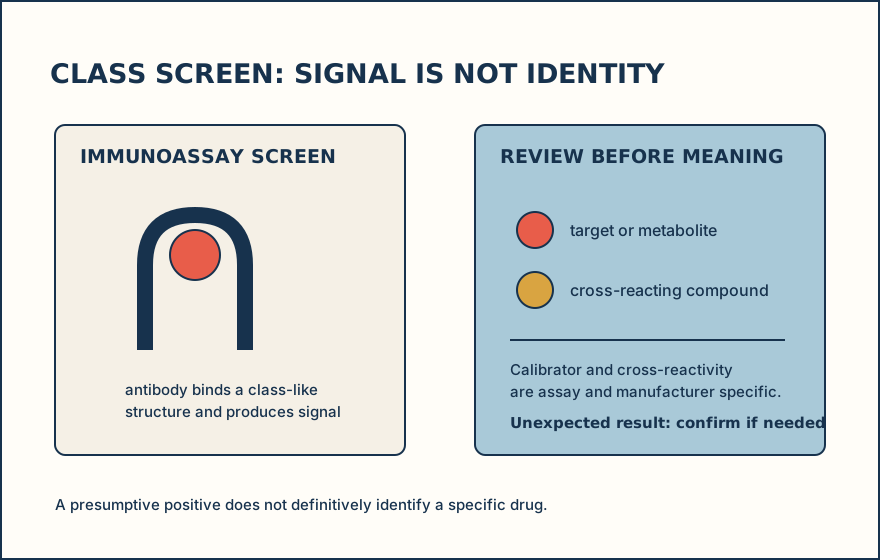
A positive class immunoassay means antibody-based assay signal met the calibrator-defined decision criterion. It is a presumptive antibody-based signal, not proof of analyte identity, dose, timing, or impairment. Cross-reactivity is assay and manufacturer specific, so an unexpected positive needs review against the exact platform and reagent instructions for use.
A routine opiates immunoassay is designed around morphine-like compounds. It may not reliably detect oxycodone, hydrocodone, hydromorphone, fentanyl, methadone, or buprenorphine unless a separately targeted assay is included. The panel menu and reflex algorithm must be declared locally.
Gas chromatography-mass spectrometry and liquid chromatography-tandem mass spectrometry separate compounds chromatographically and identify them with mass spectral patterns or transitions. These methods can provide analyte-specific identification and quantitation, subject to validation, calibration, matrix effects, and reporting limits. Whether hydrolysis is used changes whether a result represents free or total analyte and is a local validated-method detail.
Federal workplace urine cutoffs are program-specific, not default clinical laboratory cutoffs. For example, the 2024 federal urine initial and confirmatory THCA cutoffs are 50 ng/mL and 15 ng/mL. Clinical laboratories must use their own validated procedure and medical director-approved reporting algorithm.
Name the exact screen, its target class, and the definitive method before explaining a discrepancy. Check the validated test menu and reagent instructions for use. Treat cross-reactivity as method-specific.
Illustrative drawing — this picture was drawn rather than captured.
| Feature | Class immunoassay | GC-MS or LC-MS/MS |
|---|---|---|
| Measured signal | Antibody response to a class-like structure | Quantifier and qualifier transitions, accepted ion ratio, retention-time match, and stable-isotope internal standard |
| Usual output | Presumptive positive or negative at cutoff | Analyte-specific identification and quantitation |
| Principal limitation | Cross-reactivity and incomplete class coverage | Validation, calibration, matrix effects, and library or target limits |
| Best use | Efficient screen for a defined class | Confirmation or targeted definitive testing |
Knowledge checks
Reading and checks are open. Sign in only to save.
Knowledge check 1
Knowledge check 2
Section status
Finish this section
Reading and checks are open. Sign in only to save.
The module finishes after every required section is marked done and every check in those sections is correct.