Required section · Section 5 of 6
Choose the defensible laboratory action
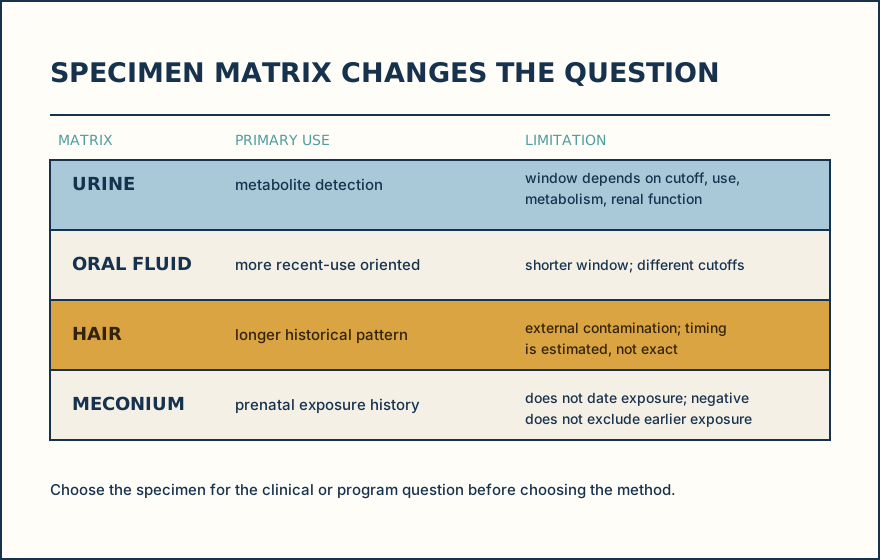
First decide what the request is trying to answer. Urine is commonly used for metabolite detection, while oral fluid is more recent-use oriented and uses different federal workplace cutoffs. Hair can show a longer historical pattern but carries external-contamination concerns and is not federally authorized for workplace testing.
Meconium and umbilical cord tissue answer a prenatal exposure-history question, whereas newborn urine reflects only very recent exposure. Meconium generally reflects later pregnancy exposure but cannot establish an exact exposure date, and a negative result does not exclude earlier exposure. The specimen and method are therefore chosen together, not after a result is already released.
For an unexpected clinically important class-screen finding, review the specimen, test menu, medication context, and local reflex policy. If definitive identification is needed, use the laboratory's validated GC-MS or LC-MS/MS pathway. Do not state that a presumptive screen proves a specific drug, impairment, dose, or timing.
Select the matrix and analytical tier that answer the stated question, then communicate the remaining uncertainty. Apply the local reflex policy when definitive testing is needed. Keep the released conclusion bounded.
Illustrative drawing — this picture was drawn rather than captured.
Ordering exercise
Put the actions in order for an unexpected clinically important class-screen result.
1. Interpret the analyte pattern
Consider parent drug, metabolites, limits, and method boundaries.
2. Release bounded language
State what is supported without inferring impairment, dose, or exact timing.
3. Review specimen and method context
Confirm matrix, collection and integrity information, assay target, cutoff, medication context, and local policy.
4. Choose validated definitive testing when needed
Use the local GC-MS or LC-MS/MS confirmation pathway when the question requires analyte-specific evidence.
Knowledge checks
Reading and checks are open. Sign in only to save.
Knowledge check 1
Section status
Finish this section
Reading and checks are open. Sign in only to save.
The module finishes after every required section is marked done and every check in those sections is correct.