Required section · Section 4 of 6
Working the case
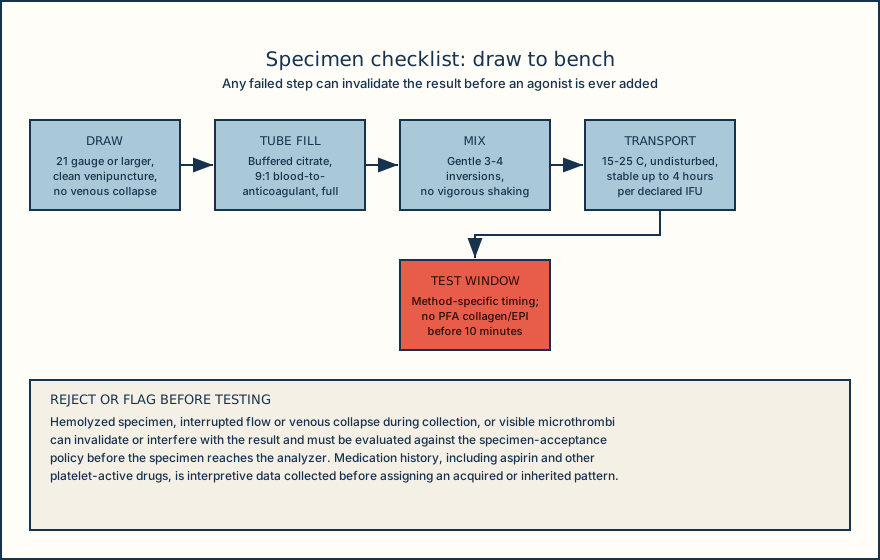
An outpatient specimen arrives for a bleeding-history workup. Collection is a clean 21-gauge venipuncture into a full 3.2% buffered citrate tube, gently inverted, transported at 20 C, and tested 95 minutes after collection. The specimen is not hemolyzed and not clotted, so it meets specimen acceptance for the declared PFA method before any result is interpreted.
The results: platelet count 238 x 10^9/L, within the 150 to 450 x 10^9/L interval. Hematocrit 40.8%, within the 35.0 to 50.0% interval. Collagen/epinephrine closure time 214 seconds, above the manufacturer's 3.2% citrate interval of 82 to 150 seconds. Collagen/ADP closure time 86 seconds, within the manufacturer's interval of 62 to 100 seconds. Medication history documents ibuprofen taken 8 hours before the draw.
Reasoning: this is a valid specimen for the declared PFA method, so the closure times can be interpreted rather than repeated for a collection problem. The normal platelet count and normal hematocrit remove two of the common non-specific explanations for a prolonged closure time, low count and low hematocrit, but removing those explanations does not prove a different one. An isolated prolonged collagen/epinephrine closure time with a collagen/ADP result inside the declared interval is a pattern compatible with an aspirin-like medication effect on this cartridge pair, and the documented ibuprofen exposure is consistent with that pattern.
What this result set does not do: it does not prove ibuprofen caused the prolongation, it does not rule out reduced VWF or an intrinsic platelet defect, and it does not stand in for a diagnosis. The correct next step is to release the method-specific result and comment according to local policy, and let qualified review decide whether medication washout and repeat testing, VWF studies, LTA, secretion testing, or flow cytometry is the appropriate next step. Labeling this result set an inherited platelet defect would overreach what a single PFA cartridge pair, on one draw, with a documented drug exposure, can support.
A compatible pattern documents what you observed and what does not exclude it; it is not the same statement as a cause.
Illustrative drawing — this picture was drawn rather than captured.
| Result | Value | Declared interval or flag |
|---|---|---|
| Platelet count | 238 x 10^9/L | 150-450 x 10^9/L |
| Hematocrit | 40.8% | 35.0-50.0% |
| PFA collagen/epinephrine closure time | 214 s | 82-150 s, manufacturer 3.2% citrate interval; high |
| PFA collagen/ADP closure time | 86 s | 62-100 s, manufacturer 3.2% citrate interval; within interval |
| Medication history | Ibuprofen taken 8 hours before draw | interpretive flag |
Knowledge checks
Reading and checks are open. Sign in only to save.
Knowledge check 1
Section status
Finish this section
Reading and checks are open. Sign in only to save.
The module finishes after every required section is marked done and every check in those sections is correct.