Required section · Section 4 of 6
Working the 07:20 case forward
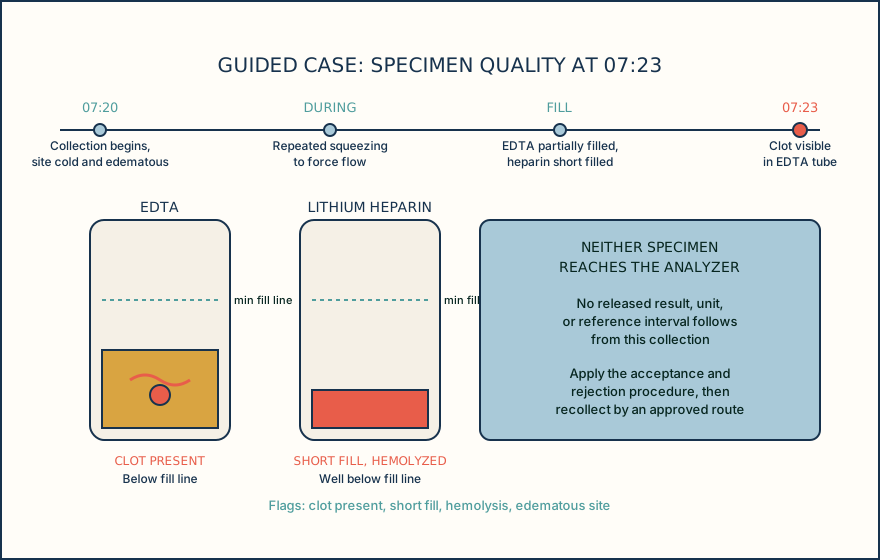
Return to the opening case with the model and variables from the last two sections in hand. Collection begins at 07:20 on an outpatient needing a CBC in EDTA and a basic chemistry panel in lithium-heparin microcontainers; no newborn-screening card is ordered. The only site available is a finger that is cold and visibly edematous. The collector makes a shallow puncture and squeezes repeatedly, then partially fills the EDTA container; a clot is visible at 07:23. The lithium-heparin container is short filled and visibly hemolyzed.
Work the failure points in order. An edematous site may dilute or contaminate a capillary specimen with tissue fluid. Repeated squeezing can contribute to tissue-fluid contamination and hemolysis, but the observed edema, squeezing, and hemolysis do not establish one sole cause. The visible clot and its timestamp are consistent with delayed or inadequate anticoagulant contact, but they do not prove one mixing error or identify a sole cause. Apply the acceptance and rejection procedure to the documented specimen conditions rather than inferring a single cause.
None of this supports inferring a patient result. There is no glucose, no potassium, no hemoglobin, and no differential from this collection, because neither container reached an analyzer. What the flags do support is a specimen-quality decision: apply the laboratory's acceptance and rejection procedure, document the clot, short fill, hemolysis, and site condition, and communicate the problem rather than reporting a comment against a compromised result. The bounded corrective action is to recollect, preferably by an approved venous alternative if the ordered tests and patient assessment permit it, or by an acceptable nonedematous capillary site if venous access is not indicated or not available.
This reasoning generalizes. Every one of the four flags in this case, clot present, short fill, hemolysis, and edematous site, maps back to a specific step in the collection sequence rather than to anything downstream. Recognizing which step produced which flag is what lets a collector fix the actual cause on recollection instead of repeating it. A compromised capillary specimen is a collection problem to correct at the source, not a result to qualify with a comment.
Illustrative drawing — this picture was drawn rather than captured.
Knowledge checks
Reading and checks are open. Sign in only to save.
Knowledge check 1
Section status
Finish this section
Reading and checks are open. Sign in only to save.
The module finishes after every required section is marked done and every check in those sections is correct.