Required section · Section 3 of 6
What actually changes, analyte by analyte
Unseparated whole blood glucose falls from ongoing cellular glycolysis, at a rate the American Diabetes Association and AACC guideline describes as about 5% to 7% per hour, with the exact rate affected by temperature, starting glucose concentration, and leukocyte count. Sodium fluoride tubes slow but do not promptly stop early glycolysis, so the presence of fluoride does not by itself prove a delayed whole-blood glucose is stable. Rapidly effective glycolysis inhibition, or immediate ice-water cooling with separation within 15 to 30 minutes, are approaches described in that guideline under stated conditions. They are not a universal cutoff and they do not replace your local assay procedure.
Whole-blood lactate can rise during a similar delay for the same reason: cells keep metabolizing. A peer-reviewed comparison found lactate changed faster at room temperature than on slushed ice, which is why lactate specimens are frequently ordered with an ice-slush handling instruction. Plasma ammonia is vulnerable in the other direction for a related reason: cell contact and delayed processing tend to push ammonia results up, so prompt separation and minimizing cell contact are the controls that matter. Cooling an unseparated ammonia specimen does not justify extending it past your laboratory's validated interval.
Blood gas results respond to a different set of variables: delay, temperature, residual air in the syringe, and continued cell metabolism can all shift a result. An air bubble creates gas exchange between the specimen and ambient air, but you cannot infer a universal direction or size of that effect without the measured gas values, the fraction of inspired oxygen the patient was on, and your method's conditions. Total bilirubin is light-sensitive; one peer-reviewed study found it stable for 24 hours at 3 C or at 22 C when protected from light, which is a useful data point but not a universal interval for every method or every neonatal specimen.
Whole-blood cells also change morphologically and functionally after collection, which is why coagulation testing and peripheral smear preparation both carry assay- and tube-specific acceptance windows for time to processing. Body-fluid specimens degenerate on a similar clock. None of these numbers transfer across analyte, matrix, method, or instrument without a manufacturer instruction, a validation study, or authoritative guidance behind them.
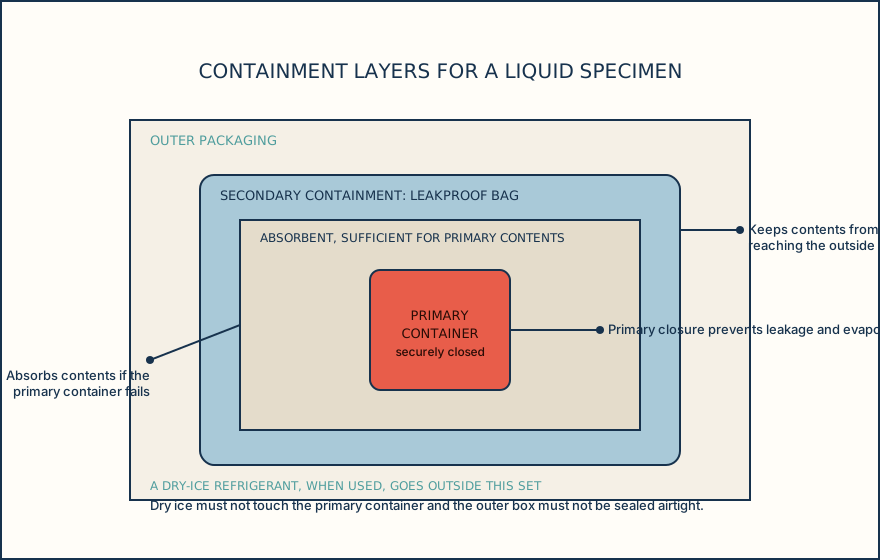
Transport mode adds its own physical variable. A systematic review of pneumatic tube systems found the effects cannot be generalized: route, acceleration, specimen type, tube hardware, and the specific assay all require local validation, and some evaluated systems produced hemolysis or affected specific chemistry or coagulation measures while others showed acceptable agreement. For a shipped liquid specimen, safe-work-practice guidance calls for a securely closed primary container, leakproof secondary packaging with enough absorbent for the primary contents, and protective outer packaging. When dry ice is used as a refrigerant it must never contact the primary container, and the outer package must not be sealed airtight.
Match the control to the analyte; glycolysis, gas exchange, light exposure, and cell contact each call for a different transport condition, not one universal rule.
Illustrative drawing — this picture was drawn rather than captured.
| Analyte example | Primary risk during delay | Control that addresses it |
|---|---|---|
| Unseparated whole-blood glucose | Cellular glycolysis lowers the result over time | Prompt separation, or an effective glycolysis inhibitor and rapid processing per local procedure |
| Whole-blood lactate | Cell metabolism raises the result faster at room temperature than on ice | Slushed ice handling and prompt processing per local procedure |
| Plasma ammonia | Cell contact and processing delay raise the result | Prompt separation and minimizing cell contact within the validated interval |
| Blood gases | Residual air causes gas exchange; delay and temperature shift results | Minimize air, control temperature and time per syringe and analyzer validation |
| Total bilirubin | Light exposure degrades the analyte | Light-protected container or covering during transport and storage |
Knowledge checks
Reading and checks are open. Sign in only to save.
Knowledge check 1
Knowledge check 2
Section status
Finish this section
Reading and checks are open. Sign in only to save.
The module finishes after every required section is marked done and every check in those sections is correct.