Required section · Section 5 of 6
Classify the excursion and choose the next step
You are the receiving technologist. The temperature log below shows the full transport window: ambient readings of 23 C to 25 C throughout, well outside the 2-8 C cold-chain band this exercise applies to a temperature-sensitive analyte on the same requisition. The specimen arrived with intact closures and matched identifiers, so this is not an identity or containment failure. It is a temperature and time excursion.
The current local exception and transport record must capture the collection and receipt information, requested and observed conditions, temperature when material to the test, and the disposition of an excursion. An out-of-range transport event triggers investigation; it is not itself an analytic conclusion, and it is not grounds to silently correct, adjust, or discard a result.
Ordering the exception-response steps correctly matters here, because acting out of order, for example authorizing release before the excursion is documented and reviewed, defeats the purpose of the process. The ordering exercise below asks you to place the response steps in the sequence a documented exception process actually follows.
A complete stability statement names only conditions material to the analyte, method, matrix, and container, and states plainly when needed information is not available. A material omission can lead to the wrong accept, reject, analyze, or release decision.
An excursion is a trigger to document and investigate under the local policy, not a signal to correct the number yourself or to release the result unchanged.
Illustrative drawing — this picture was drawn rather than captured.
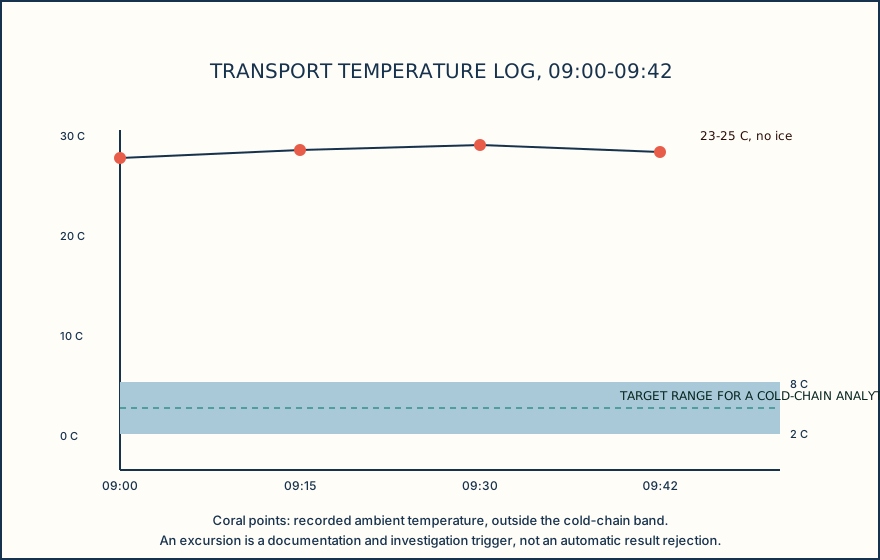
| Time | Recorded temperature | Within 2-8 C target band |
|---|---|---|
| 09:00 | 23 C | No |
| 09:15 | 24 C | No |
| 09:30 | 25 C | No |
| 09:42 | 24 C | No |
Ordering exercise
Place these steps in the order a documented exception process follows once receiving staff identify a temperature and time excursion.
1. Complete exception documentation
Collection time, receipt time, requested condition, observed condition, and the temperature record are entered per local policy.
2. Apply the accept, reject, recollect, or qualified-release decision
An authorized person applies the laboratory's validated disposition and, if released, attaches a result comment describing the exception.
3. Detect and record the excursion
Receiving staff compare the transport log to the required condition and note the mismatch at accessioning.
4. Consult the assay-specific procedure and validated interval
Staff check whether the local procedure or manufacturer instruction addresses this specific excursion for this specific analyte.
5. Hold routine release when required
Keep release controlled pending review. Continue time-sensitive analysis only as the assay-specific procedure directs; this is not a universal analytic delay.
Knowledge checks
Reading and checks are open. Sign in only to save.
Knowledge check 1
Knowledge check 2
Section status
Finish this section
Reading and checks are open. Sign in only to save.
The module finishes after every required section is marked done and every check in those sections is correct.