Required section · Section 3 of 6
Reading the defect, not just naming it
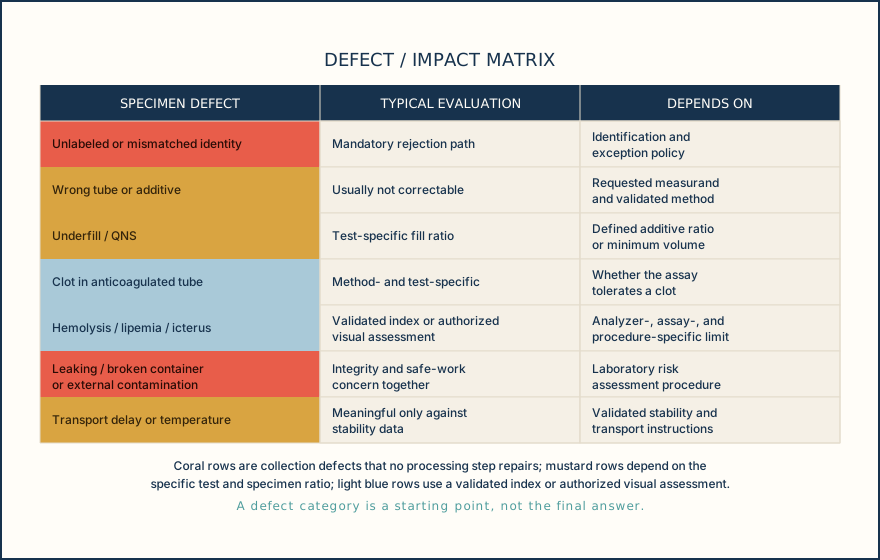
A wrong tube or additive can invalidate the requested examination outright, because specimen requirements include the collection tube and additive for a reason tied to the measurand. Underfill matters when a test requires a defined specimen-to-additive ratio; the acceptable fill line is test-specific, not a single number for every tube in the tray. A clot in an anticoagulated specimen can make a cellular or coagulation result unreliable, but whether the test can still proceed depends on the applicable method and the laboratory's own acceptability procedure.
Hemolysis can interfere through free hemoglobin absorbance and through release of intracellular constituents such as potassium, so its effect is analyte-specific and method-specific rather than a single universal problem. An automated hemolysis index is a spectrophotometric specimen-quality measurement built into the analyzer; visual assessment of a pink or red plasma is observer-dependent and can be confounded by the specimen's own color. The index gives a number a laboratory can validate against; a visual read gives an impression.
Hemolysis, icterus, and lipemia indices must never be treated as interchangeable universal cutoffs. Index scales and interference thresholds are analyzer-specific and assay-specific, so an H-index action limit validated for potassium on one instrument says nothing about magnesium on that instrument, and nothing at all about a different analyzer. The guided case uses an analyzer and an H-index scale whose numbers are not transferable to another instrument or assay; treat every number in it as a teaching example, never a transferable cutoff.
A leaking, broken, or externally contaminated container is both a specimen-integrity concern and a safe-work concern at once. Receiving staff follow the laboratory's own risk assessment and procedure for handling it, which may involve additional precautions before the specimen is even evaluated for testing. Transport temperature and elapsed time are meaningful only when compared against the requested test's own validated stability and transport instructions; a delay that is fine for one analyte can be disqualifying for another drawn in the same tube.
For a deeper look at how a specimen is collected, labeled, and transported before it reaches this decision point, see the prerequisite modules on specimen collection (GLP-01) and specimen processing and storage (GLP-05).
Know whether you are looking at an analyzer-generated index or a visual impression, because an analyzer index may carry a validated action limit; a locally validated visual assessment may also have an authorized use.
Illustrative drawing — this picture was drawn rather than captured.
| Defect | Disposition options under current procedure | What the answer depends on |
|---|---|---|
| Unlabeled or mismatched identity | No | Identification and exception policy, laboratory-director governed |
| Wrong tube or additive | No | Requested measurand and validated method |
| Underfill / quantity not sufficient | Sometimes | Test-specific fill ratio or minimum volume |
| Clot in anticoagulated tube | No | Whether the specific assay tolerates a clot |
| Hemolysis, lipemia, or icterus | No | Analyzer- and assay-specific interference limit |
| Delayed separation within stability | Yes, by correction | Validated stability interval for the test |
Knowledge checks
Reading and checks are open. Sign in only to save.
Knowledge check 1
Knowledge check 2
Section status
Finish this section
Reading and checks are open. Sign in only to save.
The module finishes after every required section is marked done and every check in those sections is correct.