Required section · Section 4 of 6
Working the emergency-department case
The specimen: lithium-heparin plasma, collected 09:58 and received sealed and intact at 10:24. It carries two correct, locally required identifiers. Volume is 1.2 mL against this laboratory's 0.9 mL minimum for the ordered panel. There is no clot. The order is a basic metabolic panel and magnesium.
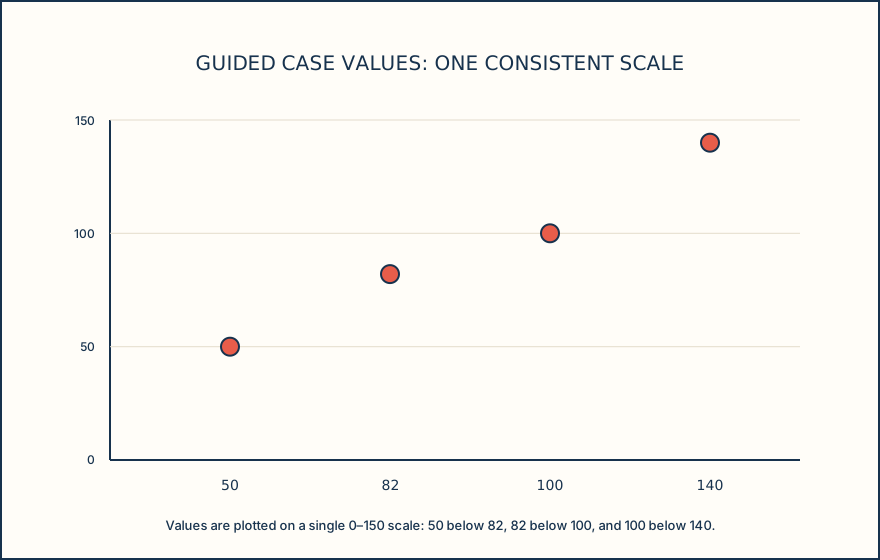
The result set on the analyzer: sodium 139 mmol/L (reference 135-145 mmol/L, no interference flag), potassium 5.9 mmol/L (reference 3.5-5.1 mmol/L, H-index interference flag), creatinine 0.92 mg/dL (reference 0.60-1.30 mg/dL, no interference flag on this method), and magnesium 2.1 mg/dL (reference 1.7-2.4 mg/dL, below this laboratory's affected-limit flag). The H-index reads 82 AU; the local chemistry procedure flags potassium as potentially positively biased at 50 AU or greater and magnesium as potentially affected at 100 AU or greater.
Run the risk screen. Identity: labeled correctly, matches the order, question one closes clean. Irreversibility: this is a standard venous draw, not an irreplaceable specimen. Correctability: nothing about the collection is wrong; the only issue is a specimen-quality index on one analyte. Urgency: an emergency-department order, so recollection delay is a real clinical cost to weigh, not to override the other three questions.
The chemistry analyzer measures a specimen-quality index, not the patient's true in-vivo potassium. Because the local validation marks potassium as potentially affected at this index, releasing the numeric potassium value without qualification is unsupported by the evidence in hand. Magnesium sits below its own affected-limit flag on this method, so it is not implicated by the same index reading; sodium and creatinine carry no flag at all.
The preferred disposition: withhold or cancel only the affected potassium result, request recollection if clinically feasible, and release sodium, creatinine, and magnesium if local procedure permits releasing unaffected tests from the same tube. If immediate clinical need or an inability to recollect drives an exception instead, the laboratory obtains its locally authorized approval, documents the H-index and the disposition, uses the approved result comment, and communicates the limitation to the ordering team. Acceptance under exception does not establish that the released number is clinically correct; it only means the laboratory has decided to report it with a stated limitation.
Separate the results a flagged index actually implicates from the results it does not, instead of treating one flag as a reason to withhold the whole panel.
Illustrative drawing — this picture was drawn rather than captured.
| Result | Value | Reference interval | Interference flag |
|---|---|---|---|
| Sodium | 139 mmol/L | 135-145 mmol/L | none |
| Potassium | 5.9 mmol/L | 3.5-5.1 mmol/L | H-index flag at or above 50 AU |
| Creatinine | 0.92 mg/dL | 0.60-1.30 mg/dL | none on this method |
| Magnesium | 2.1 mg/dL | 1.7-2.4 mg/dL | below this method's affected-limit flag |
| H-index | 82 AU | action limit differs by assay | visually pink plasma |
Knowledge checks
Reading and checks are open. Sign in only to save.
Knowledge check 1
Knowledge check 2
Section status
Finish this section
Reading and checks are open. Sign in only to save.
The module finishes after every required section is marked done and every check in those sections is correct.