Required section · Section 5 of 6
Five case cards, five dispositions
Work each card the same way: run the four-question risk screen, choose a disposition, state the required comment or communication, and flag whether the event also needs nonconforming-event review. A nonconforming-event program responds to departures from established policy, process, or procedure and tracks them through data assessment and management review; not every rejection is a nonconforming event, but a departure from the written procedure usually is.
Card A: a coagulation tube arrives at 60% fill for a test that requires a defined citrate-to-blood ratio. Card B: cerebrospinal fluid for cell count and protein arrives with no visible defect but the order form lists only one patient identifier where two are required locally. Card C: a chemistry tube separated four hours late but the requested analytes are validated stable at room temperature for six hours. Card D: a potassium sample arrives grossly hemolyzed with an H-index far above the local action limit. A late separation remains a processing departure even when an analyte has validated six-hour stability; result acceptability and process review are separate decisions.
A delayed separation that remains within a validated stability window can support a procedure-based result disposition, but it is still a processing departure requiring the required review or investigation. An underfilled specimen is not repaired after receipt: proceeding, prioritizing, recollecting, rejecting, or holding/releasing are dispositions under the current procedure. A compromised patient collection, such as the wrong identity or an unsuitable additive, cannot be repaired by centrifuging, aliquoting, or writing a comment.
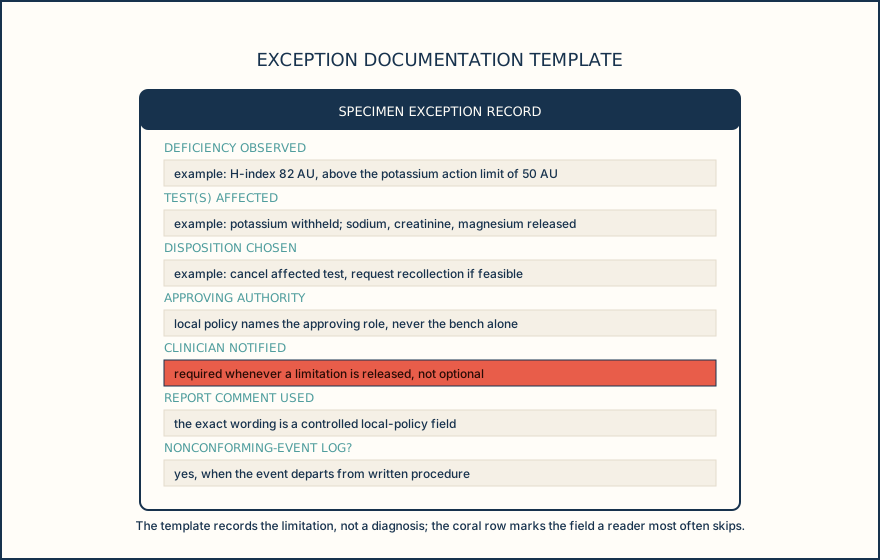
For each card, also identify the responsible next step: who approves an exception, who is notified, and what gets logged. Those specific roles, recipients, and comment wording are controlled by local policy; the pattern of the decision matters, not a universal script naming the exact people or words.
Write down the disposition and the reasoning together, because a reader coming back to the record needs to see why, not only what was decided.
Illustrative drawing — this picture was drawn rather than captured.
Ordering exercise
Card C: a chemistry tube separated four hours late, within the validated six-hour room-temperature stability window for the ordered analytes. Put the steps of the disposition workflow in the order a laboratory professional actually performs them.
1. Document the timing and the decision
Record the collection time, the separation time, and the stability basis for proceeding, so the record shows the reasoning, not just the result.
2. Release the result without a qualifying comment
Because the specimen meets the validated stability criterion, the result is released as a standard result rather than as a qualified exception.
3. Run the four-question risk screen
Confirm identity is intact, the delay does not make the collection irreplaceable, the issue is a processing timing issue, and note the order's urgency.
4. Classify as correctable, not a rejection
Because the delay is within the validated window, this is a documented processing correction rather than a compromised collection.
5. Check the analyte-specific stability window
Compare the four-hour delay against the validated stability data for the specific analytes ordered, not a single generic time limit.
Knowledge checks
Reading and checks are open. Sign in only to save.
Knowledge check 1
Knowledge check 2
Knowledge check 3
Section status
Finish this section
Reading and checks are open. Sign in only to save.
The module finishes after every required section is marked done and every check in those sections is correct.