Required section · Section 4 of 6
Guided case: a serum tube run
A chemistry bench receives two BD SST tubes drawn at 09:00. They clot for 30 minutes at room temperature. At 09:32, the technologist plans a 10-minute run in a swinging-bucket rotor with a stated maximum radius of 12.0 cm. The tube label, fill, closure, and adapter are correct. Opposite positions hold matched, complete loads. The required RCF for this cited BD SST condition is 1,300 x g.
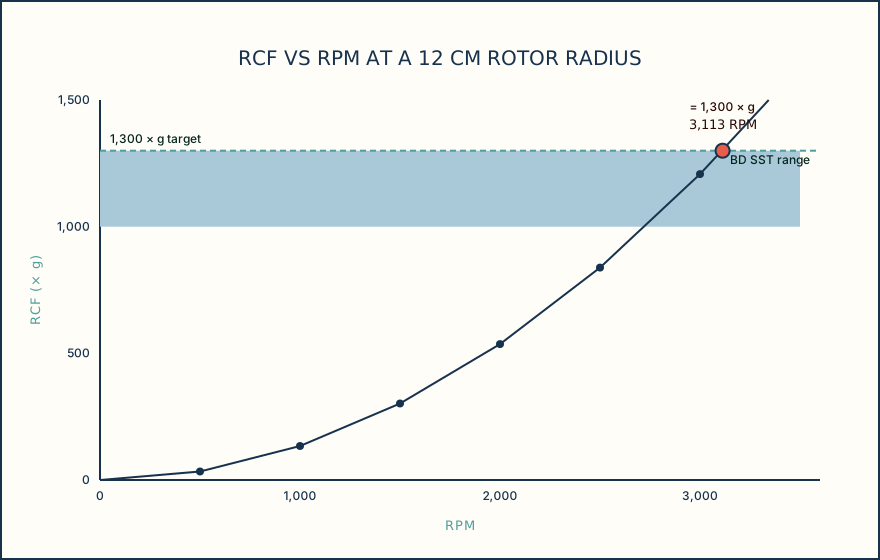
Solving RCF = 1.118 x 10^-5 x r x RPM^2 for RPM at r = 12.0 cm and RCF = 1,300 x g gives RPM = the square root of [1,300 divided by (1.118 x 10^-5 x 12.0)], which is 3,113 RPM, rounded only as the instrument display allows. The run is set to 1,300 x g, 10 minutes, room temperature, with brake per the validated local BD SST procedure.
Pre-run inspection shows no crack, corrosion, contamination, loose carrier, tube mismatch, or imbalance. At 09:42 the tubes are intact, with serum sitting above a stable gel barrier and no visible hemolysis or fibrin. The centrifuge has done its job: it prepared separated serum for downstream testing. It did not generate a patient result, reference interval, differential, critical value, or delta check, because a centrifuge is specimen-preparation equipment, not an analyzer.
The reasoning depends entirely on the confirmed 12.0 cm radius; a different rotor radius would require a different RPM for the same 1,300 x g target. If the opposing load, adapter, rotor identification, tube condition, or manufacturer limit had been uncertain at any point, the correct action is to not start the run.
A clean post-run appearance is consistent with correct processing, but appearance alone does not prove the RCF, time, or platelet removal actually achieved; that assurance comes from following the validated setting.
Illustrative drawing — this picture was drawn rather than captured.
| Item | Result or condition |
|---|---|
| Required RPM | 3,113 RPM, from RCF = 1,300 x g and r = 12.0 cm |
| Run setting | 1,300 x g, 10 min, room temperature, brake per validated local procedure |
| Pre-run flags | None: no crack, corrosion, contamination, loose carrier, tube mismatch, or imbalance |
| Post-run appearance at 09:42 | Intact tubes, serum above a stable gel barrier, no visible hemolysis or fibrin |
Knowledge checks
Reading and checks are open. Sign in only to save.
Knowledge check 1
Knowledge check 2
Section status
Finish this section
Reading and checks are open. Sign in only to save.
The module finishes after every required section is marked done and every check in those sections is correct.