Required section · Section 2 of 6
What a centrifuge actually does
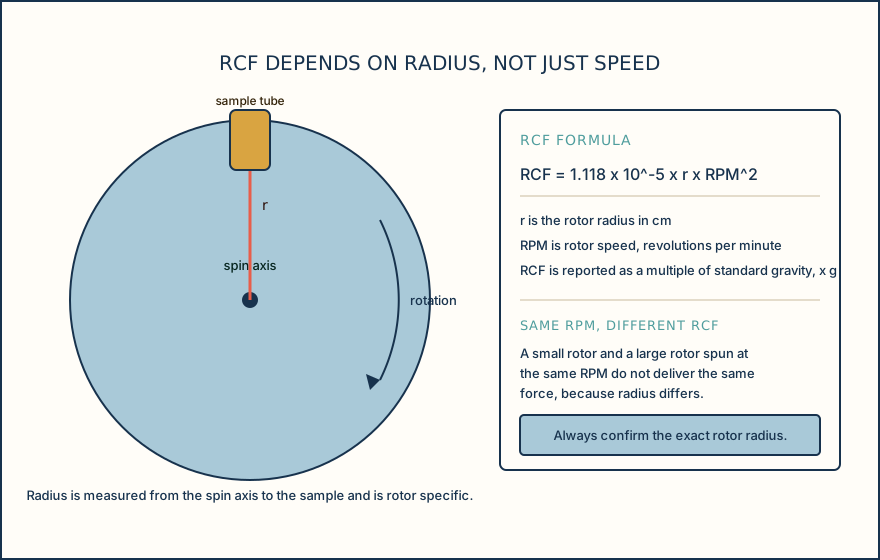
A centrifuge spins a sample around a fixed axis. That spin creates centripetal acceleration, and the denser components of the sample move outward relative to the lighter components, driven by that acceleration rather than by ordinary gravity alone. The farther a sample sits from the spin axis, the more acceleration it receives at a given speed, which is why radius belongs in the calculation and not just RPM.
The formula converts speed and radius into a force reported as a multiple of g: RCF = 1.118 x 10^-5 x r x RPM^2, with r in centimeters. The same equation solves for the RPM needed to reach a required RCF once the rotor radius is known. This formula is general physics and applies to any centrifuge; the operating limits it is used within, such as maximum RPM and maximum load, are specific to the exact instrument and rotor.
Rotor geometry also changes how separation looks, not just how much force is applied. A fixed-angle rotor holds tubes at a constant angle throughout the run, so the pellet or clot forms along the angled tube wall. A swinging-bucket rotor lets carriers swing outward as the rotor spins, so the pellet forms flat at the tube base. Both can deliver the same RCF; the geometry of the resulting separation differs.
Read RCF and radius off the rotor's own documentation before setting speed, because a number copied from a different rotor is not a verified setting.
Illustrative drawing — this picture was drawn rather than captured.
The reasoning path from a required RCF to a safe, verified run.
Identify the rotor and its radius
Confirm which rotor is installed and read its stated maximum radius, maximum RPM, and maximum load from the rotor's own documentation, not from memory or a different rotor's label.
Calculate the RPM for the required RCF
Solve RCF = 1.118 x 10^-5 x r x RPM^2 for RPM using the confirmed radius, then round only as the instrument display allows.
Load and balance the rotor
Place tubes in approved carriers or adapters, with fill and closure permitted by the tube instructions, and balance opposing positions by the rotor manual's rule, not by nominal volume alone.
Inspect before closing the lid
Check for cracks, corrosion, contamination, loose carriers, or tube mismatch. Do not start a run with any of these unresolved.
Run, then verify the result
Start the run at the calculated setting, and after it stops completely, verify the separation appearance and record the run per local procedure.
Knowledge checks
Reading and checks are open. Sign in only to save.
Knowledge check 1
Knowledge check 2
Section status
Finish this section
Reading and checks are open. Sign in only to save.
The module finishes after every required section is marked done and every check in those sections is correct.