Required section · Section 5 of 6
Load the rotor, then respond to a break
Two decisions make up this segment. The first is a loading check: given a described rotor, tube set, and opposing positions, decide whether the load is balanced and approved to run. The second is an incident response: given a described tube breakage or suspected rotor spill during or after a run, choose the defensible sequence of actions.
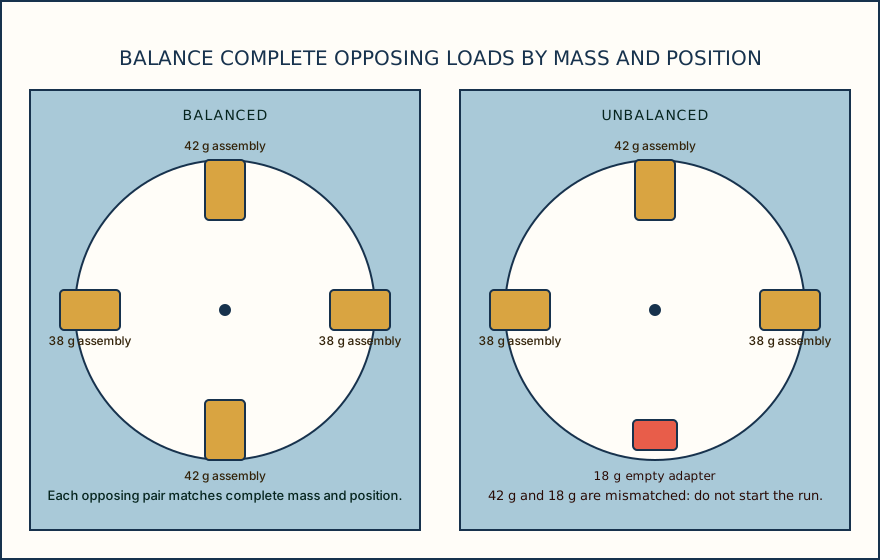
For the loading check, apply the same reasoning used in the guided case to a specific load. A four-position swinging-bucket rotor has top and bottom as one opposing pair and left and right as the other. The top position holds a tube, cap, and adapter assembly with a complete mass of 42 g, and the opposite bottom position holds a matched 42 g assembly; the left and right positions each hold a matched 38 g assembly. Every opposing pair matches complete mass and position, so this load is approved to run. If the bottom position instead held only an empty adapter at 18 g while the top position still held its 42 g assembly, the opposing pair would be mismatched by mass, and the run would not start until the load was corrected.
For the incident response, a broken tube or suspected rotor spill is an aerosol and exposure problem before it is a specimen problem. Keep the lid closed, restrict access, allow the laboratory's defined aerosol-settling interval where one applies, then use assigned personal protective equipment and the local spill and exposure procedure. Sealed rotors and safety cups are primary containment devices that reduce aerosol, droplet, and leakage release; when a risk assessment calls for containment, load and unload them inside a biological safety cabinet or another suitable containment device. Any contaminated surface or equipment gets cleaned and decontaminated with an appropriate disinfectant as soon as feasible, and equipment that cannot be decontaminated before service or shipment must be labeled and communicated as contaminated.
An unresolved loading question or a suspected spill both have the same first move: stop and do not proceed until the uncertainty or contamination is addressed by the local procedure.
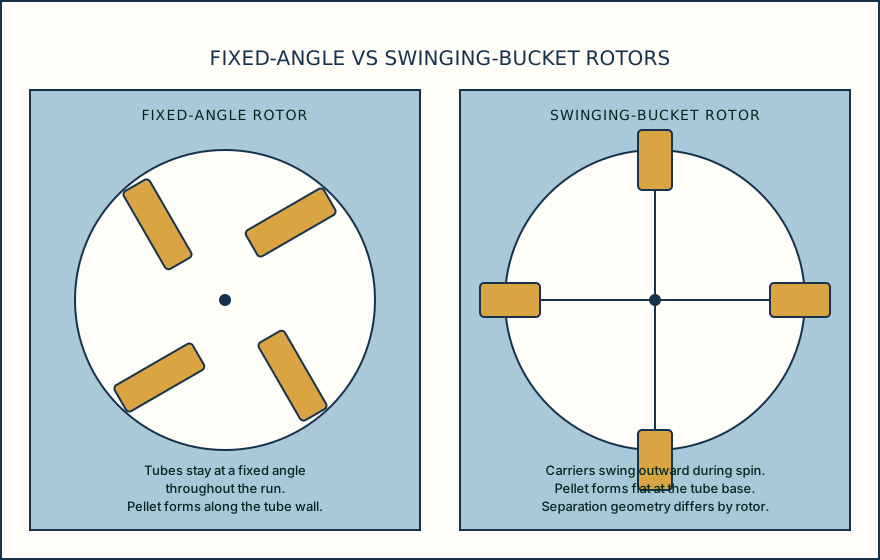
Illustrative drawing — this picture was drawn rather than captured.
Illustrative drawing — this picture was drawn rather than captured.
Ordering exercise
A tube is heard to break partway through a run and the centrifuge is still decelerating. Put the response steps in the correct order.
1. Clean and decontaminate the equipment and surfaces
Follow the local spill and exposure procedure to clean and decontaminate the centrifuge and any affected surfaces with an appropriate disinfectant.
2. Put on assigned personal protective equipment
Use the PPE assigned for this response before opening the centrifuge or handling any broken material.
3. Allow the defined aerosol-settling interval
Where the local procedure defines a settling interval before opening, observe it before proceeding.
4. Wait for the rotor to stop completely
Confirm the rotor has stopped and the lid can be opened normally before doing anything else.
5. Keep the lid closed and restrict access
Do not open the centrifuge while it is still moving or immediately after a suspected break; keep others away from the area.
Knowledge checks
Reading and checks are open. Sign in only to save.
Knowledge check 1
Knowledge check 2
Knowledge check 3
Section status
Finish this section
Reading and checks are open. Sign in only to save.
The module finishes after every required section is marked done and every check in those sections is correct.