Required section · Section 5 of 6
Your decision: label the pattern, find the date, pick the record
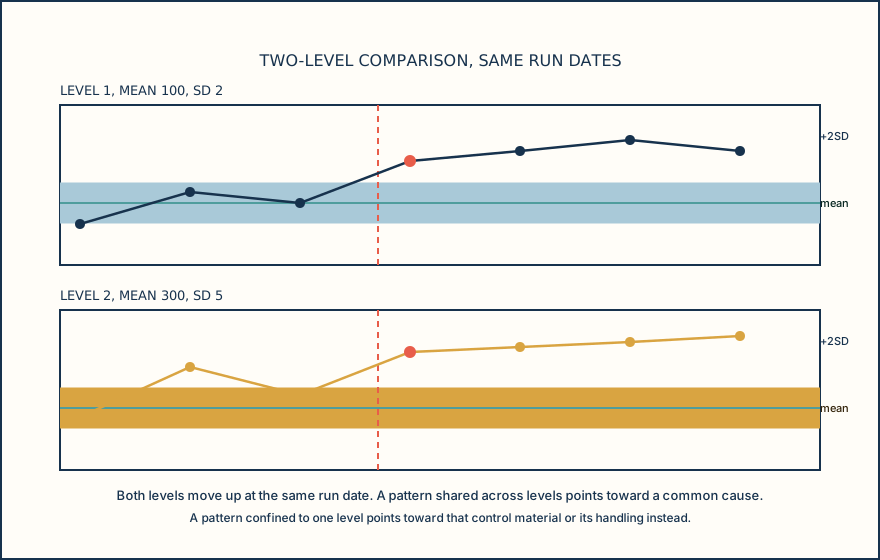
You are handed the same Aug 3 through Aug 9 chart from the guided case, now as your own call. Level 1 has moved from a baseline near 100 mg/dL to a sustained 104 to 106 mg/dL. Level 2 has moved from a baseline near 300 mg/dL to a sustained 309 to 312 mg/dL. Both levels moved on the same run date, and neither has exceeded plus 3 SD at any point.
Three things are asked of you here. First, label the pattern using the definitions from the instruction section: is this an isolated extreme, a shift, a trend, increased scatter, or a cyclical pattern. Second, state the first run date on which the evidence changed at either level. Third, choose the event record that is most relevant to inspect next, from the options in the event log: the reagent lot bridging comparison, a routine maintenance log entry from a week earlier, an operator schedule change from a month earlier, or the analyzer's internal temperature log with no listed excursion.
The figure below places level 1 and level 2 on stacked panels using the same run dates, so you can check whether the pattern is confined to one level or shared across both. A pattern shared across levels at the same run date is stronger evidence of a common cause such as a reagent or calibration event than a pattern seen at only one level. A pattern confined to a single level points instead toward that specific control material, its storage, or its handling.
Whatever you conclude, the bounded action is the same: controls must meet the laboratory's and, when applicable, the manufacturer's acceptability criteria before patient results are released, and the control procedure and your review must be documented. Recalculating the mean or SD to make the post-change points look acceptable is not an available option here; a new target requires a valid baseline and a controlled transition approved under local policy, not a response to a single flagged run. Label the pattern, name the date, and route to the record that matches the pattern, not to a shortcut around the acceptance criteria.
Illustrative drawing — this picture was drawn rather than captured.
Ordering exercise
Put these steps in the order your laboratory's procedure calls for after you identify a shared shift at a lot change, from first to last.
1. Document the decision and any action
Record the pattern, the records reviewed, the decision made, and any corrective action taken, per the control procedure.
2. Check calibration, storage, and analyzer flags
Review calibration status, reagent storage and preparation records, and any analyzer flags around the phase boundary.
3. Hold affected patient results
Do not release results from runs affected by the flagged controls until acceptability criteria are confirmed met.
4. Check the lot-bridging comparison
Review the documented comparison between the outgoing and incoming reagent lot for a clinically important difference.
Knowledge checks
Reading and checks are open. Sign in only to save.
Knowledge check 1
Knowledge check 2
Section status
Finish this section
Reading and checks are open. Sign in only to save.
The module finishes after every required section is marked done and every check in those sections is correct.