Required section · Section 3 of 6
The variables behind the numbers
Dimensional analysis means carrying units through every factor of a calculation so unwanted units cancel and only the target unit remains before a result is released. C1V1 = C2V2, concentration times volume before dilution equals concentration times volume after, applies only when the same amount of analyte is conserved and every concentration and volume uses compatible units. A dilution factor is final volume divided by specimen volume, and the pre-dilution result is the measured result multiplied by that factor. Serial dilution compounds the individual factors at each step, so a pipetting or transcription error early in the series propagates to every concentration calculated afterward.
Spike recovery is the spiked result minus the volume-adjusted base result, divided by the added concentration, expressed as a percentage. Percent bias at a stated concentration is the candidate result minus the comparator result, divided by the comparator result, times 100, when the comparator is the declared denominator. The denominator and the direction of subtraction must be declared before you calculate, because changing either one changes the reported number even though the raw data never changed.
Method comparison using patient samples, current CLSI EP09, covers scatter and difference plots, regression, confidence intervals, and bias at selected concentrations. It does not establish random error, replicate variability, or total error; those need their own planned studies. Ordinary least squares (OLS) regression minimizes vertical residuals and treats the comparator result as error-free, an assumption that is usually unsuitable when both methods carry measurement imprecision. Deming regression accounts for error in both methods but requires an error-variance relationship that is justified rather than assumed. Passing-Bablok regression is a nonparametric option based on median pairwise slopes and is one approach EP09 describes; which procedure is appropriate depends on the study design, not personal preference.
A slope different from 1 suggests a proportional difference between methods, and an intercept different from 0 suggests a constant difference; both need a confidence interval and comparison against a predefined limit before either one means anything operationally. A residual is the observed result minus the model-predicted result; a curved or concentration-related pattern in the residuals warns that a straight-line model does not fit well, and wider residual spread at higher concentration, heteroscedasticity, can make an unweighted fit unsuitable. A bias estimate at a medical decision point should be calculated at that stated concentration directly, not inferred from an average bias across the whole interval, because the two numbers can differ.
For calibration verification or validation planning, first determine whether the actual use is an unmodified cleared system or a modified or noncleared use. Then follow the current applicable verification or validation requirement; do not substitute a generic schedule or study design for that decision.
Know which formula's denominator and which regression procedure's assumptions you are using before you calculate, because the same raw data can produce different reported numbers depending on those choices.
Illustrative drawing — this picture was drawn rather than captured.
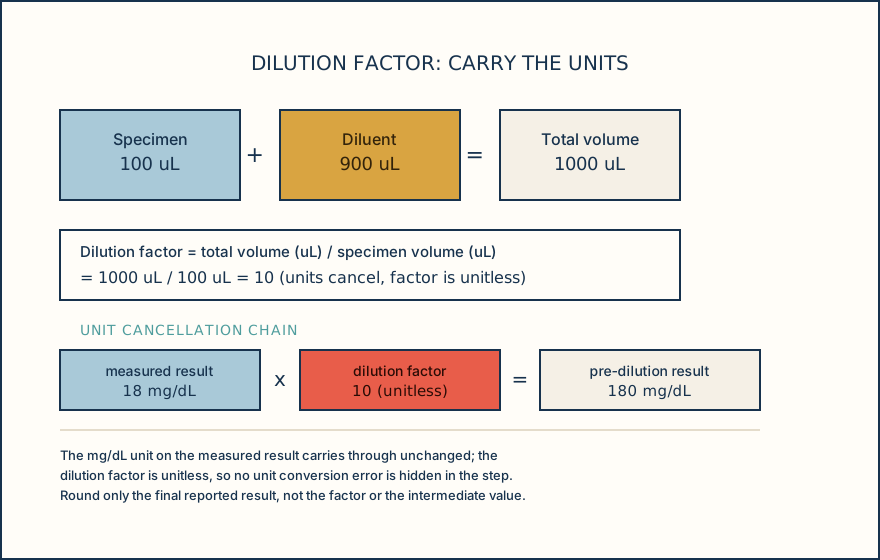
| Calculation | Formula | What it answers |
|---|---|---|
| Dilution factor | final volume / specimen volume | How much a diluted result must be multiplied to reconstruct the undiluted concentration |
| Pre-dilution result | measured result x dilution factor | The concentration the specimen would have read without dilution |
| Spike recovery | (spiked result - adjusted base result) / added concentration x 100 | Whether a known added amount came back close to what was added |
| Percent bias | (candidate - comparator) / comparator x 100, denominator declared | The point-specific difference between two methods at a stated concentration |
Knowledge checks
Reading and checks are open. Sign in only to save.
Knowledge check 1
Knowledge check 2
Section status
Finish this section
Reading and checks are open. Sign in only to save.
The module finishes after every required section is marked done and every check in those sections is correct.