Required section · Section 4 of 6
Working the numbers on one case
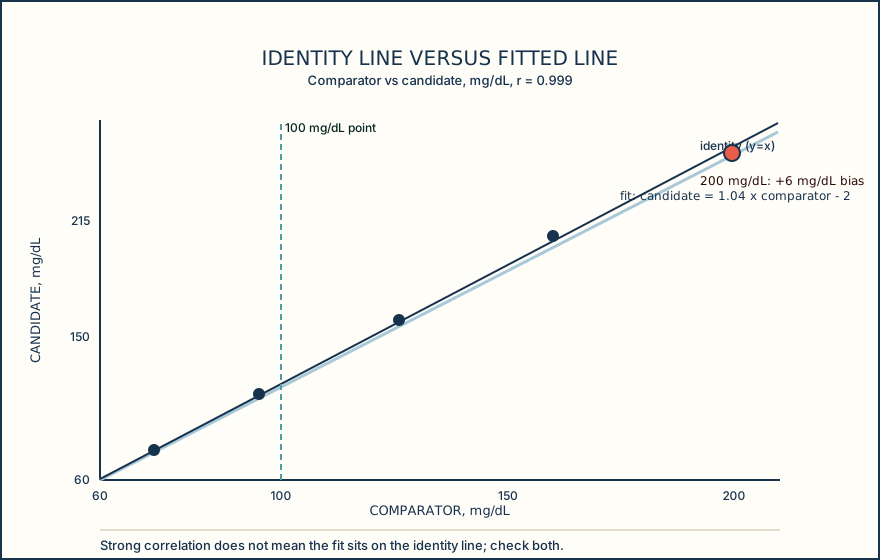
The paired results from the opening problem fit a regression line of candidate = 1.04 x comparator - 2 mg/dL, with r = 0.999. At the 100 mg/dL decision point, the fitted line predicts a candidate result of 1.04 x 100 - 2 = 102 mg/dL, a bias of +2 mg/dL or +2.0%. At the 200 mg/dL decision point, the fitted line predicts 1.04 x 200 - 2 = 206 mg/dL, a bias of +6 mg/dL or +3.0%, matching the observed pair. Both of these are calculated at the stated concentration, not read off as an average bias across the range, because the two numbers are not the same and the decision point is what matters clinically.
The identity-versus-fit plot below shows both lines on the same axes. The fitted line sits close to identity at the low end and diverges further from it as concentration rises, which is exactly the pattern a slope of 1.04 and an intercept of -2 predicts, and exactly the pattern a correlation coefficient alone would not reveal.
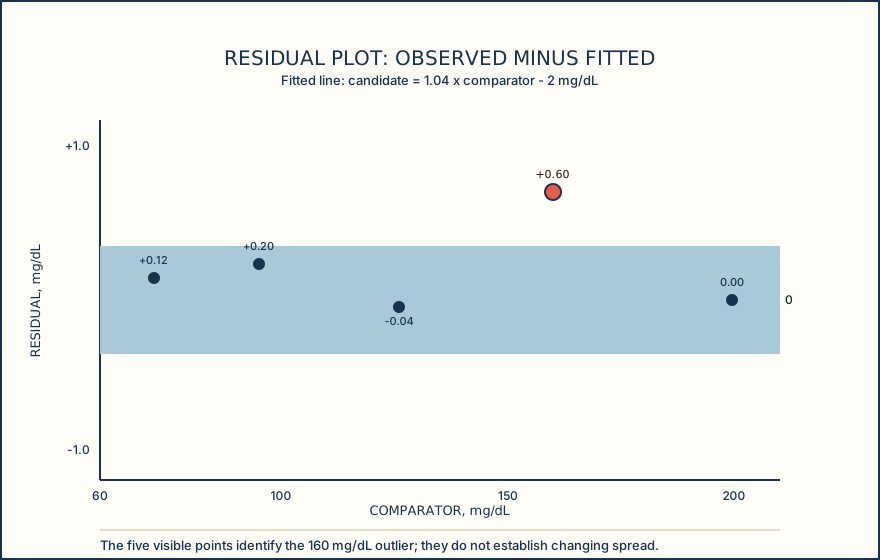
The residual plot shows observed minus fitted candidate result at each comparator concentration. In these five visible pairs, the +0.6 mg/dL residual at 160 mg/dL is the plotted outlier. Five points do not establish that residual spread changes with concentration or select a weighting approach; investigate only if a larger, appropriate study and the current procedure support that conclusion.
A 1:10 dilution in this same case is prepared as 100 uL specimen plus 900 uL diluent for 1000 uL total. A measured result of 18 mg/dL in the diluted aliquot calculates to a pre-dilution result of 18 mg/dL x 10 = 180 mg/dL, rounded only at the final reported step. A 20 uL addition of a 1000 mg/dL spike into 980 uL of base specimen produces an added concentration of (1000 mg/dL x 20 uL) / 1000 uL total = 20 mg/dL; the spiked result is compared against a volume-adjusted base result, not the undiluted base result, before recovery is calculated.
Serial dilution compounds each step's factor, so the order of operations below matters: an error made while recording the first pipetted volume changes every downstream calculated concentration, even if every later step is done correctly.
Calculate bias at the concentration that matters for the decision, look at the residual pattern before trusting the fit, and keep every intermediate value unrounded until the final reported result.
Illustrative drawing — this picture was drawn rather than captured.
Illustrative drawing — this picture was drawn rather than captured.
| Pair | Comparator, mg/dL | Candidate, mg/dL | Difference, mg/dL | Percent bias (comparator denominator) |
|---|---|---|---|---|
| 1 | 72 | 73 | +1 | +1.4% |
| 2 | 95 | 97 | +2 | +2.1% |
| 3 | 126 | 129 | +3 | +2.4% |
| 4 | 160 | 165 | +5 | +3.1% |
| 5 | 200 | 206 | +6 | +3.0% |
| Pair | Comparator, mg/dL | Fitted candidate, mg/dL | Observed candidate, mg/dL | Residual, mg/dL |
|---|---|---|---|---|
| 1 | 72 | 72.88 | 73 | +0.12 |
| 2 | 95 | 96.80 | 97 | +0.20 |
| 3 | 126 | 129.04 | 129 | -0.04 |
| 4 | 160 | 164.40 | 165 | +0.60 |
| 5 | 200 | 206.00 | 206 | 0.00 |
Ordering exercise
Put these steps in the order that prevents an early calculation error from reaching release.
1. Apply the cumulative factor
Calculate the pre-dilution concentration without rounding.
2. Record actual pipetted volumes
Record actual specimen and diluent volumes at each step.
3. Round and release
Only after the audit passes, round the final result under local policy and report it.
4. Multiply the factors together
Build the cumulative dilution factor before applying it.
5. Audit units and formula
Stop and resolve failed unit cancellation, an impossible volume, or a formula-audit discrepancy before release.
6. Calculate each step's dilution factor
Calculate total volume divided by specimen volume for each step.
Knowledge checks
Reading and checks are open. Sign in only to save.
Knowledge check 1
Knowledge check 2
Section status
Finish this section
Reading and checks are open. Sign in only to save.
The module finishes after every required section is marked done and every check in those sections is correct.