Required section · Section 3 of 6
Recognition and controls by hazard type
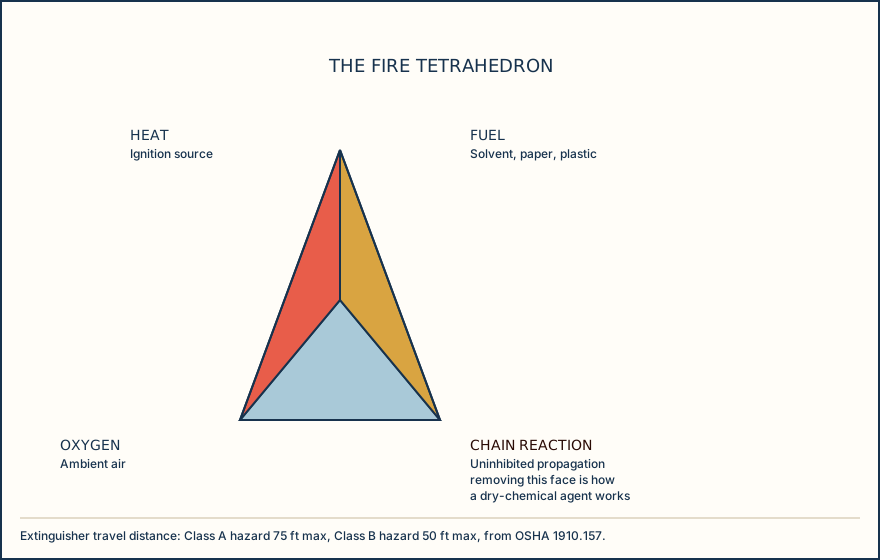
Fire: an employer may choose an evacuation-only policy instead of stocking extinguishers, but only with a written Emergency Action Plan meeting 1910.38 and a Fire Prevention Plan meeting 1910.39. Where extinguishers are provided for general employee use, OSHA requires initial and at-least-annual education on extinguisher principles, incipient-fire hazards, and when to evacuate instead of fighting a fire; employees specifically designated to fight fires need additional hands-on equipment training.
Electrical hazards can shock or ignite when damaged insulation, a missing ground pin, overload, or wet surface lets current reach a person or combustible material. Keep walking surfaces dry, remove damaged equipment from use, and keep circuits within their rated load. The consequence—not the regulation name—is why the control matters.
Electrical: common bench-level hazards are frayed or damaged cords, missing ground pins, daisy-chained power strips, an extension cord used as permanent wiring, a cord run through water or under a mat, and an unapproved homemade repair. Overcurrent devices and disconnects must stay readily accessible and away from easily ignitable material. Lockout/tagout under 29 CFR 1910.147 applies when servicing or maintenance exposes a worker to unexpected startup or stored energy; a bench technologist may unplug cord-and-plug equipment under their own exclusive control, but applying or removing a lock or tag, and any electrical repair or troubleshooting, is reserved for authorized, trained personnel and is out of scope for this role.
Sharps: a safety-engineered sharps device is the required engineering control under the Bloodborne Pathogens standard, reevaluated at least annually with input from non-managerial direct-care staff. A contaminated sharp generally may not be bent, recapped, or removed by hand except under narrow exceptions.
Sharps containers must be closable, puncture-resistant, leak-proof, kept upright, labeled, and replaced before overfilling, with the exact fill-line percentage and replacement schedule set by local policy rather than a single fixed federal number. A microtome or cryostat blade is handled as a sharp, changed with a blade holder or forceps rather than bare or gloved fingers, and placed directly into a sharps container at the point of use. Broken glass, contaminated or not, is never picked up by hand; it is collected with forceps, tongs, or a brush and dustpan into a rigid, puncture-resistant container.
Electrical: damaged cords, missing ground pins, daisy-chained strips, permanent extension-cord wiring, cords through water, and unapproved repairs can cause shock or ignition. If damaged wiring or an energized fault makes the plug unsafe to reach, do not reach through it to unplug: isolate the area and use the emergency or qualified-person procedure. Lockout/tagout and repair belong to authorized personnel.
Slip, trip, fall, heat, and mechanical: floors are kept clean and, where feasible, dry, and a spill or hazard is corrected or barricaded before the area is reused. A portable ladder must sit on a stable, level, secured surface, be inspected before each use, be tagged and removed from service if defective, and never be extended or repositioned with someone standing on it; standing on the top cap or top step, or improvising height with a box or chair, is a defined ladder violation, not an acceptable workaround.
Fall protection is required once an unprotected edge is four feet or more above a lower level. An autoclave door is opened cautiously to let residual steam clear, and a hot-plate cord and switch are inspected before use, since damaged wiring near combustible material can ignite a fire in addition to causing a burn.
A moving rotor or centrifuge creates a pinch-point or entanglement hazard controlled by guarding, lid interlocks, and keeping loose hair, gloves, and lanyards clear during normal operation, not by lockout/tagout. Continuous noise at or above an 8-hour time-weighted average of 85 dBA triggers OSHA's hearing conservation program requirements, with an enforceable exposure limit of 90 dBA TWA; no specific noise reading for any instrument is asserted here.
Most of these controls are ordinary bench habits, an unplugged strip instead of a daisy chain, a blade in a holder instead of a bare finger, a scope brought forward instead of a bent neck, and the habits work because they remove one condition the hazard needs before it reaches a person.
Illustrative drawing — this picture was drawn rather than captured.
Illustrative drawing — this picture was drawn rather than captured.
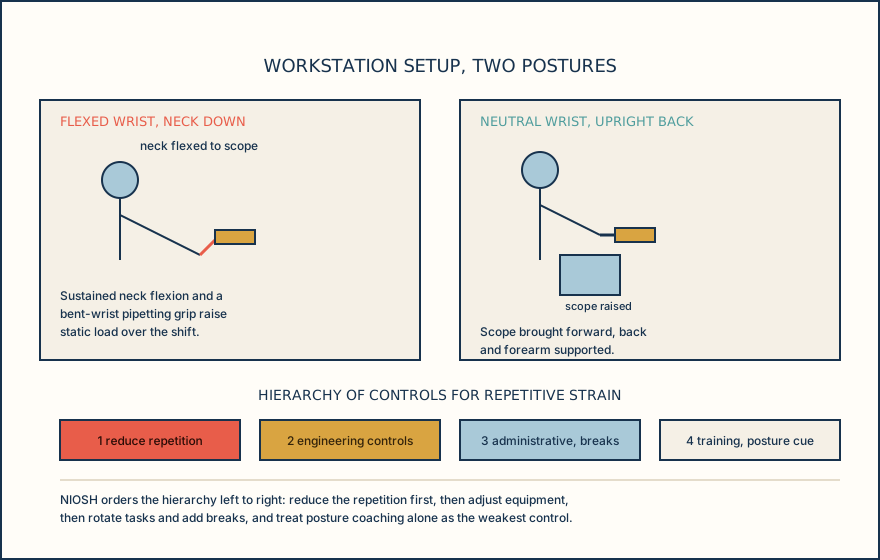
| Measure | Reported value | Note |
|---|---|---|
| Pipette hand motions per worker per day | approximately 6,000 to 11,700 | Single-site field evaluation, HHE 95-0294-2594 |
| Named controls | Reduced volume, added breaks, foot-activated dispensers, automation | Hierarchy-of-controls order applies before posture coaching |
| Applicability | Single-site example only | No universal daily pipetting benchmark exists |
Knowledge checks
Reading and checks are open. Sign in only to save.
Knowledge check 1
Knowledge check 2
Knowledge check 3
Section status
Finish this section
Reading and checks are open. Sign in only to save.
The module finishes after every required section is marked done and every check in those sections is correct.