Required section · Section 6 of 6
What this case supports, and what it does not
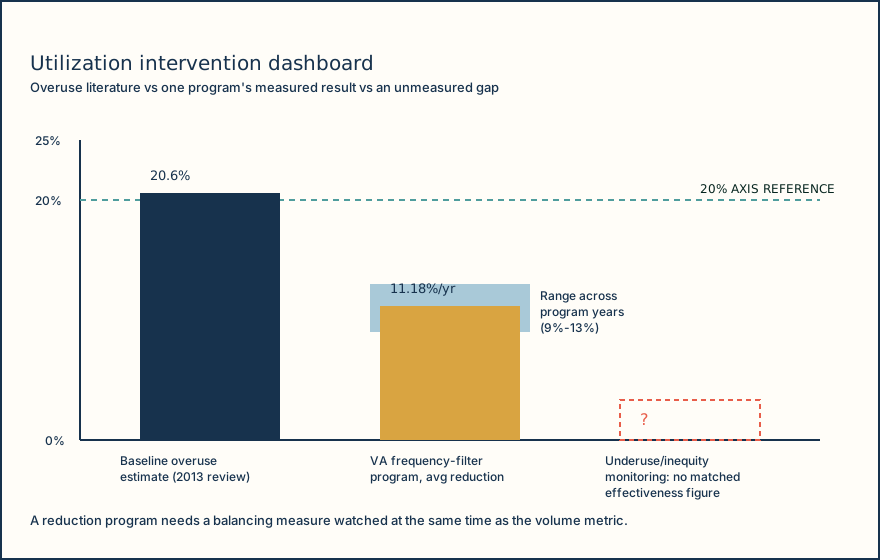
What is supported: the regulatory floor is not optional and does not move with the vendor you choose. Complexity categorization, performance verification or establishment, and instrument-specific competency reassessment apply regardless of which analyzer wins the scorecard. CAP's expectation that laboratory staff, not vendor staff, confirm verification work on known specimens is a real accreditation requirement, not a courtesy. The utilization evidence is real too: the LMBP review's positive recommendation for reflex testing, the BMJ Open Quality finding that duplicate-order alerts with an override pathway are among the better-supported single interventions, and the VA program's 11.18% average annual volume reduction with no reported harm to length of stay are all specific, citable findings, not general impressions.
What depends on method and local policy: the scorecard weights, the exact tests that get a reflex rule or a minimum re-testing interval, which committee signs off on a vendor, how conflicts of interest get disclosed and recused, backup and downtime arrangements, and the record-retention window beyond CAP's general guidance are all local decisions the laboratory has to make.
Disclosure is not permission. Route potential conflicts and procurement decisions through the applicable institutional conflict-of-interest and procurement process; no single universal set of controls applies here.
The scorecard weighting used in this case is a local decision, not a standard. The cost and staffing figures are examples, not benchmarks.
Illustrative drawing — this picture was drawn rather than captured.
| Evidence | Finding | Source class |
|---|---|---|
| LMBP systematic review, 83 studies | Positive recommendation for reflex testing; decision support, education, and feedback also reviewed | Peer-reviewed review |
| BMJ Open Quality review, 41 studies | Duplicate-order alerts with override pathway well supported; hard stops cut orders further but raise workaround concerns | Peer-reviewed review |
| VA hospital frequency-filter program | 11.18% average annual volume reduction, no reported adverse effect on length of stay | Peer-reviewed review |
| 2013 overutilization meta-analysis | Mean overutilization estimate near 20.6%; underuse flagged as a companion risk with no matched figure | Peer-reviewed review |
Knowledge checks
Reading and checks are open. Sign in only to save.
Knowledge check 1
Section status
Finish this section
Reading and checks are open. Sign in only to save.
The module finishes after every required section is marked done and every check in those sections is correct.