Required section · Section 5 of 6
Build the scorecard, then decide the utilization intervention
Two decisions sit in front of you now. The first is the procurement scorecard: score Analyzer A and Analyzer B across analytical performance, operational fit, informatics, service, total cost of ownership, and vendor governance, apply your laboratory's locally set weights, and see whether the weighted composite agrees with your instinct from the cost calculation. The scorecard below shows one example weighting; your own committee sets its own weights, and there is no universally correct set. What the scorecard forces you to do is write the weights down before you see the vendor names attached to a winning number, which is the actual point of a transparent, documented process.
The second decision is a utilization intervention. Evidence reviewed by the CDC's Laboratory Medicine Best Practices (LMBP) initiative, drawn from 83 studies, found positive-recommendation evidence for reflex testing as a utilization-management practice, alongside clinical decision support, education, feedback, and dedicated utilization teams, though evidence quality varied by intervention type.
A separate 2023 systematic review of 41 studies found that EMR decision support, audit and feedback, and changes to recurring-order defaults reduced unnecessary inpatient testing, and that duplicate-order alerts with a defined look-back interval and a clinician override pathway were among the better-supported single interventions. The same review found that hard stops with no override cut duplicate orders further but raised clinician-acceptance and workaround concerns: a stronger control is not automatically the better control.
A Veterans Affairs hospital program using frequency filters cut total test volume by an average of 11.18% a year with no reported adverse effect on length of stay, the kind of balancing measure a utilization program needs to report alongside its volume-reduction number, not instead of it. Reflex rules are not risk-free either: process-improvement work on thyroid-panel reflex algorithms found that a poorly designed reflex rule can itself generate unnecessary testing, so any intervention needs monitoring after go-live, not just careful design before it.
The evidence on underuse and inequity from these same interventions is thinner than the overuse evidence; no matched effectiveness figure was found for how often a utilization control suppresses a test a patient actually needed. That is a known gap, and no matched effectiveness figure is available.
Any intervention you design needs three parts: the rule itself, an exception path for the clinician who has a legitimate reason to override it, and a balancing measure you watch after go-live so an underuse problem does not hide behind a clean volume-reduction chart. Order the steps below the way you would actually build one. A utilization intervention with no exception path and no balancing measure is not a finished intervention; it is an unmonitored restriction.
Illustrative drawing — this picture was drawn rather than captured.
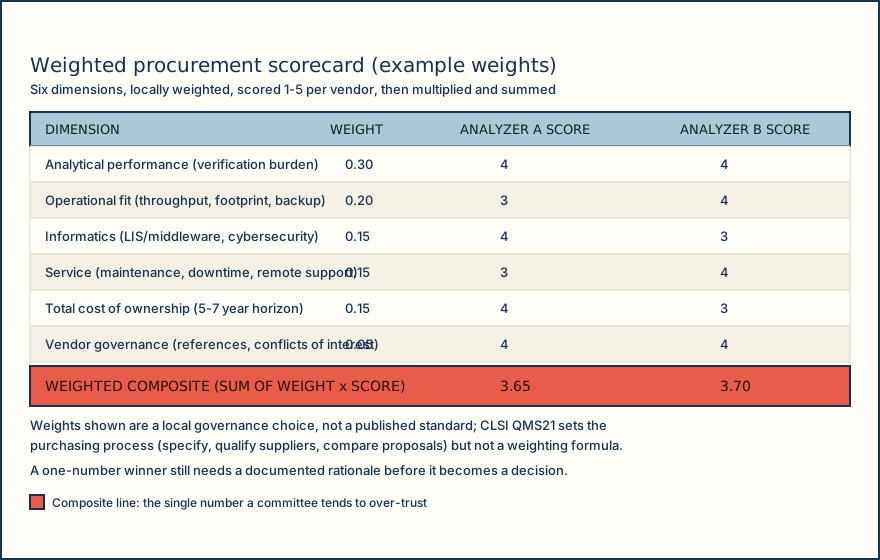
| Dimension | Weight | Analyzer A score | Analyzer B score |
|---|---|---|---|
| Analytical performance (verification burden) | 0.30 | 4 | 4 |
| Operational fit (throughput, footprint, backup) | 0.20 | 3 | 4 |
| Informatics (LIS/middleware, cybersecurity) | 0.15 | 4 | 3 |
| Service (maintenance, downtime, remote support) | 0.15 | 3 | 4 |
| Total cost of ownership (5-7 year horizon) | 0.15 | 4 | 3 |
| Vendor governance (references, conflicts of interest) | 0.05 | 4 | 4 |
Ordering exercise
Put these steps in the order you would actually follow to design and launch a utilization intervention, such as a reflex rule or a duplicate-order alert.
1. Design the intervention with an exception path
Draft the rule (reflex criteria, minimum interval, or alert threshold) and a documented override route for a clinician with a legitimate reason.
2. Monitor volume and the balancing measure
Track the intended volume reduction alongside a balancing measure such as length of stay, override rate, or a clinical outcome, and adjust the rule if either signal moves the wrong way.
3. Measure current baseline utilization
Pull order volume, repeat-order frequency, and turnaround for the target test before changing anything.
4. Implement the rule or alert
Turn on the reflex algorithm, order-set change, or duplicate-order alert in the LIS or EMR.
5. Review the design with ordering clinicians and get sign-off
Bring the medical staff and laboratory utilization committee into the design before it goes live, so the override path is understood, not improvised.
Knowledge checks
Reading and checks are open. Sign in only to save.
Knowledge check 1
Knowledge check 2
Section status
Finish this section
Reading and checks are open. Sign in only to save.
The module finishes after every required section is marked done and every check in those sections is correct.