Required section · Section 4 of 6
Working the cost-per-reportable-result calculation
Return to the BMP case. Analyzer A (purchase) costs $185,000 to acquire, has a 7-year expected service life, an annual preventive maintenance contract of $14,000, a reagent cost of $1.35 per reportable result, and average QC and calibration consumption that adds 6% to reagent volume. Installation carries two one-time costs: $9,000 for validation and training, and a $6,500 electrical circuit upgrade.
Analyzer B (reagent rental) has no acquisition cost, a 5-year minimum-purchase commitment, a bundled reagent cost of $1.95 per reportable result that already includes instrument use, most consumables, and standard service, a 3% annual escalator on that reagent price starting in year 2, and an early-termination fee if the laboratory does not meet its volume commitment. At 240 reportable results a day across a 7-day operation, annual volume for either analyzer is about 87,600 results.
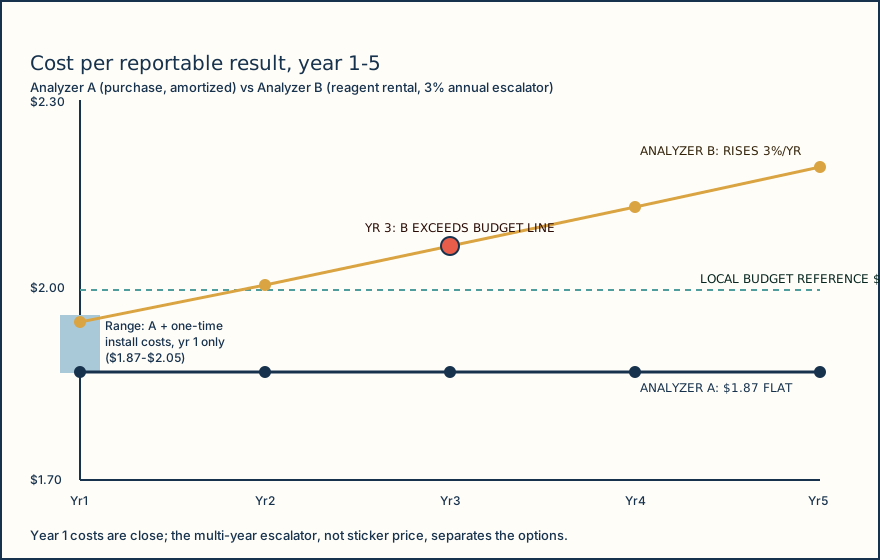
Following the cost-per-reportable-test structure described in a 2024 clinical chemistry procurement study, Analyzer A's year-1 cost per result comes out to about $1.87: reagent cost of $1.35 multiplied by the 6% QC/calibration load adds roughly $1.43, maintenance of $14,000 divided by 87,600 annual results adds about $0.16, and the $185,000 acquisition amortized over 7 years and 87,600 results a year adds about $0.30. That $1.87 does not yet include the one-time validation, training, and electrical costs; spread only over year 1's volume, those $15,500 in one-time costs add roughly another $0.18 per result in year 1 alone, then disappear from the calculation in later years.
Analyzer B's year-1 cost per result is $1.95, already inclusive of rental and service, with no separate acquisition or maintenance line to add. The number that changes the comparison is not the close year-1 gap but what happens afterward: Analyzer B's price compounds at 3% a year, reaching roughly $2.01 in year 2 and $2.07 in year 3, while Analyzer A's amortized capital cost stays flat once the one-time installation cost falls out after year 1.
A vendor’s service terms can affect total cost, but this case does not establish that they usually decide it. Compare documented acquisition, implementation, verification or validation, competency, service, and utilization costs for the proposed local configuration.
This calculation does not resolve which analyzer is "better" in the abstract. It demonstrates the structure a total-cost worksheet has to capture: the verification burden each option creates under 42 CFR 493.1253, whether the complexity classification is stable across the option, the multi-year cost trajectory, and the contract exposure (minimum-purchase commitment, early-termination fee) that a reagent-rental agreement carries and a purchase does not. A year-1 price comparison alone would have called this case a near tie; the 5-to-7-year trajectory is what actually separates the two options.
Illustrative drawing — this picture was drawn rather than captured.
| Cost component | Analyzer A (purchase) | Analyzer B (reagent rental) |
|---|---|---|
| Reagent, with 6% QC/calibration load | $1.43 | included in bundled rate |
| Maintenance, amortized per result | $0.16 | included in bundled rate |
| Acquisition, amortized over 7 years per result | $0.30 | $0 (no acquisition cost) |
| Bundled rental rate | not applicable | $1.95 |
| Year-1 subtotal per result | $1.87 | $1.95 |
| One-time validation, training, electrical (year 1 only) | +$0.18 | $0 |
Knowledge checks
Reading and checks are open. Sign in only to save.
Knowledge check 1
Knowledge check 2
Section status
Finish this section
Reading and checks are open. Sign in only to save.
The module finishes after every required section is marked done and every check in those sections is correct.