Required section · Section 3 of 6
Analytical, regulatory, informatics, and cost variables that decide the case
Start with complexity. Under the Clinical Laboratory Improvement Amendments (CLIA), 42 CFR 493.17 scores every test system across seven criteria, each rated 1 to 3; a total score of 12 or less is moderate complexity, and anything above 12 is high complexity. The category attaches to the exact test system as configured, not to the analyte in the abstract, so the same BMP analyte can sit at a different complexity level on a different instrument or with a modified protocol.
Any test system that is not yet categorized, or that a laboratory modifies from the manufacturer's cleared instructions, defaults to high-complexity requirements until CMS or FDA categorization says otherwise. That default matters at the procurement stage: choosing an instrument that requires an off-label modification quietly raises the personnel, QC, and proficiency-testing burden.
Next, performance verification versus establishment. Under 42 CFR 493.1253, an unmodified, FDA-cleared or approved test system only needs to be verified before it reports patient results: the laboratory confirms accuracy, precision, reportable range, and that the manufacturer's reference intervals fit its own patient population. A modified system, a laboratory-developed test, or a non-FDA-cleared system carries a heavier obligation: the laboratory must establish, not just verify, accuracy, precision, analytical sensitivity, analytical specificity, reportable range, and reference intervals before the first patient result goes out. The performance specifications you land on from this step are not a one-time checkbox; they set the calibration and QC frequency the laboratory commits to running for as long as the instrument stays in service.
Personnel competency travels with the specific instrument, not with the person's general experience. For high-complexity testing, 42 CFR 493.1451(b)(8) requires competency to be reassessed on the specific new test, methodology, or instrument before that person reports patient results on it; a competency record from a different analyzer, even one from the same manufacturer, does not transfer. CLIA's minimum competency assessment covers six elements: direct observation of testing, review of result reporting, review of quality-control (QC) and proficiency-testing (PT) and maintenance records, direct observation of maintenance and function checks, performance testing with blind or PT-type samples, and problem-solving assessment. A procurement decision that changes the instrument fleet is also a training-and-competency project, and that labor cost belongs in the total-cost worksheet.
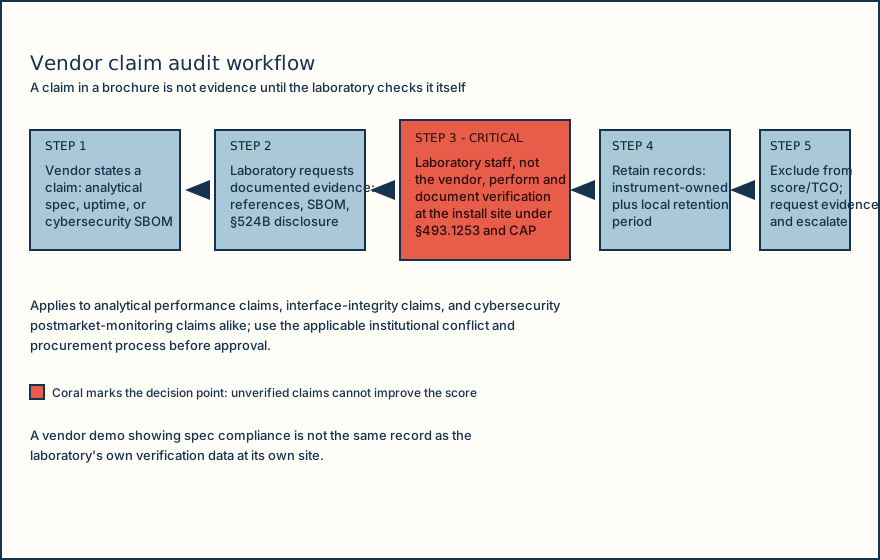
Ownership of the verification work matters as much as the work itself. CAP requires that if a method is verified by someone other than the laboratory's own personnel, such as a manufacturer's representative, the laboratory must have records showing that verification correlates with its in-house test performance by having laboratory personnel confirm the specifications on known specimens.
The same checklist section requires method performance specifications to be validated or verified in the location where patient testing will occur, so relocating an instrument to a different site requires re-confirming that the specifications still hold there. Records of that verification and validation work need to be retained for as long as the method is in use, and for at least two years after discontinuation.
Informatics and cybersecurity now belong in the same conversation as analytical performance. CAP requires laboratories to verify that results move accurately from data entry through to patient reports before an interface goes live, and again whenever a change could affect transmission accuracy. If autoverification is in use, CAP requires validation before initial use and whenever a system change could affect the logic, exercised with challenge cases such as out-of-range, critical, and interference results; neither requirement sets a fixed recurring re-testing interval independent of a change.
On the device side, current FDA premarket cybersecurity guidance expects manufacturers to address risk management, security architecture, verification and validation testing, a software bill of materials (SBOM), and postmarket vulnerability monitoring for any device with software, firmware, or programmable logic. Section 524B of the FD&C Act requires cyber device submissions to include a postmarket vulnerability-monitoring and disclosure plan alongside that SBOM, and a buying laboratory can ask a vendor to show how it meets that requirement. A scorecard that scores analytical performance but skips interface validation and cybersecurity documentation is scoring half the risk.
Illustrative drawing — this picture was drawn rather than captured.
| System type | Minimum requirement | Example trigger |
|---|---|---|
| Unmodified, FDA-cleared/approved system | Verify accuracy, precision, reportable range, and reference-interval fit to the local population | Buying a cleared chemistry analyzer and running it exactly per the manufacturer's instructions |
| Modified, laboratory-developed, or non-FDA-cleared system | Establish accuracy, precision, analytical sensitivity, analytical specificity, reportable range, and reference intervals | Changing a cleared assay's specimen type, dilution protocol, or reagent source |
| Uncategorized or modified from cleared instructions | Defaults to high-complexity requirements until CMS/FDA categorization says otherwise | A newly released assay with no complexity category yet assigned |
Knowledge checks
Reading and checks are open. Sign in only to save.
Knowledge check 1
Knowledge check 2
Section status
Finish this section
Reading and checks are open. Sign in only to save.
The module finishes after every required section is marked done and every check in those sections is correct.